Heading south-east from Vienna, each city costs a little less than the last and tells a different slice of the European twentieth century: the empire, Yugoslavia, Romanian communism, Albanian isolation. Seven destinations covered by verified dossiers, with budgets running from €140 a day down to €45.
Vienna: the dearest of the group, and the cheapest in western Europe
Vienna costs €90-140 a day in mid-season: less than Paris, less than Amsterdam, less than almost any capital to the west. In low season it drops to €55-90.
The verified gems are outside the imperial palaces: the Hundertwasserhaus, a residential building with organic façades designed without a single straight line; the Heeresgeschichtliches Museum, a military history museum the tourist flows skip; and the terrace of the Wien Museum on Karlsplatz, a little-known viewpoint framing the Karlskirche reflected in the pond below.
The best period is April-May or September-October; in November and December the Christmas markets transform the squares, with crowds and prices to match.
Zagreb: the capital everyone skips for the coast
Zagreb is systematically bypassed by people heading to Croatia for the sea, and costs €95-140 a day in mid-season. Its peculiarity is that the upper and lower towns are two worlds joined by the shortest public-transport funicular in the world: 66 metres of track, a 64-second ride, €0.66 a trip.
One clarification that saves a disappointment: the cathedral has been under reconstruction since the earthquake of 22 April 2020, with the top of the north spire removed and the towers in scaffolding. And St Mark's church, the one with the coloured roof, cannot be entered as a visitor: only during mass.
To do, and free: the Mirogoj cemetery, with five hundred metres of covered arcades, twenty minutes away on bus 106; and the Grič tunnel, an air-raid shelter beneath the upper town reopened as a public passage, ten degrees cooler in summer.
Belgrade: fortress, brutalism and free transport
Belgrade costs €55-90 a day in mid-season and is the only city on this blog where public transport is free for everyone.
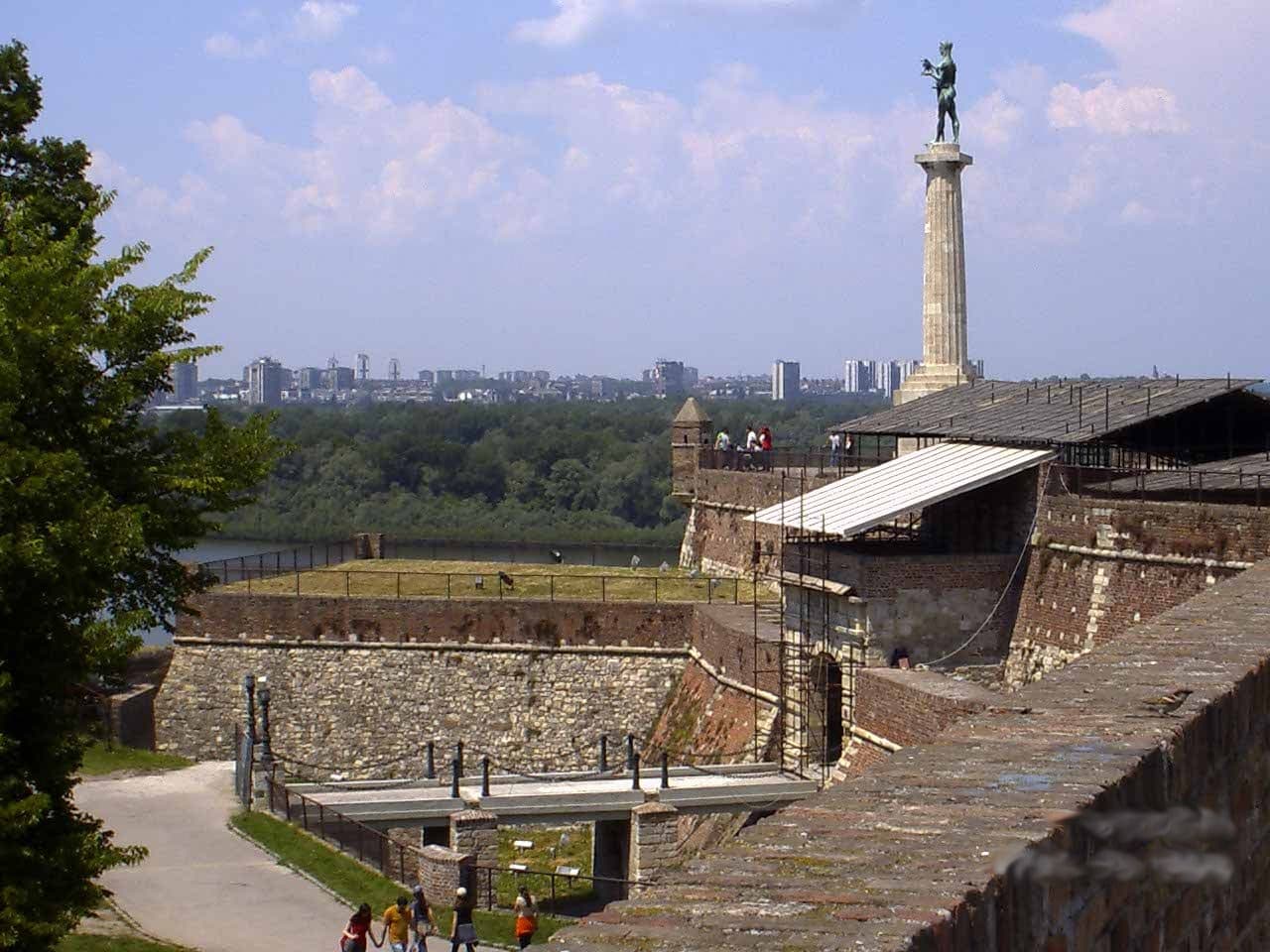
It stands on a spur where the Sava meets the Danube, and the two banks tell two eras: on one side the fortress and the old town, on the other Novi Beograd, the socialist city built from nothing from the 1950s, with blocks 21, 22 and 23 and the Genex tower, one of the icons of European brutalism.
Zemun, until 1918, was an Austro-Hungarian town facing the Ottoman Empire across the water: low houses, the fishermen's quarter on the Danube and the Gardoš tower. The Museum of Contemporary Art, reopened in 2017 after fifteen years closed, holds an extraordinary collection of 20th-century Yugoslav work.
Bucharest: Little Paris and the heaviest building in the world
Bucharest costs €60-95 a day in mid-season. The contrast that defines it: the Belle Époque buildings that earned it the nickname 'Little Paris', and the heaviest administrative building in the world, built by Ceaușescu by levelling a fifth of the old city.
The gems are three and all central: the Pasajul Macca-Villacrosse, a horseshoe arcade from 1891 roofed in yellow glass; the Biserica Stavropoleos, a small church of 1724 in Brâncovenesc style with stone carved like lace and a silent cloister; and the Cărturești Carusel bookshop, six white floors inside a 19th-century mansion confiscated by the regime and later restored.
The best moment is May-June, when the city moves outdoors, or September-October.
Brașov: Transylvania without the cliché
Brașov is a Saxon town of red roofs pressed between its walls and Mount Tâmpa, with the largest Gothic church in Eastern Europe and the Carpathian castles half an hour away by car. It costs €65-105 a day in mid-season, and twenty minutes from the old town is Poiana Brașov, which works as a ski resort in winter.
The district that explains the town is Șchei: where Romanians were confined outside the walls of the Saxon town, with St Nicholas's church, the hillside cemetery and the museum of the First Romanian School. The Bastionul Țesătorilor, the weavers' bastion with its wooden galleries on four levels, is the best-preserved piece of the fortifications.
Sofia: the cheapest capital in the Union
Sofia costs €55-95 a day in mid-season and €40-70 in low, and it is the cheapest capital in the European Union. Since 1 January 2026 it pays in euros, at a fixed rate of 1.95583 lev, and since the obligation to display prices in both currencies ended on 8 August of the same year, the price lists in lev still circulating online make everything look twice what it is: if a figure seems to have doubled, it is almost always the same figure read in the wrong currency.
The centre is crossed on foot in an hour and lines up, within three hundred metres around Sveta Nedelya square, the Orthodox cathedral, the sixteenth-century Banya Bashi mosque still in use, the Sephardic synagogue of 1909 and the Catholic cathedral of St Joseph: all four in ninety minutes, free or by donation. And the mountain sits inside the city timetable, because Vitosha's Cherni Vrah reaches 2,290 metres and you get there on a service bus, €0.80 a ride. To know before setting off: the Simeonovo and Dragalevtsi lifts are not running, so anyone counting on the cable car to reach the top will be walking.
The two gems are hidden in the literal sense. The Rotunda of St George, the oldest building in the city, is a fourth-century brick rotunda invisible from the street: it stands in a courtyard ringed by the Presidency buildings, five minutes from Sveta Nedelya square, and costs nothing. The Serdica archaeological complex, the paved Roman streets and baths that surfaced during the metro works, was left below street level and roofed with a glass structure: it is not a ticketed museum but a pedestrian passage, crossed free at any hour, and in winter it is also the warmest way to cut through the centre.
Tirana: the cheapest in Europe
Tirana costs €45-75 a day in mid-season and €35-60 in low: it is the best-value destination on this blog. The grey blocks were repainted in colour by a mayor who was a painter, and the nuclear bunkers have become museums.
The two places worth the trip tell the story of Hoxha's Albania: the Shtëpia me Gjethe, the villa where the Sigurimi bugged and filed Albanians, now the national museum of secret surveillance with the hidden microphones still in place; and the Postbllok memorial at the entrance to the Blloku, the district once forbidden to ordinary citizens, where an original bunker, pillars from the Spaç prison mine and a piece of the Berlin Wall stand together.
An hour to the north is Kruja, Skanderbeg's citadel perched on the mountain with its old bazaar.
How to line them up
Vienna, Zagreb and Belgrade sit on a continuous railway line and can be done in sequence; Bucharest and Brașov are two and a half hours apart by train and form a natural pair; Sofia reaches on towards Plovdiv or towards the Rila monastery, two and a half hours away by road and worth a full day; Tirana stands alone and is reached by air. In all of them the best months are April-June and September-October. And the price gap with western Europe is not marginal: what one day costs in Reykjavík buys four in Tirana.