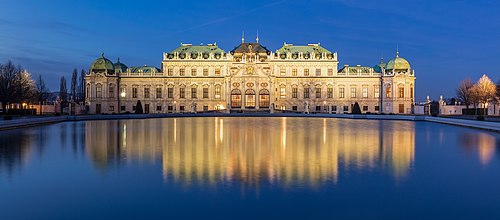
Vienna, Austria
Photo: Gerda Arendt, Wikimedia Commons (CC0)
← All destinations

Vienna, Austria

Vienna gives itself with measured elegance: historic cafés where time stands still, imperial palaces that have never stopped playing their part, and a musical life still beating in the same halls where Mozart and Strauss played, between real waltzes and fake costumed Mozarts to avoid.

✓ Sources verified by hand on 2026-06-297 sources cited

What to see

Schloss Schönbrunn

The Habsburgs' baroque palace with 1,441 rooms and monumental gardens, one of Austria's most visited attractions

Stephansdom (St. Stephen's Cathedral)

A Gothic symbol in the heart of the city, with the famous multicoloured tiled roof visible from every point of the centre

Hofburg and Imperial Treasury

The Habsburgs' former winter residence, today home to museums, the national library and the imperial crown jewels

✦ Hidden gems — off the standard guides

Hundertwasserhaus

A residential building with organic, colourful facades, designed by the artist Friedensreich Hundertwasser with no straight lines

Heeresgeschichtliches Museum

A military history museum off the mass-tourism flows, with collections spanning the Napoleonic Wars to World War I

Wien Museum terrace on Karlsplatz

A little-known viewpoint that frames the Karlskirche reflected in the pond below

Want an itinerary tailored to your dates in Vienna?

Travel dates, where you stay and the kind of trip — we tailor this same verified dossier to your exact needs.

Coming soon
A detail of the wrought-iron lamps of the Hundertwasserhaus: even the smallest elements follow the building's same anti-straight-line philosophy.
A detail of the wrought-iron lamps of the Hundertwasserhaus: even the smallest elements follow the building's same anti-straight-line philosophy.Photo: Dietmar Rabich, Wikimedia Commons (CC BY-SA 4.0)

Before you go

Recurring scams and local rules worth knowing before you arrive.

⚠ Scams to know

Costumed 'Mozart' vendors selling concert tickets

low confidence

They're licensed by the city (about 18 vendors per zone), but the concerts on offer are often student ensembles in rented halls, not the prestigious shows the costume and price (€55-85) suggest

How to avoid it: Buy classical-concert tickets only from the official sites of the Wiener Staatsoper, Musikverein or Konzerthaus, ignoring the costumed vendors outside the Opera

Source

Unbooked taxis queuing at Vienna airport

low confidence

They charge fixed fares of €50-70 to the centre, against €33-39 for a ride booked in advance or €4.40 for the S7 train

How to avoid it: Book a fixed-fare taxi in advance via an app or request a transfer from your hotel, or use the S7 train or the City Airport Train (CAT)

Source

Restaurants on Kärntner Strasse with hidden surcharges

low confidence

Some tourist venues charge a 'Besteckgebühr' (cutlery fee) or a €3-8 per-person cover, often shown only in small print on the menu

How to avoid it: Check the whole menu before ordering and prefer venues off the most touristy central streets, frequented by Viennese too

Source

Pickpocketing in crowded areas and on public transport

low confidence

Although Vienna is a very safe city, the risk of petty theft rises in crowded stations and on tourist routes, especially around Schwedenplatz and Karlsplatz at night

How to avoid it: Use shoulder bags in front of you, avoid flashing your phone and wallet in crowded areas

Source

⚖ Laws & penalties

Ban on drinking/openly carrying alcohol in some zones (Alkoholverbotszonen), e.g. around Westbahnhof station

medium riskverified

Confirmed by the source: in the area around Westbahnhof the ban covers both drinking and visibly carrying alcohol when it's clear you're about to drink; fines start at €50. Higher amounts cited elsewhere (up to €4,600) refer to another specific zone (Fritz-Imhoff-Park) and shouldn't be applied generally to all of Vienna.

Source

Ban on riding e-scooters and bicycles on pavements

medium riskmedium confidence

A rule confirmed by the City of Vienna (wien.gv.at): riding e-scooters and similar vehicles on pavements and pedestrian crossings is banned — they must use cycle lanes or the road; allowed instead in 'Wohnstraße' and shared zones at pedestrian speed. The same blood-alcohol limit as for drivers (0.8 g/l) also applies.

Source

Environmental zone (Umweltzone) with a sticker requirement for heavy vehicles

low risklow confidence

Vienna's environmental zone mainly concerns commercial vehicles and trucks (categories N1, N2, N3): since 2016 at least the Euro 3 standard is required. The fine for a missing sticker can reach €2,180. It doesn't apply to tourists' ordinary private cars. The official source (umwelt-pickerl.at) was not directly reachable for verification of the exact wording, so the figure should be treated as indicative.

Source

Austro Control permit required to fly drones over most of the urban area

high risklow confidence

Vienna lies within the airport's air-control zone, so almost any drone flight in the city requires a special Austro Control permit; since 2022 drones under 250 grams and below 30 metres are exempt from the permit for regulated zones, but flying over historic monuments and sensitive sites remains banned. It was not possible to verify a specific official regulatory text via WebFetch.

Source

Valid ticket required on public transport despite the absence of gates

high riskverified

The Wiener Linien system runs on 'honour' with no physical barriers, but around 100 inspectors operate daily and anyone travelling without a valid ticket pays an immediate penalty. From 1 January 2026 the amount is €135 (immediate payment), rising to €145 if paid by invoice.

Source
Stalls of mushrooms, fruit and hand-written labels at the Naschmarkt, the historic market where Viennese still do their everyday shopping.
Stalls of mushrooms, fruit and hand-written labels at the Naschmarkt, the historic market where Viennese still do their everyday shopping.Photo: Dietmar Rabich, Wikimedia Commons (CC BY-SA 4.0)

Recurring events

Hover over a month on the timeline for details.

Budget & timing

Average daily cost

Season low (January-February (excluding the Opernball period), July-August)55-90€
Season mid (March-May, September-October)90-140€
Season high (June, November-December (Christmas markets))140-200€

Rough estimate (lodging + meals + local transport), not a precise verified source.

Best time by type of trip

Culture and monuments April-May, September-October

Mild weather and more manageable queues at the imperial museums than at the height of summer.

Christmas atmosphere November-December

The Christmas markets transform squares and historic palaces, though crowds and accommodation prices rise sharply.

Budget January-February (outside the Opernball period), July-August

Lower hotel rates and fewer tourists, though the Viennese summer can be muggy and locals are often on holiday.

Did you know... On and around Stephansplatz, costumed 'Mozart' vendors have been selling concert tickets for decades: they're licensed by the city, but the concerts they offer rarely match the prestige of the costume.

Getting around

Car recommended: No — The old town is compact and well served by metro, tram and bus; parking is scarce and expensive, and most central streets restrict private traffic.

The Wiener Linien network with 5 U-Bahn lines, trams and buses, running on an 'honour' system with no gates but with random checks and steep fines for travelling without a valid ticket. The Vienna City Card is available for 24h (€8.20), 48h (€14.10) or 72h (€17.10) with unlimited transport.

  • Always validate your ticket before boarding: surprise checks mean immediate fines even for distracted tourists
  • Avoid the taxi queues outside the airport: the S7 train costs just €4.40 against the €50-70 often charged by unbooked taxis
  • The U-Bahn network is dense and frequent: for the old town, walking is often quicker than changing lines
  • Buy single tickets or multi-day passes via the Wiener Linien app or at station machines, avoiding improvised street sellers

Safety

  • Vienna is considered one of the safest cities in the world, with a very high safety index according to the main industry sources
  • The main risk for tourists remains pickpocketing in crowded places and on transport, not violent crime
  • Use only licensed taxis with a regular meter or official apps, avoiding anyone offering unsolicited fixed fares at the airport

Sources

Every source below was opened and checked by hand — not just cited. Entries that didn't hold up were downgraded to "low confidence" or dropped, not presented as certain.