Sicily and Sardinia are often put in the same sentence and are barely alike: the first is stratification (Arabs, Normans, Spaniards one on top of another), the second is isolation, with a language of its own and five thousand years of prehistory still standing in the fields. Six destinations covered by verified dossiers.
Palermo: the most intense, and the cheapest
Palermo is not visited, it is entered: a thousand years of foreign rule compressed into a city you eat your way through and cross like a market. It is also the best value of the group: €65-100 a day in mid-season, €45-70 in low.
The verified gems are strong ones. The Capuchin Catacombs hold about 8,000 mummies in period clothing hanging along the corridors, sorted by class and trade: not for everyone. Palazzo Abatellis keeps the Triumph of Death and Antonello da Messina's Annunciate. And the Vucciria, which by day now dozes, becomes the city's rough drawing room after dark.
The week to know about: 10-15 July, when the Festino di Santa Rosalia turns Palermo up to full volume. A unique experience, but fierce heat and accommodation to book ahead.
Syracuse: Greece in Italy
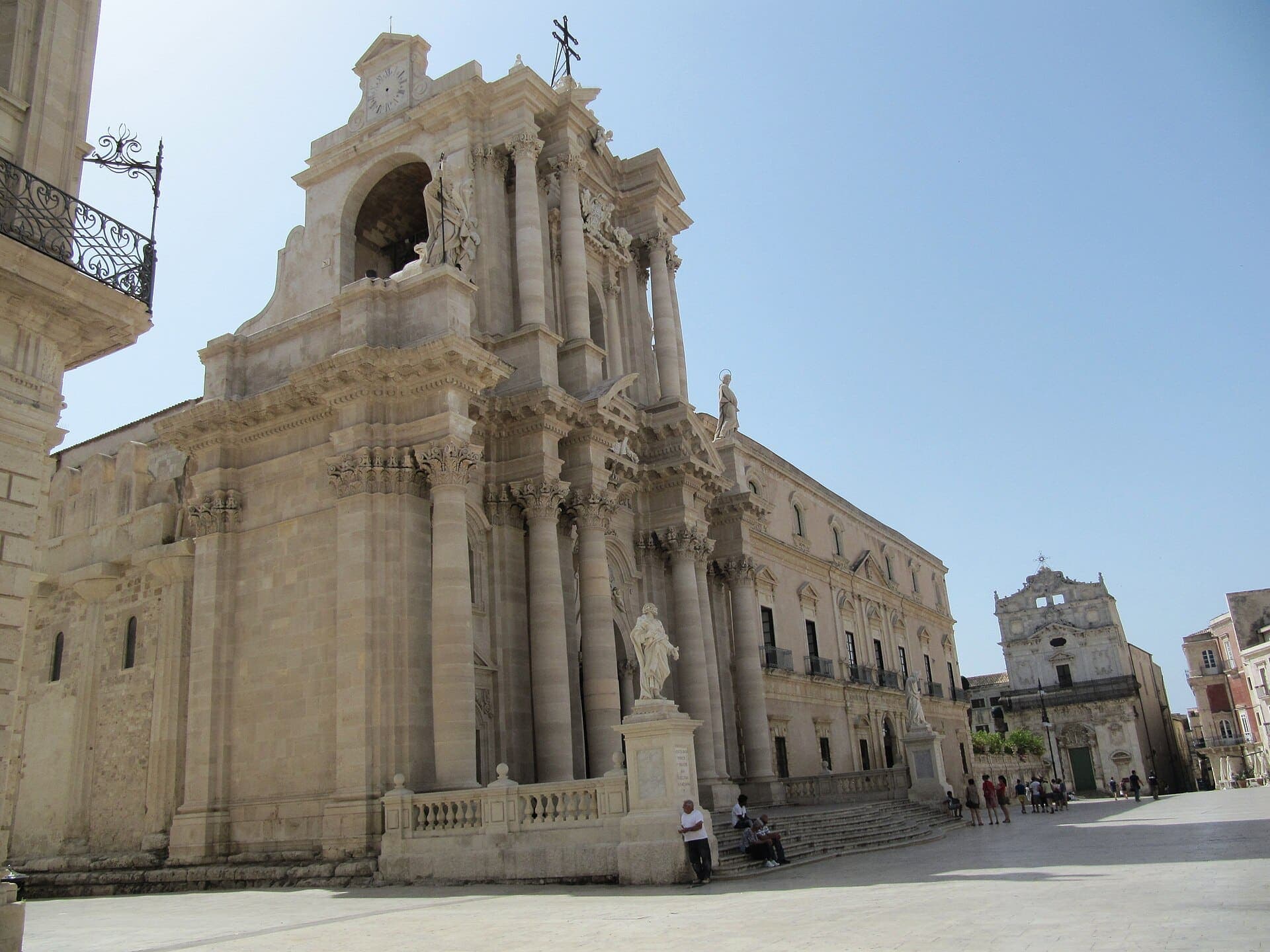
In Syracuse a baroque cathedral was built inside a Greek temple, and the Doric columns are still visible in the wall. Ortigia, the old town on an island, has the sea a few steps from every lane.
The right moment is May and June: classical tragedies are performed in the Greek Theatre at sunset, as they have been for 2,500 years. Tickets and accommodation need booking months ahead.
Off the routes: the Giudecca with its miqwe, the Jewish ritual bath cut into the rock beneath a hotel; and the Burial of St Lucy, painted by Caravaggio in flight from Malta in 1608 and back since 2020 on the altar it was made for.
Taormina: beautiful and expensive
Taormina is Sicily as a stage set: a Greek theatre suspended between Etna and the Ionian, a baroque high street polished by two centuries of travellers. It is by far the dearest of the six: €130-220 a day in high season, against Palermo's €85-140.
The corrective is to climb or to leave. The Villa Comunale, the gardens created by the same Englishwoman who made Isola Bella, is free and has an unbroken balcony over the sea. Castelmola, the acropolis-village at 550 metres, is ten minutes by bus. And the Alcantara gorges, twenty kilometres away, have black basalt walls up to twenty-five metres high.
Catania: lava baroque, with Etna at the end of the street
Catania is the only one of the six built out of what the volcano threw at it: the baroque of the centre is black lava stone, and Via Etnea, three kilometres running dead straight from Piazza del Duomo, has Etna closing the perspective at the end of the street. It costs €70-110 a day in mid-season and €50-80 in low, and keeping the food bill down takes no effort: granita and a brioche col tuppo, which here are breakfast and not dessert, stay under €5 almost everywhere.
Two things to know before leaving the house. La Pescheria, the fish market behind Piazza del Duomo, opens at dawn from Monday to Saturday and starts packing up around lunchtime: turning up at 11 means seeing the tail end of the day, the live part is before 9, and on Sunday there is none. And the Castello Ursino has been closed since 7 February 2025 for building work estimated at two years: the civic collections have moved a hundred metres away, to the Pinacoteca Santa Chiara, and it is the commonest mistake made by anyone arriving with an old guidebook.
The counter-intuitive season is winter: between December and March, snow-covered Etna seen from Via Etnea is the image that makes the city, and you can ski on the volcano in the morning and be in shirtsleeves in the centre by the afternoon. Anyone without a car should reckon with there being a single public service a day to Etna: the AST bus leaves at 8.15am from Piazza Papa Giovanni XXIII, in front of the central station, and heads back down from the Rifugio Sapienza at 4.30pm. Miss it and there is no evening alternative.
Cagliari: the capital nobody considers
Cagliari has eight kilometres of urban beach, pink flamingos nesting inside the city at Molentargius, and a fortress quarter from which, on clear days, you can see Africa. It costs what Palermo costs: €65-100 a day in mid-season.
Beneath the Stampace district lies an underground Cagliari: the rock-cut crypt of Santa Restituta, used as an air-raid shelter in 1943. The Bonaria sanctuary on the hill is the one that gave Buenos Aires its name.
The secret is September: warm water, half the crowds, and the beaches of Villasimius and Chia still at their best.
Alghero: a Catalan town in Sardinia
In Alghero people still speak Algherese, a variety of Catalan, and you walk on Spanish ramparts above the sea. Around it is the Coral Riviera, with white cliffs and caves.
The two things almost nobody plans for are prehistoric: the Palmavera nuraghe, a three-thousand-year-old village on the road to Porto Conte, with its meeting hut and carved model nuraghe; and the necropolis of Anghelu Ruju, 38 domus de janas cut into the rock five thousand years ago, ten minutes from town.
The Porto Conte park and the Le Prigionette reserve, home to Giara ponies, fallow deer and the white donkeys of Asinara, are the green part that beach tourism skips.
In short
For a first trip to Sicily: Palermo and Syracuse, which are each other's opposite and together tell the island. Catania if you want the volcano inside the itinerary and a city that is cheap at the table too. Taormina is worth a night, not a week, and in June or September rather than August. In Sardinia, Cagliari for a real city with the sea inside it, Alghero for the north-west coast and the prehistory. In all six, the right months are April-June and September-October: the price difference against July and August is thirty or forty euros a day, and the heat is another matter entirely.