Ostuni, Puglia, Italy
Photo: Benjamin Smith, Wikimedia Commons (CC BY-SA 4.0)
← All destinations

Ostuni, Puglia, Italy

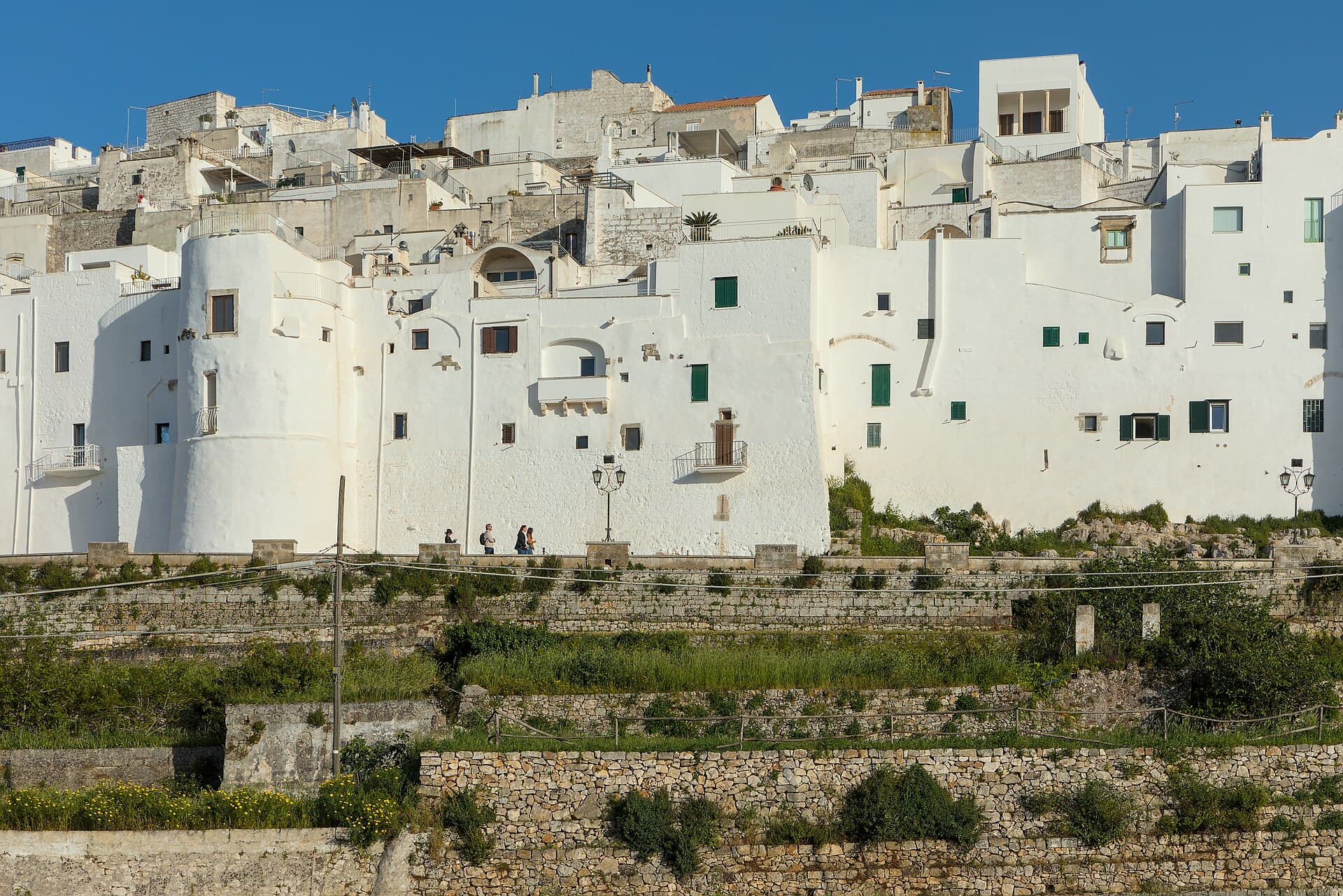
A lime-white maze on three hills, eight kilometres above the sea, with a countryside of thousand-year-old olive trees worth as much as the old town. Ostuni is walked, and walked uphill, and the practical part is all in working out how to move between the town and its beaches.

✓ Sources verified by hand on 8 September 20268 sources cited

What to see

Monuments3

The white old town

The walled core locals call la Terra is a ring of lanes, arches and stairways around the cathedral: there are no ticketed monuments, the visit is the walk itself and it takes 90 minutes at a slow pace. It is all up and down on polished stone, so the time doubles in the wrong shoes. The best light for photographs is the first hour after sunrise, before the white turns blinding.

Co-cathedral of Santa Maria Assunta

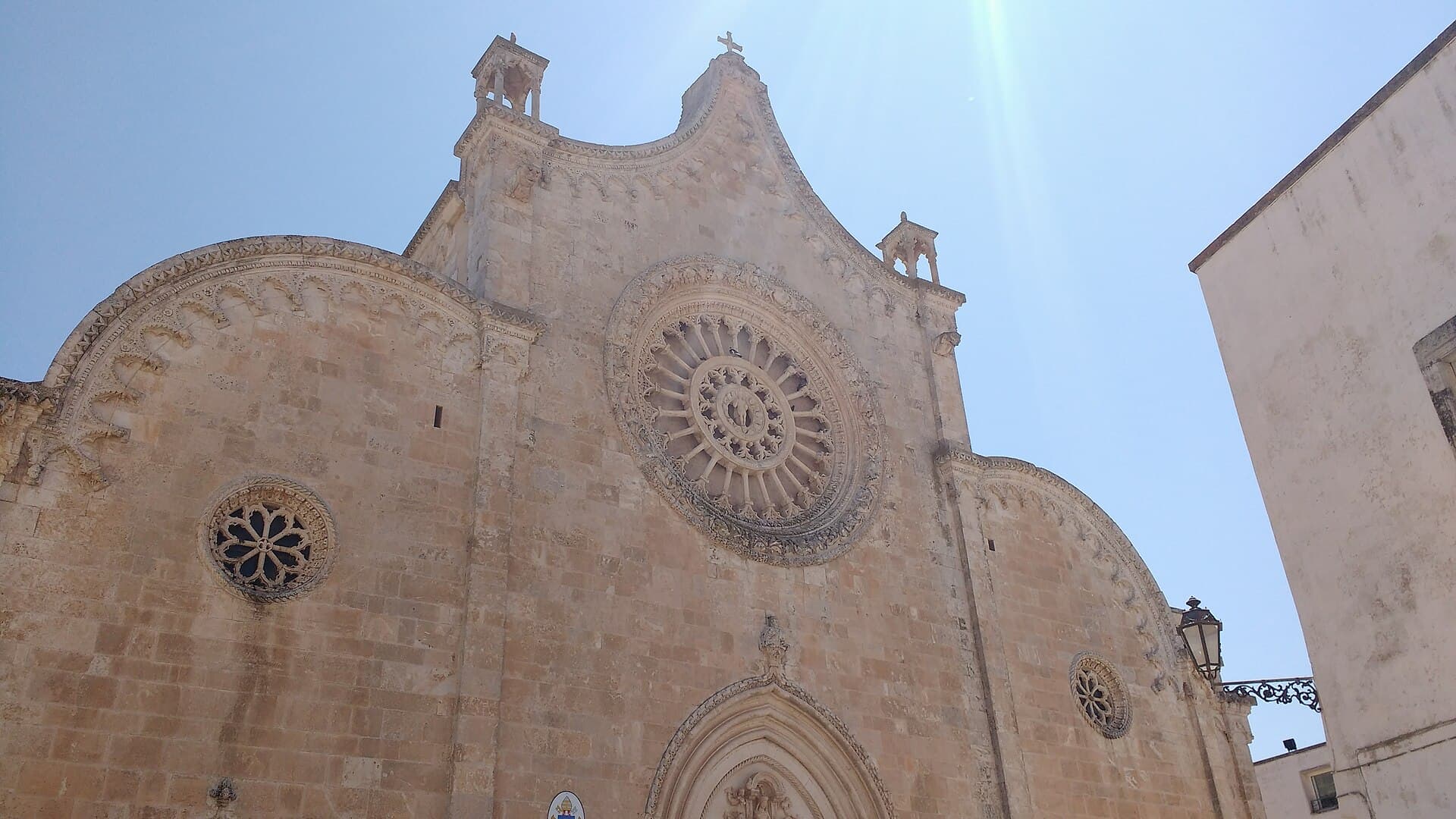
At the top of the hill, a 10-minute climb from the nearest car park, with a late Gothic facade closing a space too narrow to photograph whole and a twenty-four-spoke rose window, the largest in Puglia. Entry is free. The detail to look at is the three-curved-gable front, which resembles no other Apulian church: a Venetian graft onto a local structure.

Piazza della Liberta and the column of Sant'Oronzo

The square where the town gathers, outside the walls but 5 minutes on foot from the cathedral, with the baroque column of 1771 rising about twenty metres and the patron saint's statue on top. It is the starting point of the August procession and the terminus of the buses for the coast, so you pass through anyway. The bars on the square cost more than those in the lanes fifty metres away.

Nature1

Torre Guaceto reserve

20 km south, a marine protected area established in 1991 with dunes, scrub and an Aragonese tower: the least built-up stretch of Adriatic coast around here, with summer access regulated by car park and shuttle. The fully protected zones are closed to swimming and fishing, while the open sectors have clear water precisely because the fishing ban has held for thirty years.
Beaches1

The marine: Rosa Marina, Costa Merlata, Torre Pozzelle, Pilone

Ostuni's coast lies eight kilometres from the centre and alternates rocky coves (Costa Merlata, Torre Pozzelle) with sandy beaches (Lido Morelli, Pilone), some run as beach clubs and some free. There are around fifteen hundred free parking spaces along the shore, and in July and August the town opens temporary areas at 5 euros a day with a free shuttle. The town bus costs 90 cents, the intercity one 1.10 euros, and on board that rises to 1.50.

Museums1

Museum of Pre-Classical Civilisations and the woman of Ostuni

At Via Cattedrale 15, inside the former Carmelite convent: ticket 5 euros, reduced 3 for over 65s and groups above twelve, free under 6. Open daily 10am-6pm, so it works at lunchtime when everything else shuts. The piece that justifies the visit is the reconstruction of Delia's burial. Photography inside is banned, and the ban is enforced.

Food3

Extra virgin olive oil and underground mills

The countryside around Ostuni is covered in olive trees, and under the farmhouses lie the frantoi ipogei, mills carved into the rock to keep the temperature steady during winter pressing. The working mills nearly all sit within 10 km of the centre: there you taste the oil before buying and it costs less than in the old town shops. The local protected designation is Collina di Brindisi, and you can see the pressing running between October and December.

Orecchiette, broad beans with chicory, bombette

The local peasant dish is dried broad bean puree with wild chicory, served with a thread of new oil: it costs little and it is what you eat in the trattorias off the circuit. Then orecchiette with turnip tops, and bombette, cheese-stuffed pork rolls that come from the Valle d'Itria and are cooked over coals. In the old town prices climb with the view: the neighbourhood trattorias are 10 minutes' walk away and cost half.

Ostuni DOC and Ottavianello

The local appellation covers a light white and above all Ostuni Ottavianello, a red from a grape grown in Italy almost only here, giving pale, easy-drinking wines very unlike the muscular primitivos of the rest of Puglia. The wineries bottling it sit within 15 km of town, and it is the bottle to look for in the local wine shops: outside the province of Brindisi you will hardly ever find it.

Nightlife1

Evenings on the square and the bastions

In summer life moves to the bastions and the small squares facing the olive plain, where bars set their tables towards the sea and people drink late. It is a low-key scene, with no clubs in the centre, and it starts after 22.00. The view from the bastion on Corso Vittorio Emanuele at sunset is free and worth a drink from anywhere.

✦ Hidden gems · off the standard guides

Santa Maria di Agnano archaeological park

The site where Delia was found, 2 km from the centre on the SS16 towards Fasano: a sanctuary cave used from the Palaeolithic to the Messapian age. The catch is the opening: Sundays and public holidays only, 10.00 to 13.00, or by telephone booking. Anyone turning up on a Tuesday finds the gate shut, and it is the commonest mistake among people who have just visited the museum.

The free evening shuttle to the beaches

In the summer months the town and STP run a completely free coastal circular leaving the Viale Tenente Specchia car park at 8.15pm, 9.30pm, 10.45pm and midnight, with stops as far as Pilone and Rosa Marina. It exists for people staying in town who want to eat by the sea without driving, or the reverse: it is the least known service in Ostuni and appears in almost no guidebook.

Masseria Brancati and the ancient olive groves

A fortified farm of medieval origin in the middle of the olive plain, with around eight hundred trees registered as a national monument and an underground mill cut into the rock. The guided visit runs 70 minutes across the grove, the underground mill and a tasting of the estate's oils, is booked at least a day ahead and paid on the day, in cash or by card. Open Monday to Saturday 9am-7pm, closed Sundays and public holidays.

Dune Costiere nature park

Between Torre Canne and Torre San Leonardo, 8 km of dunes, wetlands, coastal towers and centuries-old olive groves crossed by a flat cycle path. It is the only way to see what this coast looked like before the resorts, and it can be ridden in half a day. In high season the seaward part is busy; the inland stretch among the olives stays practically deserted.

Diocesan museum and church of San Vito Martire

In the bishop's palace beside the cathedral, with vestments, silverware and paintings from the diocese. The thing to know is the opening, which is very tight: Saturdays and Sundays only, 10.00 to 13.00. Anyone who wants to see it has to build the weekend around it, which is why it is almost always empty even in August.

Sample itineraries

Three routes for different travel styles, built only from this dossier's verified places. Realistic pace: 2-3 stops a day.

First time

2 days

The landmark sights, at the right pace.

Day 1

  • The white old town

    The walled core locals call la Terra is a ring of lanes, arches and stairways around the cathedral: there are no ticketed monuments, the visit is the walk itself and it takes 90 minutes at a slow pace. It is all up and down on polished stone, so the time doubles in the wrong shoes. The best light for photographs is the first hour after sunrise, before the white turns blinding.

  • Co-cathedral of Santa Maria Assunta

    At the top of the hill, a 10-minute climb from the nearest car park, with a late Gothic facade closing a space too narrow to photograph whole and a twenty-four-spoke rose window, the largest in Puglia. Entry is free. The detail to look at is the three-curved-gable front, which resembles no other Apulian church: a Venetian graft onto a local structure.

  • Piazza della Liberta and the column of Sant'Oronzo

    The square where the town gathers, outside the walls but 5 minutes on foot from the cathedral, with the baroque column of 1771 rising about twenty metres and the patron saint's statue on top. It is the starting point of the August procession and the terminus of the buses for the coast, so you pass through anyway. The bars on the square cost more than those in the lanes fifty metres away.

Day 2

  • Museum of Pre-Classical Civilisations and the woman of Ostuni

    At Via Cattedrale 15, inside the former Carmelite convent: ticket 5 euros, reduced 3 for over 65s and groups above twelve, free under 6. Open daily 10am-6pm, so it works at lunchtime when everything else shuts. The piece that justifies the visit is the reconstruction of Delia's burial. Photography inside is banned, and the ban is enforced.

  • The marine: Rosa Marina, Costa Merlata, Torre Pozzelle, Pilone

    Ostuni's coast lies eight kilometres from the centre and alternates rocky coves (Costa Merlata, Torre Pozzelle) with sandy beaches (Lido Morelli, Pilone), some run as beach clubs and some free. There are around fifteen hundred free parking spaces along the shore, and in July and August the town opens temporary areas at 5 euros a day with a free shuttle. The town bus costs 90 cents, the intercity one 1.10 euros, and on board that rises to 1.50.

  • Torre Guaceto reserve

    20 km south, a marine protected area established in 1991 with dunes, scrub and an Aragonese tower: the least built-up stretch of Adriatic coast around here, with summer access regulated by car park and shuttle. The fully protected zones are closed to swimming and fishing, while the open sectors have clear water precisely because the fishing ban has held for thirty years.
Off the beaten path

2 days

Hidden gems away from the usual circuits.

Day 1

  • Santa Maria di Agnano archaeological parkhidden gem

    The site where Delia was found, 2 km from the centre on the SS16 towards Fasano: a sanctuary cave used from the Palaeolithic to the Messapian age. The catch is the opening: Sundays and public holidays only, 10.00 to 13.00, or by telephone booking. Anyone turning up on a Tuesday finds the gate shut, and it is the commonest mistake among people who have just visited the museum.

  • The free evening shuttle to the beacheshidden gem

    In the summer months the town and STP run a completely free coastal circular leaving the Viale Tenente Specchia car park at 8.15pm, 9.30pm, 10.45pm and midnight, with stops as far as Pilone and Rosa Marina. It exists for people staying in town who want to eat by the sea without driving, or the reverse: it is the least known service in Ostuni and appears in almost no guidebook.

  • Masseria Brancati and the ancient olive groveshidden gem

    A fortified farm of medieval origin in the middle of the olive plain, with around eight hundred trees registered as a national monument and an underground mill cut into the rock. The guided visit runs 70 minutes across the grove, the underground mill and a tasting of the estate's oils, is booked at least a day ahead and paid on the day, in cash or by card. Open Monday to Saturday 9am-7pm, closed Sundays and public holidays.

Day 2

  • Dune Costiere nature parkhidden gem

    Between Torre Canne and Torre San Leonardo, 8 km of dunes, wetlands, coastal towers and centuries-old olive groves crossed by a flat cycle path. It is the only way to see what this coast looked like before the resorts, and it can be ridden in half a day. In high season the seaward part is busy; the inland stretch among the olives stays practically deserted.

  • Diocesan museum and church of San Vito Martirehidden gem

    In the bishop's palace beside the cathedral, with vestments, silverware and paintings from the diocese. The thing to know is the opening, which is very tight: Saturdays and Sundays only, 10.00 to 13.00. Anyone who wants to see it has to build the weekend around it, which is why it is almost always empty even in August.

Food & markets

2 days

Eat and drink where locals actually go.

Day 1

  • Extra virgin olive oil and underground mills

    The countryside around Ostuni is covered in olive trees, and under the farmhouses lie the frantoi ipogei, mills carved into the rock to keep the temperature steady during winter pressing. The working mills nearly all sit within 10 km of the centre: there you taste the oil before buying and it costs less than in the old town shops. The local protected designation is Collina di Brindisi, and you can see the pressing running between October and December.

  • Orecchiette, broad beans with chicory, bombette

    The local peasant dish is dried broad bean puree with wild chicory, served with a thread of new oil: it costs little and it is what you eat in the trattorias off the circuit. Then orecchiette with turnip tops, and bombette, cheese-stuffed pork rolls that come from the Valle d'Itria and are cooked over coals. In the old town prices climb with the view: the neighbourhood trattorias are 10 minutes' walk away and cost half.

Day 2

  • Ostuni DOC and Ottavianello

    The local appellation covers a light white and above all Ostuni Ottavianello, a red from a grape grown in Italy almost only here, giving pale, easy-drinking wines very unlike the muscular primitivos of the rest of Puglia. The wineries bottling it sit within 15 km of town, and it is the bottle to look for in the local wine shops: outside the province of Brindisi you will hardly ever find it.

  • Evenings on the square and the bastions

    In summer life moves to the bastions and the small squares facing the olive plain, where bars set their tables towards the sea and people drink late. It is a low-key scene, with no clubs in the centre, and it starts after 22.00. The view from the bastion on Corso Vittorio Emanuele at sunset is free and worth a drink from anywhere.

🧭

Build your itinerary

Tell us how many days you're staying and in which month: we'll compose an itinerary from this dossier's verified places, with notes about the period.

Your itinerary

1

Day 1

  • The white old town

    The walled core locals call la Terra is a ring of lanes, arches and stairways around the cathedral: there are no ticketed monuments, the visit is the walk itself and it takes 90 minutes at a slow pace. It is all up and down on polished stone, so the time doubles in the wrong shoes. The best light for photographs is the first hour after sunrise, before the white turns blinding.

  • Co-cathedral of Santa Maria Assunta

    At the top of the hill, a 10-minute climb from the nearest car park, with a late Gothic facade closing a space too narrow to photograph whole and a twenty-four-spoke rose window, the largest in Puglia. Entry is free. The detail to look at is the three-curved-gable front, which resembles no other Apulian church: a Venetian graft onto a local structure.

  • Extra virgin olive oil and underground mills

    The countryside around Ostuni is covered in olive trees, and under the farmhouses lie the frantoi ipogei, mills carved into the rock to keep the temperature steady during winter pressing. The working mills nearly all sit within 10 km of the centre: there you taste the oil before buying and it costs less than in the old town shops. The local protected designation is Collina di Brindisi, and you can see the pressing running between October and December.

2

Day 2

  • Piazza della Liberta and the column of Sant'Oronzo

    The square where the town gathers, outside the walls but 5 minutes on foot from the cathedral, with the baroque column of 1771 rising about twenty metres and the patron saint's statue on top. It is the starting point of the August procession and the terminus of the buses for the coast, so you pass through anyway. The bars on the square cost more than those in the lanes fifty metres away.

  • Museum of Pre-Classical Civilisations and the woman of Ostuni

    At Via Cattedrale 15, inside the former Carmelite convent: ticket 5 euros, reduced 3 for over 65s and groups above twelve, free under 6. Open daily 10am-6pm, so it works at lunchtime when everything else shuts. The piece that justifies the visit is the reconstruction of Delia's burial. Photography inside is banned, and the ban is enforced.

  • Orecchiette, broad beans with chicory, bombette

    The local peasant dish is dried broad bean puree with wild chicory, served with a thread of new oil: it costs little and it is what you eat in the trattorias off the circuit. Then orecchiette with turnip tops, and bombette, cheese-stuffed pork rolls that come from the Valle d'Itria and are cooked over coals. In the old town prices climb with the view: the neighbourhood trattorias are 10 minutes' walk away and cost half.

3

Day 3

  • Torre Guaceto reserve

    20 km south, a marine protected area established in 1991 with dunes, scrub and an Aragonese tower: the least built-up stretch of Adriatic coast around here, with summer access regulated by car park and shuttle. The fully protected zones are closed to swimming and fishing, while the open sectors have clear water precisely because the fishing ban has held for thirty years.
  • The marine: Rosa Marina, Costa Merlata, Torre Pozzelle, Pilone

    Ostuni's coast lies eight kilometres from the centre and alternates rocky coves (Costa Merlata, Torre Pozzelle) with sandy beaches (Lido Morelli, Pilone), some run as beach clubs and some free. There are around fifteen hundred free parking spaces along the shore, and in July and August the town opens temporary areas at 5 euros a day with a free shuttle. The town bus costs 90 cents, the intercity one 1.10 euros, and on board that rises to 1.50.

  • Ostuni DOC and Ottavianello

    The local appellation covers a light white and above all Ostuni Ottavianello, a red from a grape grown in Italy almost only here, giving pale, easy-drinking wines very unlike the muscular primitivos of the rest of Puglia. The wineries bottling it sit within 15 km of town, and it is the bottle to look for in the local wine shops: outside the province of Brindisi you will hardly ever find it.

Want an itinerary tailored to your dates in Ostuni?

Travel dates, where you stay and the kind of trip: we tailor this same verified dossier to your exact needs.

Coming soon
The late Gothic facade of the co-cathedral with its twenty-four-spoke rose window, the largest in Puglia.
The late Gothic facade of the co-cathedral with its twenty-four-spoke rose window, the largest in Puglia.Photo: GC85, Wikimedia Commons (CC BY-SA 4.0)

Before you go

Recurring scams and local rules worth knowing before you arrive.

⚠ Scams to know

Beach clubs with no price list on display in high season

medium confidence

On some stretches of coast the price of front-row sunbeds and an umbrella only becomes clear when you pay, and in August front-row figures are a long way from those of the back rows. The rules require prices to be clear and legible before purchase, and the customer is entitled to pay the displayed price: the practical problem is that sometimes there is no list at all.

How to avoid it: Ask for the full price list before sitting down and compare two neighbouring clubs. Otherwise the free stretches genuinely exist, are signposted and have free parking: all it takes is your own umbrella and arriving before 10am.

Source

Driving into the old town behind a sat nav

medium confidence

The entrances to la Terra are camera-controlled at set hours, but the practical problem comes first: the lanes are narrower than an average car, uphill and with nowhere to turn. Every summer someone gets wedged and needs a recovery truck.

How to avoid it: Leave the car in the outer ring car parks (Viale Tenente Specchia, Viale Pola, Foro Boario) and walk up: from the furthest one to the cathedral is ten minutes of climb.

Source

Turning up at the archaeological park on a weekday

verified

The Santa Maria di Agnano site opens only on Sundays and public holidays from 10am to 1pm, or by booking: anyone arriving after visiting the museum, assuming the hours are the same, finds the gate shut and has walked two kilometres for nothing.

How to avoid it: Phone the civic museum and book, or put the visit on a Sunday morning. The museum in town, by contrast, is open every day from 10am to 6pm.

Source

Buying oil in the old town shops

low confidence

In the lanes the bottles come in handsome packaging at souvenir prices, and do not always name the mill they came from: you pay more for the wrapping than the contents, in an area where oil is the main product.

How to avoid it: Buy at a mill or a masseria, where you taste before choosing and the price per litre is the real one. Look for the Collina di Brindisi designation and the harvest year on the label.

Source

Restaurants with a view over the olive plain

low confidence

Tables looking out from the bastions are paid for: the same dishes routinely cost twice what a trattoria in an inner lane two hundred metres away charges, without the kitchen being any different. It is the classic location premium.

How to avoid it: Take the aperitivo with the view and dinner in the lanes, or move outside the walls where locals eat. On a dinner for two the difference is easily forty euros.

Source

⚖ Laws & penalties

The entrances to the old town are camera-controlled at set hours

medium riskmedium confidence

Access to the limited traffic zone runs through four monitored gates, among them Via Francesco Cavallo and Via Francesco Vitale (active 7-10am and 2-5pm) and Via Montegrappa (8am-1pm and 4-7pm). The bands differ from gate to gate, so there is no single rule covering the whole centre: outside the bands you may pass, inside them you may not, and plate recognition is automatic.

Source

Parking tariffs change between high and low season

low riskmedium confidence

From 16 September to 14 June ordinary parking costs a little over fifty cents an hour, while from 15 June to 15 September a night band runs in the seaward zone from 9pm to 2am at 1.20 euros an hour. In the main town car parks rates run from 50 cents to 1.20 euros an hour, with the Foro Boario at around 4 euros for a whole day.

Source

Photography is prohibited in the civic museum and archaeological park

low riskverified

The Ostuni museums' regulations ban photographs and video of the exhibits at both sites, along with smoking, and make anyone damaging vegetation in the archaeological park financially liable. The photography ban is enforced by staff, it is not a decorative sign.

Source

In the fully protected zones of Torre Guaceto you do not enter the water

medium riskmedium confidence

The marine protected area is divided into zones, and in the fully protected ones swimming, fishing, anchoring and navigation are prohibited, while in the open sectors you may swim in the marked areas. Summer access to the reserve is managed by car park and shuttle, and it is patrolled: the fishing ban in force for decades is why the water is so clear.

Source

Monumental olive trees are protected by regional law

medium riskverified

Puglia's regional law on monumental olive trees prohibits damaging, felling, uprooting and trading trees on the regional register, with administrative fines running from 3,000 to 30,000 euros per tree and a ceiling of 250,000. For a visitor the practical consequence is simple: do not climb the trees, do not break off branches and do not walk into private groves, nearly all of which are enclosed by dry stone walls.

Source
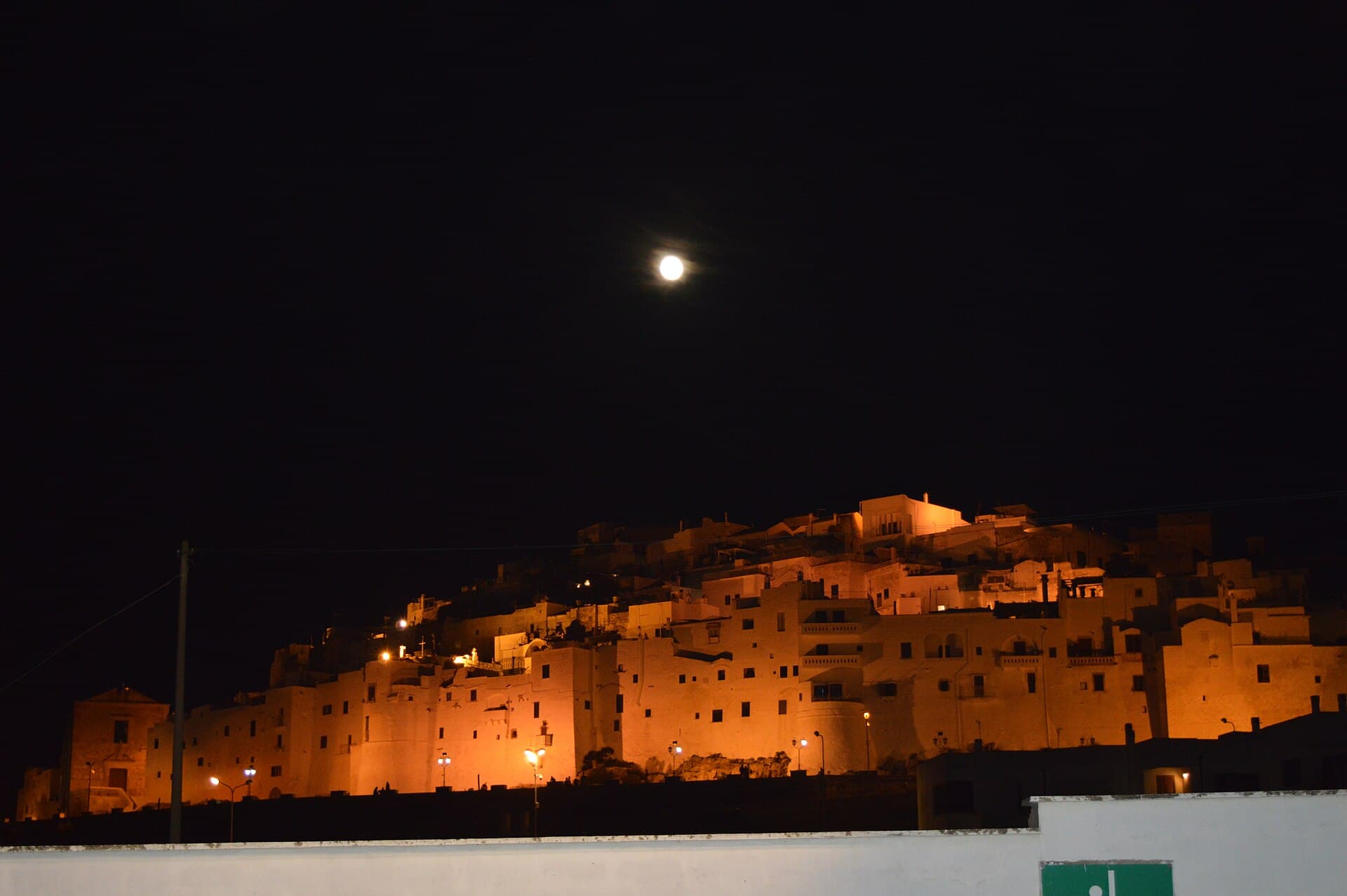
The old town lit up at night: the lime bounces artificial light the way it bounces the sun by day.
The old town lit up at night: the lime bounces artificial light the way it bounces the sun by day.Photo: Danymartini81, Wikimedia Commons (CC BY-SA 4.0)

Recurring events

Hover over a month on the timeline for details.

Budget & timing

Average daily cost

Season low (November-March)50-85€
Season mid (April-May, October)75-125€
Season high (June-September)110-190€

Rough estimate (lodging + meals + local transport), not a precise verified source.

Best time by type of trip

Sea and town together · June, September

Warm water, beaches still served by the buses and the evening circular, but without August's crowds and prices. September also brings the feast of Sant'Oronzo in the last days of August and the sea at its warmest.

Olives and countryside · April-May, October

Twenty degrees, green countryside and farm visits with no queues. October opens the olive harvest and the mills start running, which is the moment this area makes most sense.

The white town in winter · November-March

The old town stays lived in and alive all year, and in winter you walk it practically alone with accommodation at its lowest. The beaches, though, are closed and deserted: this is a trip about the town and the countryside, not the sea.

Did you know... On 26 August the riders of the Cavalcata di Sant'Oronzo wear a red jacket, the colour of martyrdom, white trousers and a cylindrical hat with a scarlet plume, and ride Murgese horses draped in embroidered crimson caparisons that reach down to the hooves.

Getting around

Car recommended: Yes. The old town is walked and nothing else, but the sea is eight kilometres away and the farms, mills and Dune Costiere park are scattered across the countryside: without a car you depend on bus timetables, which work well in summer and much less the rest of the year. In town the car simply gets left outside the walls.

The station is outside the centre and the official link is called Ostuni Link: an STP Brindisi bus leaving from in front of the station and reaching Piazza della Liberta, with twenty-four services on weekdays and sixteen on holidays. The ticket costs 1.10 euros and is bought together with the train ticket on all Trenitalia channels. Town buses to the beaches cost 90 cents, intercity ones 1.10 euros and 1.50 on board.

  • Buy the Ostuni Link ticket together with your train ticket: it costs 1.10 euros and saves hunting for a vendor on arrival, where there are none.
  • Do not follow the sat nav into the old town: the lanes are barely wider than a car and there is nowhere to turn. All the car parks are on the outer ring.
  • In summer the evening circular to the beaches is free and leaves from Viale Tenente Specchia: four departures between 8.15pm and midnight.
  • There are around fifteen hundred free spaces along the coast: better to arrive early than to pay, because by mid-morning in August they are all taken.

Safety

Areas to avoid

  • Ostuni is a quiet town with no areas to avoid, not even at night. The only ordinary care is at the crowded beach car parks in August, where the usual rules about things left in cars apply.
  • The most concrete risk is the paving in the old town: the chianche are polished and turn slippery in rain, and many lanes are stepped with no handrail.
  • Closed shoes with grip: the old town is all uphill on polished stone and flip-flops slide on it.
  • In summer the centre has no shade and the lime reflects the light: hat, sunglasses and visits in the first hours or after 6pm.
  • On the rocky beaches (Costa Merlata, Torre Pozzelle) water shoes are needed: the bottom is rock and there are sea urchins.
  • Single emergency number: 112.

Did you know... Olive trees planted in Roman times grow around the town: at Masseria Brancati alone about eight hundred are registered as a national monument, and some are two thousand years old.

Sources

Every source below was opened and checked by hand, not just cited. Entries that didn't hold up were downgraded to "low confidence" or dropped, not presented as certain.

Related destinations

Other dossiers close by country, area or kind of trip.