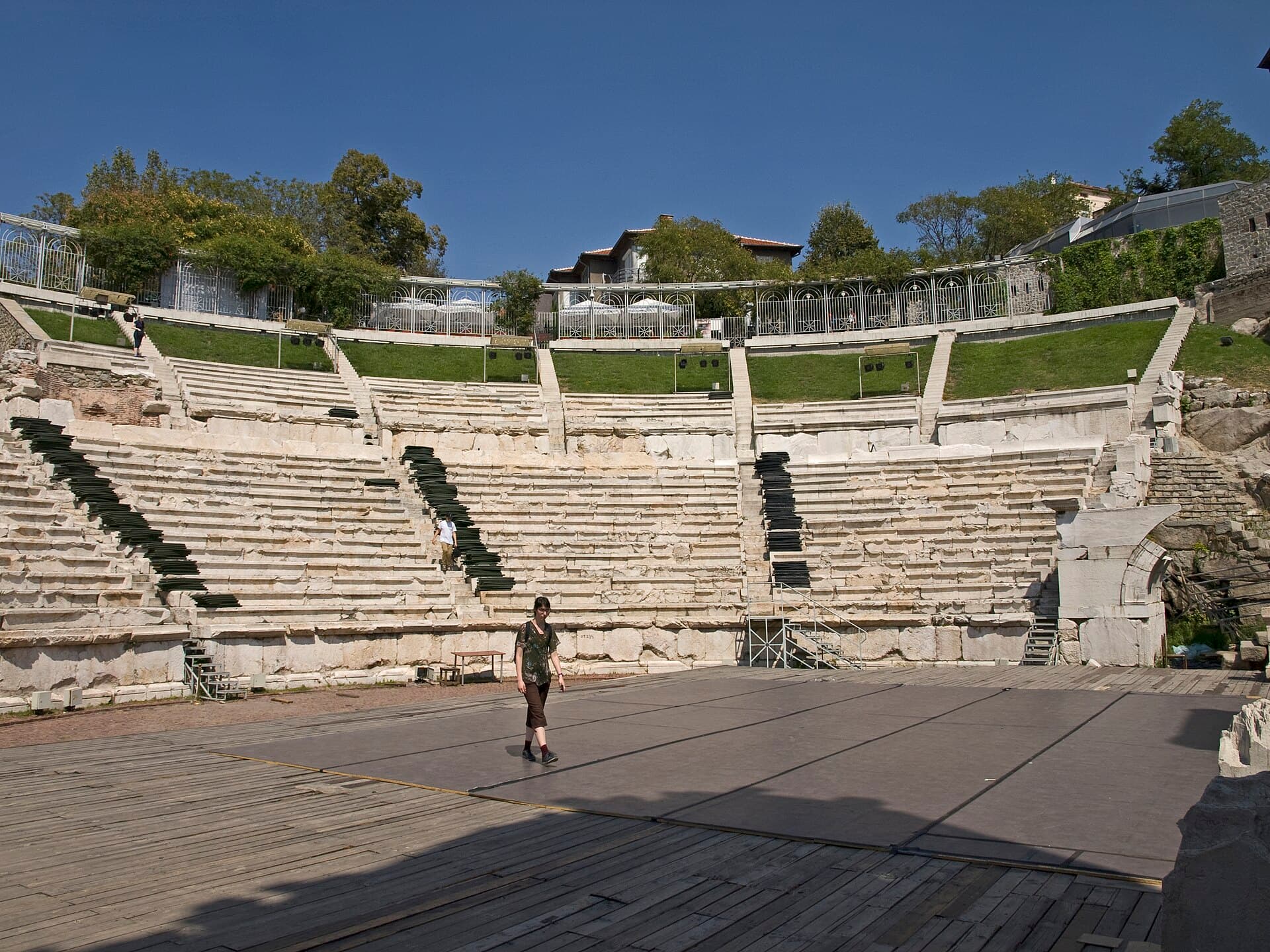
Sofia is where you land, and the question many people ask is whether it's worth spending a day on Plovdiv, 156 kilometres away by rail. The short answer: yes, and better a night than a day. Sofia is the capital with a 2,290-metre mountain reachable by city bus; Plovdiv is the older, prettier and cheaper city, with a Roman theatre still in use and a district, Kapana, that comes alive in the evening, which is exactly when day-trippers are already on the train back. Bulgaria has used the euro since 1 January 2026: the prices below are already in euros, and the lev price lists still floating around are out of date.
What they cost, season by season
Sofia costs €40-70 a day per person from November to March, €55-95 in April, May and October and €75-130 from June to September. Plovdiv costs €35-55, €45-75 and €60-100 over the same periods: less in every season, by €15-30 a day. With one Sofia quirk: in summer hotels cost no more than in spring, because the city loses tourists to the Black Sea. The tourist tax is small change in both and depends on the star rating: in Sofia from €0.51 to €1.53 a night, in Plovdiv from €0.20 to €0.61.
On transport Sofia has the metro at €0.80 a ride, with line M4 linking the airport to the centre in twenty minutes, and a 24-hour card at €3 that covers night services and pays for itself after four rides; Plovdiv has the city bus at €0.50, but the centre is pedestrian and you won't need it. On attractions the balance flips: in Sofia the best things are free (the Aleksandar Nevski cathedral, the Rotunda of St George, the Roman complex of Serdica you walk through from the metro) and the paid ones are the cathedral crypt at €4.09, Boyana church at €6.14 and the National History Museum at €9. In Plovdiv the Roman theatre costs €5.11 and the Old Town house-museums are visited with the 'Ancient and Eternal' combined ticket at €30.68, valid 72 hours: the single biggest spend in either city, but it covers the whole circuit.
How much time you need
Sofia asks for two days. The first is in the centre, crossed on foot in twenty minutes: the square of tolerance around Sveta Nedelya, with an Orthodox cathedral, a mosque, a synagogue and a Catholic cathedral within three hundred metres, then Nevski with its crypt, Serdica under glass and Battenberg Square with the guard in historic uniform, which on the first Wednesday of the month performs the ceremony with the band. The second day is for Boyana, where you go in nine at a time for ten minutes, and for Vitosha on bus 66, knowing that the Simeonovo and Dragalevtsi lifts are out of service and the altitude is earned on foot. Rila monastery is a full third day, with the bookable shuttle at around €30.
Plovdiv takes one full day: the Old Town in two hours, uphill on uneven cobbles, the Roman theatre (with a 12:30-13:00 break when nobody gets in, and early closing on performance evenings), the sphendone of the stadium viewed from the square for free, the Dzhumaya mosque next door. But the two things worth most don't fit an excursion's timetable: Nebet Tepe at sunset, with no ticket and no fence and local teenagers sitting on the stones, and Kapana after 19:00, which is half closed on Mondays and Tuesdays. Anyone returning to Sofia on the afternoon train misses both. That's why the dossier puts the hit-and-run visit first among the mistakes to avoid.
Safety and traps
Sofia is a quiet capital and the centre is safe in the evening too. The two traps the dossier documents with the British advisory are the unlicensed taxis from the airport, with the per-kilometre sticker written to confuse (5.20 printed as 05.2, which looks like 0.52), and the so-called gentlemen's clubs in the centre, where the bill reaches hundreds of euros with threats for anyone who won't pay. The first is avoided with the M4 metro, the second by not following anyone who invites you into a venue. The rest is ordinary care: pickpockets on Vitosha boulevard and on the metro at rush hour, broken and icy pavements in winter, and from November to February the windless days when the air in the basin is heavy. Plovdiv is quiet and safe even in Kapana at night; the only warning is about shoes, because the cobbled climbs are slippery in the rain. Throughout Bulgaria you must carry ID, and the British authorities say a printed copy of the passport photo page is enough.
How to travel between the two
The Bulgarian railways' train does Sofia-Plovdiv in 2 hours 40 minutes at best and three hours otherwise, with about ten direct services a day from 6:30 to 22:50: the 8:22 and the 10:15 are the ones for a day trip, the 16:25 is the fastest. A ticket costs €5.62 in second class on fast trains and €7.62 on fast trains with compulsory reservation, which is the official fare for the 151-160 kilometre band; buy at the station or online. With works on the network the times change, so check again on the day. The bus leaves from the Centralna Avtogara, next to the railway station, sector 6: €11 with Meritrans, about two hours, departures almost hourly. It costs twice the train and saves half an hour. You don't need a car in either city, and in central Sofia all parking is paid.
What you only find there
In Sofia there are the fountains beside the Mineral Baths pouring thermal water at around forty degrees, where locals come with jerrycans; the fourth-century rotunda hidden in the Presidency courtyard; the Zhenski Pazar market with the city's real prices; a bottle of mavrud under €10 in a wine shop. In Plovdiv there are three hundred metres of Roman stadium still buried under the pedestrian street, the fifteenth-century mosque ten metres from the sphendone, kavarma in the clay pot of the mehanas with live music, and the mavrud wineries in the plain around the city. In both, rakija is drunk before, with the shopska salad, and not as a digestif: ordering it at the end is the mistake that gives you away at once.
In short
If we had to reduce the choice to one line per profile:
- A two-night weekend: Sofia, with Boyana and Vitosha; Plovdiv only if one of the two nights is spent there
- Three nights: two in Sofia and one in Plovdiv, with the 10:15 train out and sunset on Nebet Tepe
- Budget: Plovdiv for sleeping and eating, Sofia for the free things; the difference is €15-30 a day
- Winter: Sofia, for the snow on Vitosha half an hour away by bus, checking the air on windless days