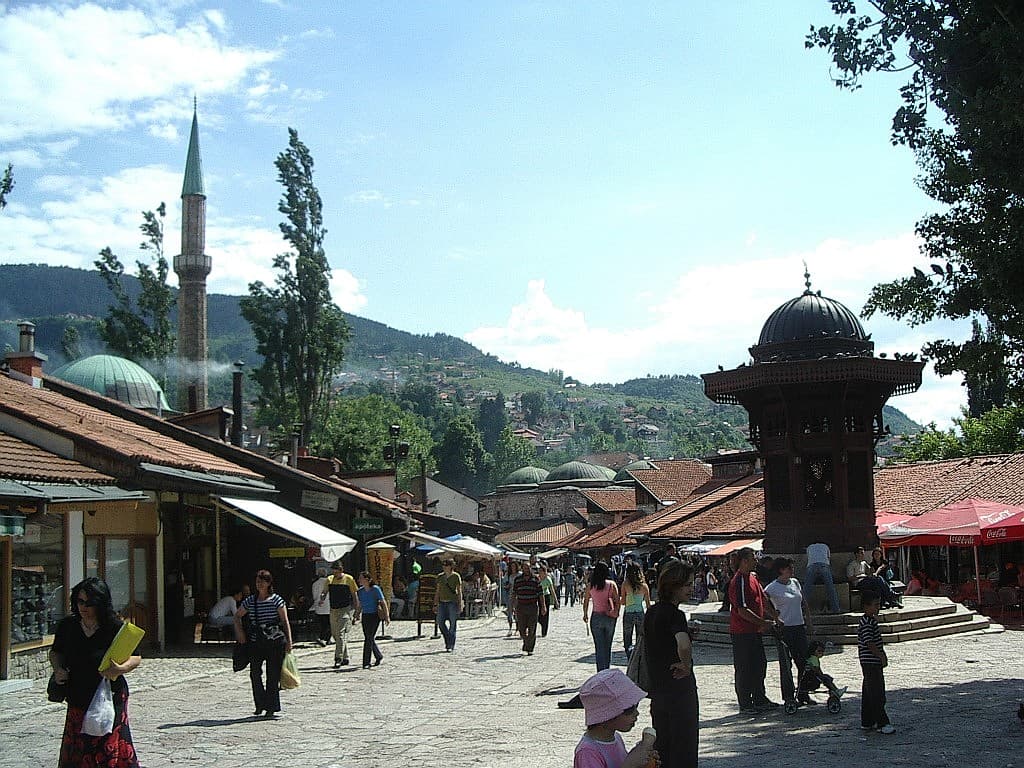
Sarajevo is the choice for those with two days who want to understand the twentieth century: the 1914 assassination, the siege, the line on the ground where the Ottoman bazaar turns into an Austro-Hungarian city. Mostar is the choice for those with one day who are after an image: the bridge, the green Neretva, the Blagaj spring a quarter of an hour away. The two cities are two hours apart by train, so the answer for anyone with three nights is both, with one night in Mostar. The numbers below come from the two verified dossiers.
What they cost, season by season
On price they are almost level. Sarajevo costs €30-50 a day per person in low season (January-March and November), €50-75 in mid season and €75-110 in high season, which is short: July and August, for the festivals. Mostar costs €35-55 from November to March, €45-75 in April, May and October and €65-110 from June to September, so its high season lasts four months against the capital's two. The tourist tax is the same, 3 convertible marks a night (about €1.53) in both from 2026, with one difference: in Sarajevo Canton during the festivals, meaning July, August and the year-end holidays, a separate festival tax applies, 4 marks in 2025.
The rest is small change. A Sarajevo tram ticket costs 2.20 marks, the day pass 7.10; Mostar's city bus 1.80 marks in zone 1, but you don't need it in the old town, because around the bridge you only walk. In both the currency is the convertible mark, pegged to the euro by the central bank: changing money in the bazaar exchange offices means paying a commission the rate doesn't justify, and a few key places, Sarajevo's Tunnel museum first of all, take only cash in marks.
How much time you need
In Sarajevo two full days are the minimum. Baščaršija and the Vijećnica (open daily 9:00-17:00, ticketed), the corner by the Latin Bridge, the Gazi Husrev-beg mosque outside prayer times and the climb to the Žuta Tabija for sunset fill the first. The second goes on the Tunnel of Hope, which from 1 April to 31 October opens 8:30-17:00 with last entry at 16:30 and costs 20 marks in cash, and the Trebević cable car with the 1984 Olympic bobsleigh track; Gallery 11/07/95, on the Srebrenica genocide, stays open until 20:00 and is one of the few things to do at the end of the day, but it is not a stop to squeeze in between the bazaar and lunch.
Mostar itself takes a day: the Stari Most, the Kujundžiluk bazaar, the Koski Mehmed-Paša minaret for the view from above, the gutted buildings along the Bulevar ten minutes from the bridge. The city's Mostar Pass covers the bridge museum, the minaret and the bell tower and is worth checking before buying single tickets. The second day is for trips: the Blagaj tekke 15 minutes away, Počitelj 30 minutes south, the Kravice waterfalls (20 marks, 7:00-22:00 from June to September) where you swim in cold water even in August. The rule holds either way: sleep there. Between 11 and 16 Mostar is overrun by day-trip groups from Split and Dubrovnik, and at dawn or after 18:30 the bridge empties.
Safety: the question everyone asks
The two most searched questions about these cities are 'is Sarajevo safe?' and 'is Sarajevo dangerous?'. The dossier's answer, which rests on the British travel advisory, is that Sarajevo is one of the safest capitals in South-East Europe for tourists: the risk is pickpocketing on trams and in the Baščaršija lanes at peak hours, plus airport taxis that propose a flat fare or declare the meter broken, which is why the dossier recommends booking a transfer through your accommodation. The landmines left from the war concern only rural and wooded areas off the marked trails, never the centre; Trebević was declared mine-impact free in 2021. After dark avoid outlying districts such as Alipašino Polje and Dobrinja, which have nothing to see anyway.
Mostar is a safe city with two practical warnings: the ruined buildings along the former front line are viewed from outside, because they are not structurally safe, and nobody dives off the Stari Most without going through the divers' club, which trains and supervises, because the jump is over twenty metres into icy water. Throughout Bosnia every foreigner must be registered with the police within 72 hours: hotels and hostels do it at check-in, those renting from unregistered private hosts have to do it themselves. The single emergency number is 112.
How to travel between the two
The federal railways' train is the best way: two services a day in each direction, from Sarajevo at 7:15 and 16:46, about two hours along the Neretva gorge, and it is one of the most beautiful lines in Europe. It costs under ten euros, but the exact fare isn't on the operator's website and online sales were suspended when we checked, in September 2026: buy at the station. In summer, from Friday to Sunday, the morning train continues to Ploče, on the Croatian coast. The Centrotrans bus is the alternative when the train times don't work: eight departures a day between 6:00 and 19:55, two hours forty, 34 marks (about €17.40), ticket online or at the bus station, next to the railway station. You don't need a car in either city: in Sarajevo the centre is pedestrian and the tram does the rest, in Mostar you leave it in the car parks outside the old town.
What you only find there
In Sarajevo there is the line marked on the ground where the fifteenth-century bazaar ends and the late-nineteenth-century facades begin, the stretch of road by the Latin Bridge where the archduke's car took a wrong turn, the graffiti-covered concrete of the bobsleigh track in the woods, the Sephardic cemetery on Kovačići hill and the ritual of Bosnian coffee, drunk over thirty minutes with the lokum before, not after. In Mostar there are the divers, who jump when the collection from passers-by is enough and not on a fixed schedule, sogan-dolma, stuffed onions found only in the aščinice and gone early, and two grape varieties almost nobody else has, the white Žilavka and the red Blatina, at prices a long way from Western Europe's.
In short
If we had to reduce the choice to one line per profile:
- Three nights in Bosnia: two in Sarajevo and one in Mostar, with the 7:15 train and the afternoon at Blagaj
- A single day from the Croatian coast: Mostar, but staying the night, to see the bridge without the groups
- An interest in twentieth-century history: Sarajevo, with 20 marks in cash for the Tunnel and Gallery 11/07/95 at the end of the day
- Budget: they're level; in Sarajevo avoid July and August for the festivals, in Mostar the whole summer costs more