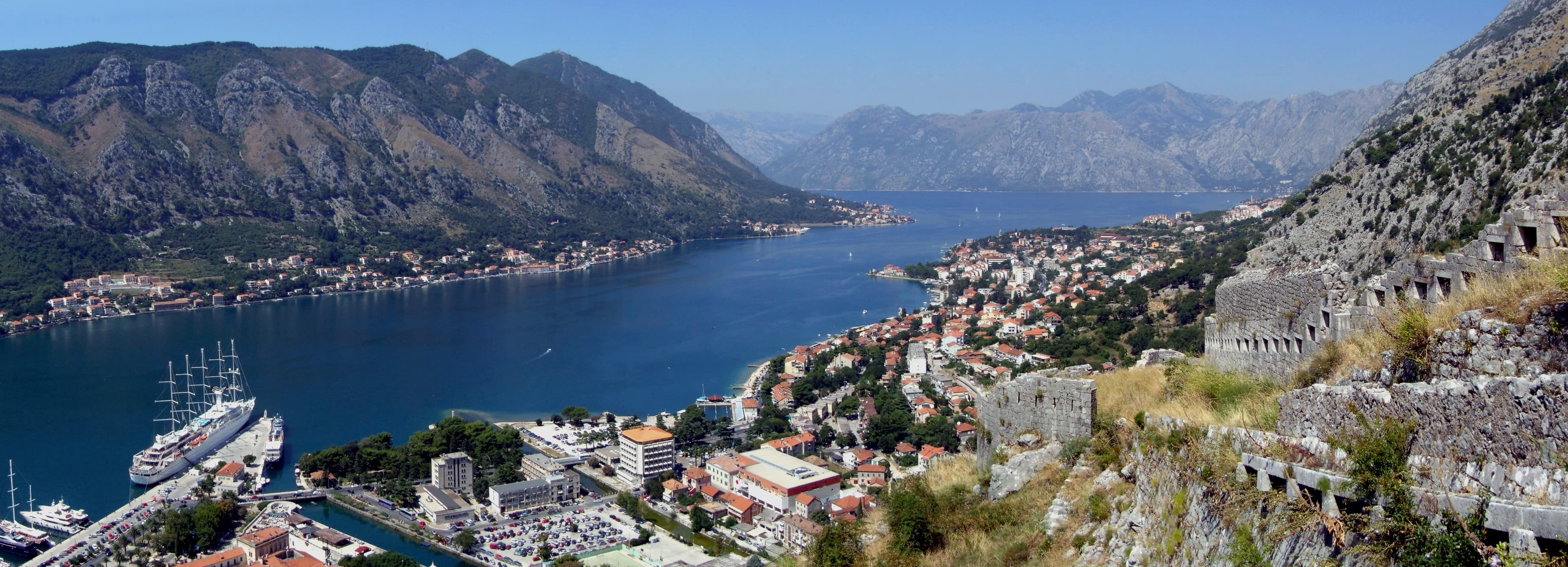
Three walled cities on the same sea, all with Venetian stone, cruise ships and black risotto, and three budgets that look nothing alike. Kotor is the choice for those who want to spend less and have a car: the bay, Perast and the Lovćen serpentine are the reason for the trip. Dubrovnik is the choice for those who want the image, the walls and the Stradun, and accept paying for it and sharing it. Split is the choice for those who want a lived-in city as a base for the islands, and it costs the most. The numbers come from the three verified dossiers, per person per day, flights excluded.
What they cost, season by season
The scale is clear. Kotor costs €35-55 a day from November to March, €55-85 in April, May and October and €85-130 from June to September. Dubrovnik costs €50-70, €70-110 and €120-180 over the same periods. Split costs €60-100 in low season, €100-150 from April to June and in September-October, and €150-230 in July and August, peaking during Ultra Europe, the July electronic music festival that fills every bed in town. In high season there is €100 a day per person between Kotor and Split.
The fixed items follow the same scale. The tourist tax is €2.65 a night from April to September in Dubrovnik and Split (€1.85 and €1.86 in winter), €1 in Kotor, the most Montenegrin law allows; under-12s pay nothing in any of the three. The city bus costs €1.73 in Dubrovnik at the kiosks (€2.50 on board), about €2 in Split (€1 in the app, €3 from the driver) and €1 in Kotor, €1.50 as far as Perast. Attractions weigh on Dubrovnik: the walls have a ticket, which also covers Lovrijenac fortress (those who don't know pay twice), Lokrum island costs €30 ferry included and the Srđ cable car €30 return, closed from December to March. In Split Diocletian's Palace has no entrance and no ticket, because it's an inhabited district: you only pay for the cellars, and anyone staying at least five nights from April to October collects the free SplitCard with three civic museums. In Kotor the cat museum is free and the fortress is paid in steps: 1,350 of them.
How much time you need
Dubrovnik is two days: the walls at opening or in the last hour, because the 1,940-metre circuit is one-way and shadeless, the Stradun at 8:00 or after 21:00 when the cruise ships are gone, the friars' pharmacy of 1317 a few steps from Pile Gate, and on the second day Lokrum or Sveti Jakov cove, which its staircase keeps half empty even in August. Split is two days for the city and as many as you like for the islands: the ferry to Supetar, on Brač, leaves from the Riva, takes 50 minutes and the ticket is valid all day on any sailing. Kotor is crossed in ten minutes from gate to gate and is done in a day and a half, with the climb to the fortress at dawn (at least two hours there and back, never between 11:00 and 16:00 in summer) and Perast in the afternoon; the second day is the Lovćen serpentine, twenty-five tight bends with low walls, for anyone comfortable driving in the mountains.
In all three the ships set the pace. In Kotor between mid-morning and early afternoon the lanes are single file and at 18:00 the same street is empty; in Dubrovnik the windows are the same; in Split the crowd packs the Palace and the Riva at disembarkation time. Anyone sleeping in town always beats anyone on a day trip, and in Kotor those who have understood how the coast works sleep in Perast, where no ship docks.
How hard it is to get there
Dubrovnik's airport is 21 kilometres away, with a fixed taxi fare of €30-40 displayed at the official desks; Kotor's is Tivat, 7 kilometres, ten minutes, but the taxis waiting outside arrivals quote verbal fares: licensed only, booked or through an app. Split has its own airport and port, and the island ferries leave from there. There is no train between the three: Split-Dubrovnik is 235 kilometres of coast road, Dubrovnik-Kotor 80 kilometres with the Montenegrin border in between, which adds time in summer. None of the three needs a car for the city, all three have a pedestrian centre closed to traffic: in Dubrovnik, since June 2025, the regulated traffic zone around the walls costs €260 if you breach it. The car is for Kotor's bay, and that's it.
Rules and traps
The rules are those of three cities defending themselves from tourism. In Dubrovnik walking around the old town in swimwear or bare-chested costs about €265, and climbing on monuments or drinking alcohol near protected sites is fined; the €265 fine for noisy wheeled suitcases, on the other hand, is a hoax, denied by the city. In Split swimwear in the centre costs up to €150 and the British advisory reports fines of up to €4,000 for brawls and drunken behaviour. In Montenegro you must always carry ID, register within 24 hours (hotels do it for you) and never photograph police or military. The traps are few and similar: in Kotor the stalls in front of the cruise terminal cost three to five times the streets inside the walls, and on the fortress steps someone may tag along offering unrequested explanations and ask for money at the top; in Dubrovnik the tourist menus without clear prices near the Stradun; in Split no official reports, just the difference between a table on the Riva and one in the lanes for the same dish.
What you only find there
In Dubrovnik there is Buža, not a bar with a view but a gap in the city wall you step through onto the rocks; the Gundulić market that vanishes by 12:00; rožata flavoured with rose-petal liqueur. In Split there is picigin at Bačvice, played in knee-deep water since 1908, even on 1 January; the Varoš quarter without a single souvenir shop; peka to be ordered the day before. In Kotor there is Our Lady of the Rocks, the islet built by sailors throwing stones for centuries; Njeguši ham bought from the houses along the Lovćen road; vranac, the red that is hardly exported and drunk only here.
In short
If we had to reduce the choice to one line per profile:
- Budget: Kotor, €35-55 in low season and €85-130 in high, with the tourist tax at €1
- First time on the Adriatic and the postcard image: Dubrovnik, on the walls at opening, sleeping outside the walls and arriving on the €1.73 bus
- A week with islands and a city that lives: Split, but not in July, when Ultra Europe takes it to €150-230
- A car and a slow pace: Kotor sleeping in Perast, with the serpentine and Njeguši on the second day