Northern Belgium is crossed end to end in under an hour by train, which makes the question legitimate: with three days, where do you spend them? The four cities are not interchangeable: the price, the pace and above all how much you feel surrounded by other visitors all change. Below, what really separates them, with figures taken from the verified dossiers.
Bruges: the most beautiful and the most crowded
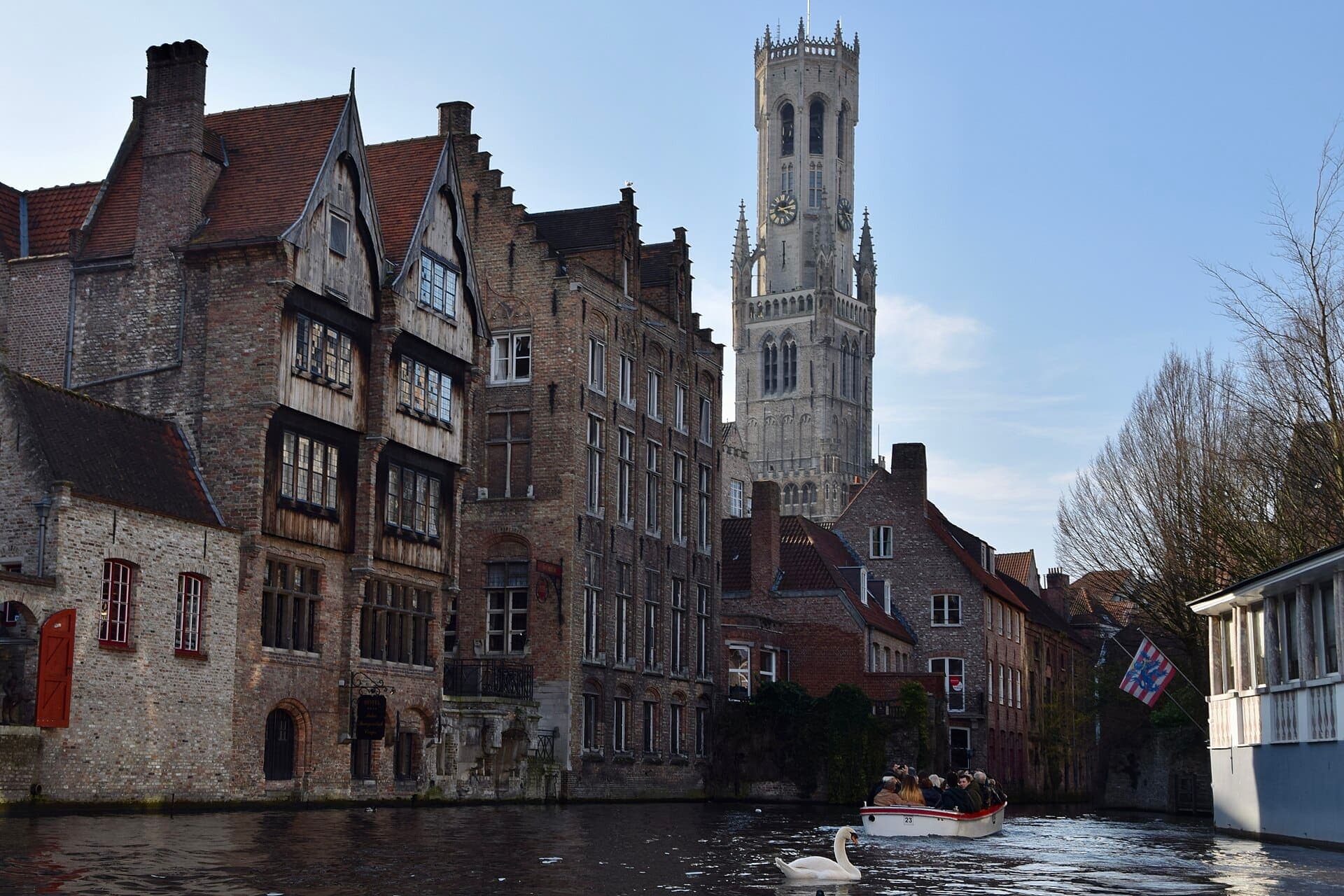
Bruges is the intact medieval centre everyone has in mind, and it is small: you walk all of it. The price of that beauty shows in the budget, the highest of the four: €130-180 a day in mid-season, against €110-160 for Ghent and €95-150 for Antwerp.
There is a corrective, and it is the clock. Between 11am and 4pm the day-trippers arrive from Brussels; at dawn and after dinner the city genuinely empties, because most visitors do not sleep here. Stay one night and you get Bruges to yourself twice a day.
The verified gem is the four windmills on the eastern ramparts, along the Kruisvest: a quarter of an hour on foot from the centre, on a grass bank with not a shop in between. They are the last of twenty-five that once ringed the city.
Ghent: the one the Belgians keep
Ghent has the same raw material as Bruges (canals, guild houses, a castle on the water), but it is a lived-in university city rather than a preserved old town. Which means the bars close late and prices run a third lower.
Off the circuit: the Patershol, the maze of cobbled lanes behind the Gravensteen that became the food quarter; and the Werregarenstraatje, a 120-metre alley left to the writers since 1995, where walls, windows and frames change every week.
One date to know: in July the Gentse Feesten take over the city for ten days of free festival. It is the most characteristic thing Ghent does, but accommodation has to be booked months ahead and the budget jumps to €160-230.
Antwerp: fashion, diamonds and a station worth seeing
Antwerp is the least picture-postcard and the most contemporary: this is where the Antwerp Six studied, the six designers who put the city on the fashion map in the 1980s, and around the Nationalestraat are the boutiques of their heirs.
Two practical warnings. Rubens's house is closed for restoration and will not reopen before 2030: since 2024 you enter through a new building and see the Rubens Experience, the baroque garden and the library, not the painter's rooms. And the diamond district behind the station is not a zone of shop windows but a business centre: for buying there is one rule, AWDC-certified dealers with the laboratory certificate.
The concourse of the central station, by contrast, is walked through without a train ticket: a glass dome 75 metres up, marble of twenty kinds, and the good view is from the upper gallery, not the platform floor.
Brussels: the logical base, and more interesting than its reputation
Brussels takes abuse it does not entirely deserve. It is the natural logistical base, the other three are all under an hour away, and it is the cheapest in low season, €65-90 a day in January and February.
What is worth your time is not the Atomium and the Manneken Pis (sixty-one centimetres tall, and the one in the street is a copy). It is the comic-strip route, some sixty murals on the blank walls of the centre, free and on foot; the flea market on Place du Jeu de Balle, open every day of the year with over three hundred stalls; and the Horta museum, the architect's house and studio and a UNESCO site.
On the Horta museum, though, watch the hours, which are unusual: closed Monday, and from Tuesday to Friday it opens only in the afternoon. Online booking is compulsory, and photography inside is not allowed.
How I would decide
If it is one trip and you want the image of Flanders, Bruges: sleeping there, not passing through. If you want the same thing for less and with more real life, Ghent. If fashion, design and a city that does not perform appeal, Antwerp. Brussels works as a base for two or three days with daily excursions, and it is the only one of the four that also holds up as a destination in itself.
The bill, briefly
Verified daily budgets in mid-season: Bruges €130-180, Ghent €110-160, Antwerp €95-150, Brussels €90-130. In low season (January, February, November) everything drops by thirty or forty euros a day, and Flanders in winter has the advantage that almost everything worth doing is indoors.