Alberobello, Puglia, Italy
Photo: Benjamin Smith, Wikimedia Commons (CC BY-SA 4.0)
← All destinations

Alberobello, Puglia, Italy

Sixteen hundred dry-stone cones spread across two districts, on the UNESCO list since 1996, and more coaches than residents on any given day. Alberobello takes half a day: the question is which half, because between ten and four it is a different place.

✓ Sources verified by hand on 8 September 20268 sources cited

What to see

Monuments3

Rione Monti

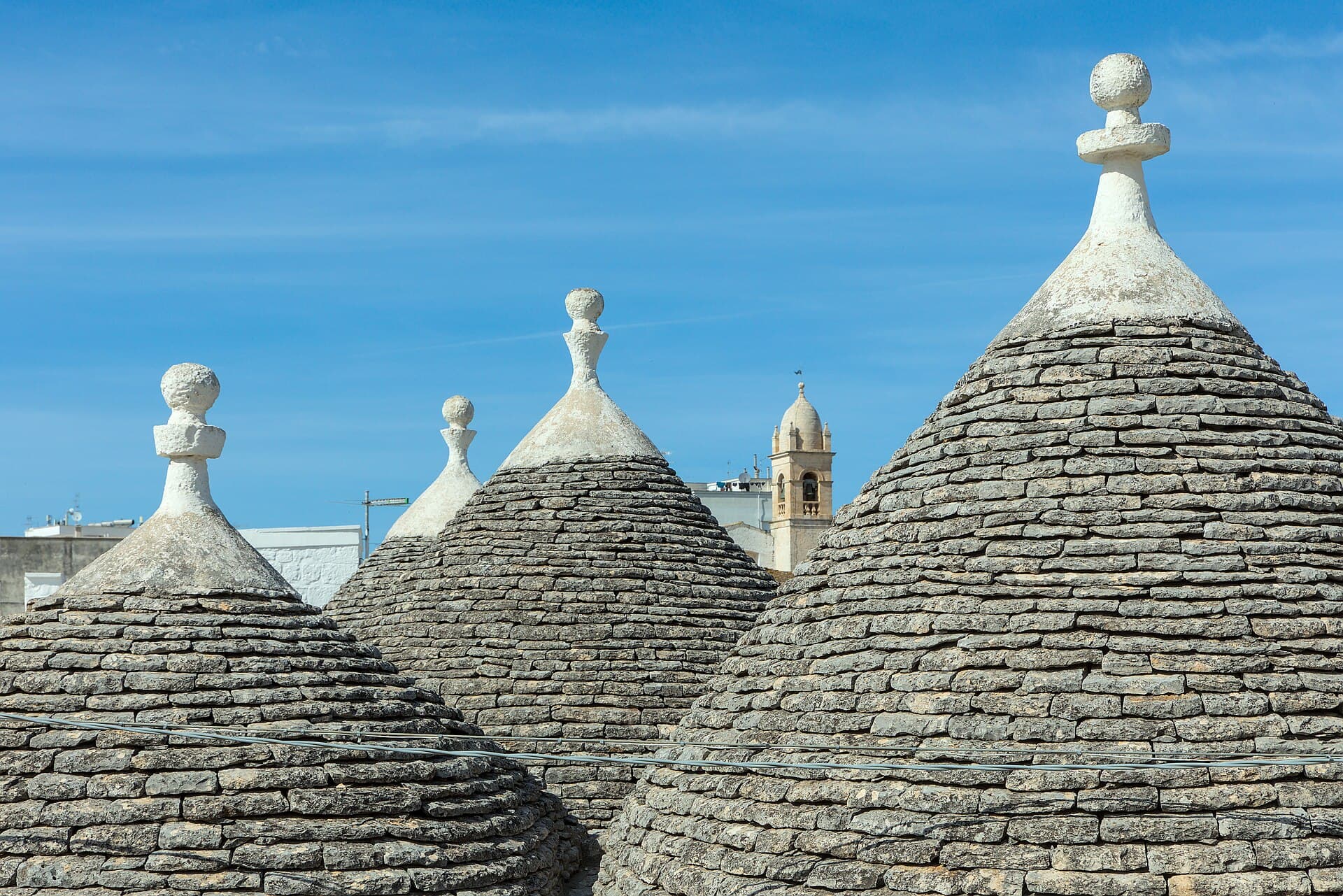
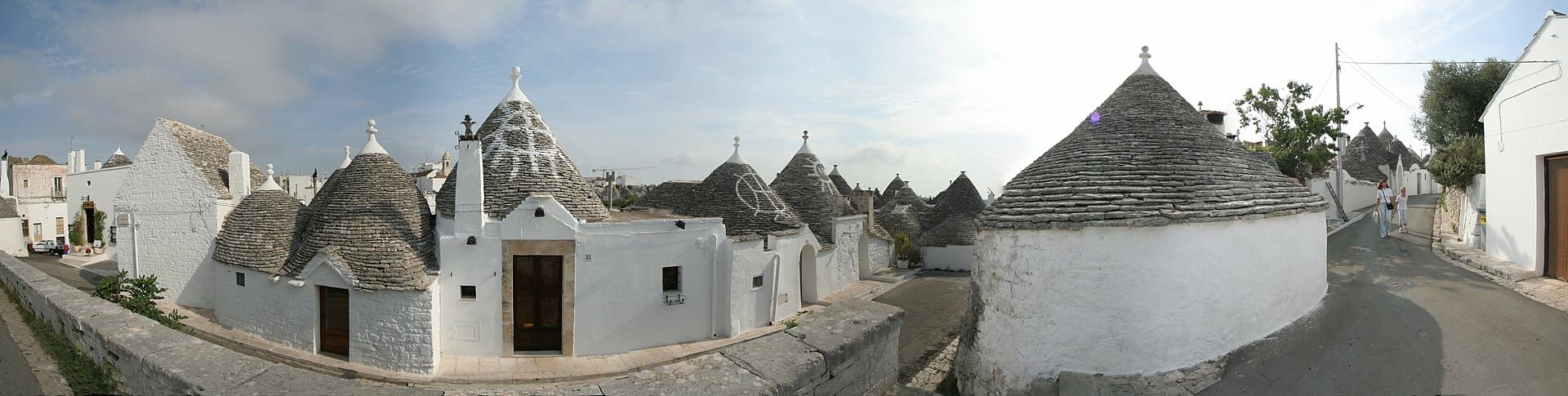
One thousand and thirty trulli on a slope, the district everyone photographs, walked in barely an hour and free. The thing to know is that almost every ground floor has become a shop: from ten to four the street is a retail corridor packed with groups, while before 9.30am and after 5.30pm, once the shutters come down, only the cones and the stone remain.

Casa d'Amore

The first building in Alberobello made with mortar, in 1797, right after the town was freed from the counts of Conversano: a political act before an architectural one. Today it houses the tourist information office, entry is free and 5 minutes is enough, but without this story the trulli stay merely odd rather than meaningful.

Church of Sant'Antonio

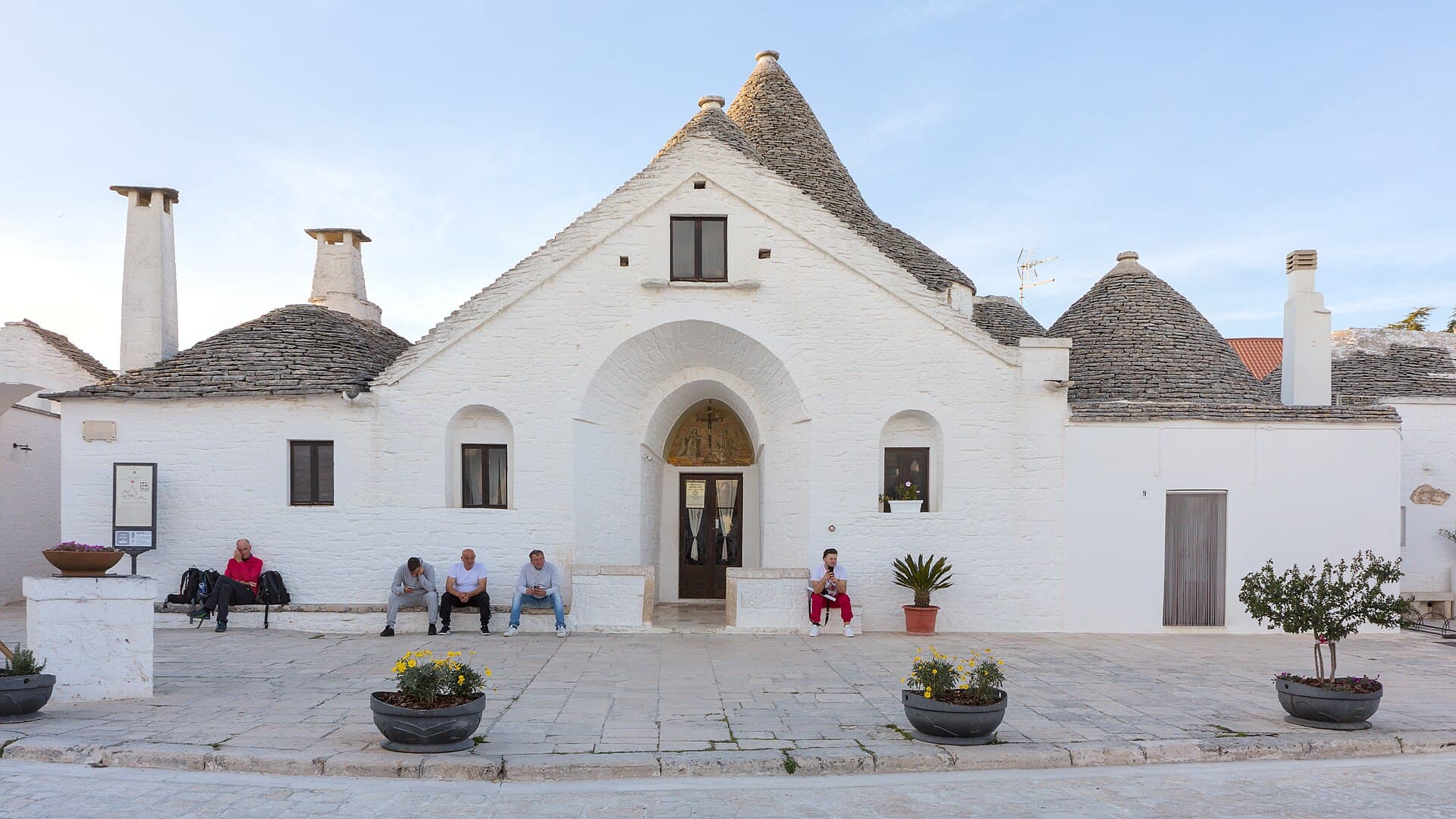
At the top of Rione Monti, a 10-minute climb from the bottom of the district, a church built in the 1920s in the shape of a trullo, with a conical dome and a Greek cross plan: it is not old, it is a stylistic exercise made once the town had already grasped that the cones were its identity. Entry is free, and it is also the highest point of the climb, so you arrive with the roofs spread out behind you.

Nature1

Castellana Caves

15 km away, the most famous karst system in the south: visits are guided only and there are two routes, the short one of a kilometre in 50 minutes and the full one of three kilometres in an hour and forty, which is the only one that includes the White Cave. Inside it is a constant 16.5 degrees all year, so a jumper is needed even in mid-August, and slots need booking.

Museums2

Trullo Sovrano

The only two-storey trullo, built in the mid-18th century by a priest's family and today a house museum furnished in period style. A single 2.50-euro ticket, the cheapest in town. The hours include a long break that catches many people out: 10am-12.45pm and then 3.30-6.30pm from April to October, 3.30-6pm from November to March. Turning up at two in the afternoon means finding it shut.

Museo del Territorio Casa Pezzolla

Fifteen interconnected trulli on Piazza XXVII Maggio, a 19th-century doctor's house turned into a museum of rural life and building technique: the right place to understand why a dry-laid cone stays up. Open daily 10am-8pm with last entry at 7.30pm, continuous hours that make it the only possible visit at lunchtime. It hosts temporary exhibitions, so the ticket price changes with whatever is installed.

Food3

Bombette and grilled meat

Bombette are rolls of pork capocollo stuffed with cheese, and the ritual is the fornello pronto: you choose the raw meat at the butcher's counter, pay by weight and they grill it while you wait at the table next door. The home of the system is Cisternino, 20 minutes away by car, and Martina Franca, but you find it in Alberobello too: either way it costs a fraction of a restaurant.

Orecchiette and Martina Franca capocollo

Orecchiette with turnip tops is the house dish, made by hand with a knife rather than a mould. Martina Franca capocollo is a Slow Food presidium: the meat sits under salt for two or three weeks, is washed with cooked wine and then smoked for two days over fragno wood, the valley's own oak, together with almond husks. The presidium's producers are all within 20 km of Alberobello: buying from them or from the valley's delicatessens is a different thing from buying along the coach route.

Valle d'Itria wines

Around Alberobello they make light, sharp whites, the Locorotondo DOC from verdeca and bianco d'Alessano, which is the wine to drink with Adriatic fish 30 minutes away. The reds are dominated by primitivo and negroamaro, though those come from further south. The valley's wineries sit within 10 km of town and run visits and tastings by appointment.

Other2

Belvedere Santa Lucia

The terrace above Largo Martellotta, 3 minutes on foot from the coach park, where the classic photograph of Rione Monti is taken with all the cones lined up on the slope. It is public, free and asks nothing of you, unlike the shop terraces. At sunset twenty people crowd a few metres of railing: the best light for photographs is early morning, when you have it to yourself.
Locorotondo

9 km away, the most immaculate white village in the Valle d'Itria, with its cummerse, houses under steep pitched roofs found nowhere else. The Ferrovie del Sud Est train stops there too, on the same line as Alberobello, so it works without a car. White on white, geraniums at the windows and no coaches: it is what many people expect of Alberobello and do not find.

✦ Hidden gems · off the standard guides

Rione Aia Piccola

Five hundred and ninety trulli on the other side of Largo Martellotta, 5 minutes' walk from Rione Monti: there are no shops here because the district is still lived in. This is where you understand what a trullo actually is, with vegetable plots, washing lines and residents' cars. Which is why common-sense rules apply that nobody thinks about in Rione Monti: no drones, no photographs through windows, quiet voices in the evening.

The shop terraces

Many trullo-shops in Rione Monti put out a sign inviting you to go up to the terrace for free and look over the roofs: the access really is free, it takes 2 minutes up and down, and the view onto the cones differs from the belvedere's. The implicit bargain is that you buy something on the way down, and anyone who would rather skip that small awkwardness already has the Belvedere Santa Lucia for nothing.

Trullo Siamese

Two joined cones with two entrances opening onto different streets, 5 minutes' walk from Casa d'Amore: local legend tells of two brothers who split the house after falling out over a woman. It is a shop, so you walk in free and leave when you like, and it takes half a minute: the thing to look at is how the two rooms share a wall without connecting.

Martina Franca and Cisternino

Martina Franca is the baroque capital of the valley, with its ducal palace and a white old town best walked in the evening; Cisternino is smaller and lives on fornelli pronti, butchers where you pick your meat at the counter and they grill it there and then. They are 15 and 20 minutes away by car: without one the public link exists but is awkward, and in the evening there is no way back.

Sample itineraries

Three routes for different travel styles, built only from this dossier's verified places. Realistic pace: 2-3 stops a day.

First time

2 days

The landmark sights, at the right pace.

Day 1

  • Rione Monti

    One thousand and thirty trulli on a slope, the district everyone photographs, walked in barely an hour and free. The thing to know is that almost every ground floor has become a shop: from ten to four the street is a retail corridor packed with groups, while before 9.30am and after 5.30pm, once the shutters come down, only the cones and the stone remain.

  • Casa d'Amore

    The first building in Alberobello made with mortar, in 1797, right after the town was freed from the counts of Conversano: a political act before an architectural one. Today it houses the tourist information office, entry is free and 5 minutes is enough, but without this story the trulli stay merely odd rather than meaningful.

  • Church of Sant'Antonio

    At the top of Rione Monti, a 10-minute climb from the bottom of the district, a church built in the 1920s in the shape of a trullo, with a conical dome and a Greek cross plan: it is not old, it is a stylistic exercise made once the town had already grasped that the cones were its identity. Entry is free, and it is also the highest point of the climb, so you arrive with the roofs spread out behind you.

Day 2

  • Trullo Sovrano

    The only two-storey trullo, built in the mid-18th century by a priest's family and today a house museum furnished in period style. A single 2.50-euro ticket, the cheapest in town. The hours include a long break that catches many people out: 10am-12.45pm and then 3.30-6.30pm from April to October, 3.30-6pm from November to March. Turning up at two in the afternoon means finding it shut.

  • Museo del Territorio Casa Pezzolla

    Fifteen interconnected trulli on Piazza XXVII Maggio, a 19th-century doctor's house turned into a museum of rural life and building technique: the right place to understand why a dry-laid cone stays up. Open daily 10am-8pm with last entry at 7.30pm, continuous hours that make it the only possible visit at lunchtime. It hosts temporary exhibitions, so the ticket price changes with whatever is installed.

  • Belvedere Santa Lucia

    The terrace above Largo Martellotta, 3 minutes on foot from the coach park, where the classic photograph of Rione Monti is taken with all the cones lined up on the slope. It is public, free and asks nothing of you, unlike the shop terraces. At sunset twenty people crowd a few metres of railing: the best light for photographs is early morning, when you have it to yourself.
Off the beaten path

2 days

Hidden gems away from the usual circuits.

Day 1

  • Rione Aia Piccolahidden gem

    Five hundred and ninety trulli on the other side of Largo Martellotta, 5 minutes' walk from Rione Monti: there are no shops here because the district is still lived in. This is where you understand what a trullo actually is, with vegetable plots, washing lines and residents' cars. Which is why common-sense rules apply that nobody thinks about in Rione Monti: no drones, no photographs through windows, quiet voices in the evening.

  • The shop terraceshidden gem

    Many trullo-shops in Rione Monti put out a sign inviting you to go up to the terrace for free and look over the roofs: the access really is free, it takes 2 minutes up and down, and the view onto the cones differs from the belvedere's. The implicit bargain is that you buy something on the way down, and anyone who would rather skip that small awkwardness already has the Belvedere Santa Lucia for nothing.

  • Trullo Siamesehidden gem

    Two joined cones with two entrances opening onto different streets, 5 minutes' walk from Casa d'Amore: local legend tells of two brothers who split the house after falling out over a woman. It is a shop, so you walk in free and leave when you like, and it takes half a minute: the thing to look at is how the two rooms share a wall without connecting.

Day 2

  • Martina Franca and Cisterninohidden gem

    Martina Franca is the baroque capital of the valley, with its ducal palace and a white old town best walked in the evening; Cisternino is smaller and lives on fornelli pronti, butchers where you pick your meat at the counter and they grill it there and then. They are 15 and 20 minutes away by car: without one the public link exists but is awkward, and in the evening there is no way back.

  • Castellana Caves

    15 km away, the most famous karst system in the south: visits are guided only and there are two routes, the short one of a kilometre in 50 minutes and the full one of three kilometres in an hour and forty, which is the only one that includes the White Cave. Inside it is a constant 16.5 degrees all year, so a jumper is needed even in mid-August, and slots need booking.

Food & markets

1 days

Eat and drink where locals actually go.

Day 1

  • Bombette and grilled meat

    Bombette are rolls of pork capocollo stuffed with cheese, and the ritual is the fornello pronto: you choose the raw meat at the butcher's counter, pay by weight and they grill it while you wait at the table next door. The home of the system is Cisternino, 20 minutes away by car, and Martina Franca, but you find it in Alberobello too: either way it costs a fraction of a restaurant.

  • Orecchiette and Martina Franca capocollo

    Orecchiette with turnip tops is the house dish, made by hand with a knife rather than a mould. Martina Franca capocollo is a Slow Food presidium: the meat sits under salt for two or three weeks, is washed with cooked wine and then smoked for two days over fragno wood, the valley's own oak, together with almond husks. The presidium's producers are all within 20 km of Alberobello: buying from them or from the valley's delicatessens is a different thing from buying along the coach route.

  • Valle d'Itria wines

    Around Alberobello they make light, sharp whites, the Locorotondo DOC from verdeca and bianco d'Alessano, which is the wine to drink with Adriatic fish 30 minutes away. The reds are dominated by primitivo and negroamaro, though those come from further south. The valley's wineries sit within 10 km of town and run visits and tastings by appointment.

🧭

Build your itinerary

Tell us how many days you're staying and in which month: we'll compose an itinerary from this dossier's verified places, with notes about the period.

Your itinerary

1

Day 1

  • Rione Monti

    One thousand and thirty trulli on a slope, the district everyone photographs, walked in barely an hour and free. The thing to know is that almost every ground floor has become a shop: from ten to four the street is a retail corridor packed with groups, while before 9.30am and after 5.30pm, once the shutters come down, only the cones and the stone remain.

  • Casa d'Amore

    The first building in Alberobello made with mortar, in 1797, right after the town was freed from the counts of Conversano: a political act before an architectural one. Today it houses the tourist information office, entry is free and 5 minutes is enough, but without this story the trulli stay merely odd rather than meaningful.

  • Bombette and grilled meat

    Bombette are rolls of pork capocollo stuffed with cheese, and the ritual is the fornello pronto: you choose the raw meat at the butcher's counter, pay by weight and they grill it while you wait at the table next door. The home of the system is Cisternino, 20 minutes away by car, and Martina Franca, but you find it in Alberobello too: either way it costs a fraction of a restaurant.

2

Day 2

  • Church of Sant'Antonio

    At the top of Rione Monti, a 10-minute climb from the bottom of the district, a church built in the 1920s in the shape of a trullo, with a conical dome and a Greek cross plan: it is not old, it is a stylistic exercise made once the town had already grasped that the cones were its identity. Entry is free, and it is also the highest point of the climb, so you arrive with the roofs spread out behind you.

  • Trullo Sovrano

    The only two-storey trullo, built in the mid-18th century by a priest's family and today a house museum furnished in period style. A single 2.50-euro ticket, the cheapest in town. The hours include a long break that catches many people out: 10am-12.45pm and then 3.30-6.30pm from April to October, 3.30-6pm from November to March. Turning up at two in the afternoon means finding it shut.

  • Orecchiette and Martina Franca capocollo

    Orecchiette with turnip tops is the house dish, made by hand with a knife rather than a mould. Martina Franca capocollo is a Slow Food presidium: the meat sits under salt for two or three weeks, is washed with cooked wine and then smoked for two days over fragno wood, the valley's own oak, together with almond husks. The presidium's producers are all within 20 km of Alberobello: buying from them or from the valley's delicatessens is a different thing from buying along the coach route.

3

Day 3

  • Museo del Territorio Casa Pezzolla

    Fifteen interconnected trulli on Piazza XXVII Maggio, a 19th-century doctor's house turned into a museum of rural life and building technique: the right place to understand why a dry-laid cone stays up. Open daily 10am-8pm with last entry at 7.30pm, continuous hours that make it the only possible visit at lunchtime. It hosts temporary exhibitions, so the ticket price changes with whatever is installed.

  • Belvedere Santa Lucia

    The terrace above Largo Martellotta, 3 minutes on foot from the coach park, where the classic photograph of Rione Monti is taken with all the cones lined up on the slope. It is public, free and asks nothing of you, unlike the shop terraces. At sunset twenty people crowd a few metres of railing: the best light for photographs is early morning, when you have it to yourself.
  • Valle d'Itria wines

    Around Alberobello they make light, sharp whites, the Locorotondo DOC from verdeca and bianco d'Alessano, which is the wine to drink with Adriatic fish 30 minutes away. The reds are dominated by primitivo and negroamaro, though those come from further south. The valley's wineries sit within 10 km of town and run visits and tastings by appointment.

Want an itinerary tailored to your dates in Alberobello?

Travel dates, where you stay and the kind of trip: we tailor this same verified dossier to your exact needs.

Coming soon
The Trullo Sovrano, the only two-storey one: a 2.50-euro ticket, but with a long lunch break to plan around.
The Trullo Sovrano, the only two-storey one: a 2.50-euro ticket, but with a long lunch break to plan around.Photo: Benjamin Smith, Wikimedia Commons (CC BY-SA 4.0)

Before you go

Recurring scams and local rules worth knowing before you arrive.

⚠ Scams to know

The free shop terraces with a moral obligation to buy

low confidence

Many trullo-shops invite you up to the terrace freely: the access really is free, but once back down you feel obliged to buy something, which is exactly what the sign counts on. It is a widespread commercial practice rather than a swindle, and visitors report it constantly.

How to avoid it: Go up by all means, but decide in advance whether you want to buy: saying no and walking out is entirely acceptable. Otherwise the Belvedere Santa Lucia gives a better overall view and asks nothing of anyone.

Source

Parking after 8pm on Corso Vittorio Emanuele II

medium confidence

That stretch carries a total parking ban from 8pm which applies even if you have paid: the ticket on the windscreen protects you from nothing and towing is possible.

How to avoid it: After dinner move the car to the car parks off the corso or on the outskirts. Charges in the trulli zone run until 10pm, and until midnight in July and August, so check the meter hours too.

Source

Restaurants lined up along the coach route

low confidence

The places along the line between the coach park and Rione Monti work almost entirely on day groups, with fixed menus and portions timed to the guide's schedule: you eat fast and pay more than the same food would cost in Locorotondo or Cisternino. This is a recurring complaint rather than a dishonest practice.

How to avoid it: Walk three hundred metres off the group circuit, or move dinner to a nearby village. If you stay in Alberobello, look for places that still have customers at 9.30pm, when the coaches left hours ago.

Source

Local products and souvenirs bought along the corso

low confidence

Many of the miniature trulli and ceramics sold in Rione Monti are imported factory production, displayed alongside genuinely handmade pieces with no obvious distinction. The same goes for cured meats: Martina Franca capocollo is a Slow Food presidium with named producers and a defined technique, while the corso sells generic packets using the name.

How to avoid it: For crafts, ask where it was made and look for a workshop. Food works better: capocollo, oil and wine are bought from the presidium's producers and the valley's delicatessens, where you taste before choosing.

Source

Not knowing the Trullo Sovrano closes at lunchtime

verified

The town's main museum closes at 12.45pm and reopens at 3.30pm: anyone who arrives at noon and eats on the spot ends up wandering between two and three with everything shut except Casa Pezzolla.

How to avoid it: Put the Trullo Sovrano early in the morning or late in the afternoon, and use the lunch break for the Museo del Territorio, which runs continuously from 10am to 8pm.

Source

⚖ Laws & penalties

Access to the trulli area is regulated and nearly all parking is charged

medium riskmedium confidence

Alberobello has no camera-enforced limited traffic zone as big cities do: control runs through paid parking instead, with the residential zone active 9am-8pm and the UNESCO trulli zone 9am-10pm, until midnight in July and August. An access pass exists but is issued only to residents and businesses through the municipal app.

Source

Trulli are protected and you do not climb on the roofs

medium riskmedium confidence

Both districts have been a national monument since 1930 and UNESCO World Heritage since 1996, and any work on the roofs requires authorisation: the chiancarelle, the limestone slabs of the cone, are laid dry and shift under weight. Climbing onto a roof for a photograph damages a protected structure as well as risking a fall.

Source

Drones over the old town require authorisation

medium riskmedium confidence

In Italy drone flying follows the European rules administered by ENAC: flying over gatherings of people is banned and built-up areas require pilot certification, operator registration and specific operational scenarios. In Rione Monti, with streets full of people and houses lived in, there is no configuration in which a hobby drone is compliant.

Source

Aia Piccola is a lived-in quarter, not a museum

low riskmedium confidence

In the older district the trulli are private homes with people inside: walking into courtyards, photographing through windows or making noise at night is not banned by any sign, but it is the residents' constant complaint and the reason some lanes have been closed off with private gates. The rules here are those of good neighbourliness.

Source

Dry stone walls are protected heritage

low riskmedium confidence

The art of dry stone walling is inscribed on the UNESCO intangible cultural heritage list, with Italy among the submitting countries, and consists of building with no binding material at all: stability depends solely on how the stones are chosen and fitted. In the Valle d'Itria those walls mark the field boundaries along every country road: moving their stones, climbing on them or pulling a section apart to park damages private property as well as protected heritage.

Source
The lime-painted symbols on the cones of Rione Monti: repainted at every whitewashing and different from house to house.
The lime-painted symbols on the cones of Rione Monti: repainted at every whitewashing and different from house to house.Photo: User:MatthiasKabel, Wikimedia Commons (CC BY-SA 3.0)

Recurring events

Hover over a month on the timeline for details.

Budget & timing

Average daily cost

Season low (November-March)55-90€
Season mid (April-May, October)80-130€
Season high (June-September)110-180€

Rough estimate (lodging + meals + local transport), not a precise verified source.

Best time by type of trip

Valle d'Itria in flower · April-May

Twenty degrees, green countryside, groups still manageable and prices well off the peak: this is when you can be in town in the middle of the day without queueing along the lanes.

Sea and villages · June, September

The Adriatic is half an hour away, and in June and September you can combine trulli in the morning with the beach in the afternoon without August's heat and crowds. September also brings the patronal feast at the end of the month.

Winter lights · December-January

The only moment when Alberobello makes sense in the evening, with the Presepe di Luce lighting Rione Monti from dusk and the living nativity in Aia Piccola. It is cold and damp, but the lanes are empty and the houses are houses again.

Did you know... The symbols painted in lime on the cones are not decoration for visitors: hearts, crosses, trees of life and astrological signs are old marks repainted at every whitewashing, and they change from trullo to trullo.

Getting around

Car recommended: Yes. Alberobello itself is walked end to end, but the town alone is worth half a day: a car is for the Valle d'Itria, meaning Locorotondo, Cisternino, Martina Franca and the Castellana Caves, which are the real reason to sleep in the area. Public links between the villages exist but are built for commuters and stop in the evening.

The Ferrovie del Sud Est regional train links Bari to Alberobello in about an hour and forty on the line towards Martina Franca and Taranto, and stops at Locorotondo too. Since 2023 Sunday and holiday services have been strengthened with trains rather than replacement buses alone. Alberobello station is a ten-minute walk from Rione Monti, all of it slightly uphill.

  • Parking in the trulli area is charged every day from 9am to 10pm, until midnight in July and August: around 2 euros an hour, with day rates between 6 and 8 euros.
  • On Corso Vittorio Emanuele II a total parking ban applies from 8pm even with a valid ticket displayed: it is the easiest fine to collect in town.
  • If you come by train from Bari, check the last return departure before booking dinner: the FSE line shuts down early in the evening.
  • The town takes two or three hours. With a full day, add Locorotondo in the morning and Cisternino for dinner rather than two more museums in Alberobello.

Safety

Areas to avoid

  • Alberobello is a town of just over ten thousand people and has no dangerous areas. By day the issue is the crush in the lanes of Rione Monti; in the evening the town empties and goes quiet.
  • Watch the sloping lanes of Rione Monti when it rains: the chianche, polished stone slabs, turn as slippery as ice.
  • Shoes with grip: the stone paving is polished by use and the climbs in Rione Monti are steep.
  • In summer there is almost no shade in the districts and the white stone reflects: hat, water and visits at the low ends of the day.
  • On the country roads of the Valle d'Itria the dry stone walls cut visibility at junctions and the lanes are narrow: drive slowly, especially at night.
  • Single emergency number: 112.

Did you know... The pale stone pinnacle on top of each cone was, by tradition, the signature of the master builder: spheres, discs, cones and different combinations identified the craftsman who built the house.

Sources

Every source below was opened and checked by hand, not just cited. Entries that didn't hold up were downgraded to "low confidence" or dropped, not presented as certain.

Related destinations

Other dossiers close by country, area or kind of trip.