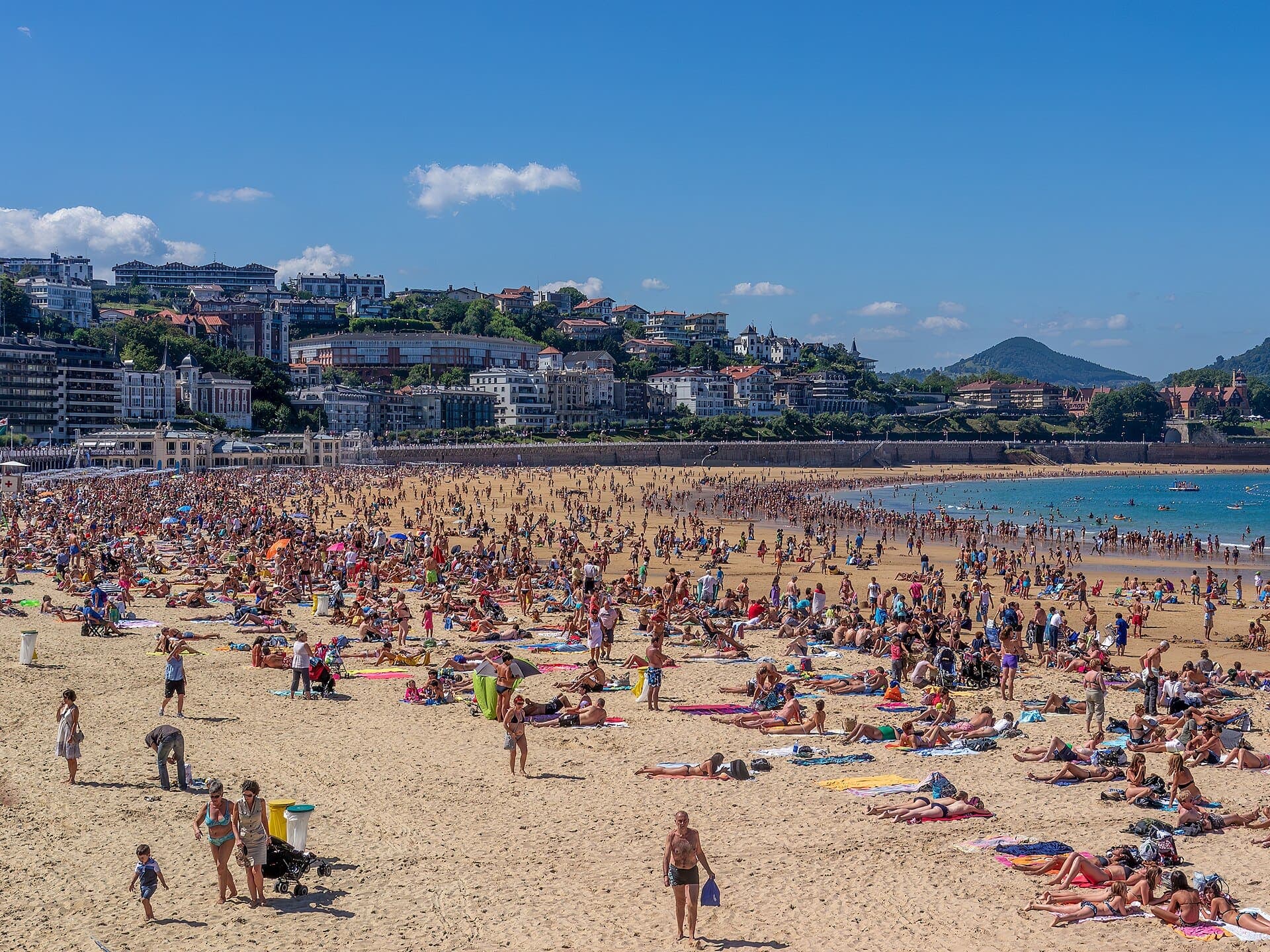
Anyone who has already done Barcelona and Madrid faces a Spain that changes radically every three hundred kilometres: the green, rainy Atlantic north, the Mediterranean Levante, stone Castile, and the islands, which are not one thing. Seven destinations covered by verified dossiers, and what separates them.
Basque Country: Bilbao and San Sebastián, an hour apart
Bilbao is the textbook case of a museum changing a city: the titanium Guggenheim on the river transformed an industrial port. But the part that surprises is free: the Azkuna Zentroa, a former wine warehouse gutted by Philippe Starck, with a walk-through atrium held up by 43 columns all different from each other; and the 1915 funicular that climbs Mount Artxanda in three minutes for the price of a bus ride.
The detail that saves money at the Guggenheim: from 4pm to 7pm the ticket drops by 50%.
San Sebastián is an hour away and is another matter: the Concha bay, the highest concentration of Michelin stars in the world and the Parte Vieja, capital of the pintxo. It costs more, €130-180 a day in mid-season against Bilbao's €110-160, and in September, with the Film Festival, it reaches €180-260.
Valencia: the best value of the big cities
Valencia is Spain's third city and costs less than the first two: €110-160 a day in mid-season. It has something no other has, the Turia Gardens: nine kilometres of continuous park in the bed of the river diverted after the 1957 flood, crossing the whole city and cycled end to end.
Two things worth the trip. The Lonja de la Seda, a UNESCO Gothic masterpiece, costs two euros and is free on Sundays and public holidays. And every Thursday at noon, in front of the cathedral's Apostles' Door, the Tribunal de las Aguas convenes: ten minutes, free, and the oldest court in Europe still functioning.
To avoid, unless it is what you are after: March. During the Fallas the budget rises to €160-230 and the city is full.
Toledo: the day trip to do in two
Toledo is half an hour by train from Madrid and is the most popular day trip in Spain, which is why the verified advice is the opposite: stay the night. When the coaches leave, the stone labyrinth on its spur in the arms of the Tagus changes completely.
The city of three cultures is not a slogan: the synagogue of Santa María la Blanca was built by Muslim craftsmen in Mudéjar style and later became a church. Horseshoe arches and white columns tell all three religions in one building. The Mezquita del Cristo de la Luz dates from the year 999 and takes five minutes to see.
The point from which Toledo looks like an El Greco is the Mirador del Valle, across the river: magnificent at sunset and at night.
Three islands that are nothing alike
Tenerife is a continent in miniature: a 3,715-metre volcano with snow, and beaches where you swim in January. It is the only one of the three with the seasons reversed: high season is winter, €100-170 a day between December and February, while from May to November it drops to €55-85.
Lanzarote is the island where an artist wrote the building rules: white houses, no billboards, no towers, and around them two hundred volcanic cones and vines grown in hollows of ash. Manrique's Casa Museo del Campesino is free to enter, and is the only one of his art centres that does not charge.
Menorca is the quiet sister of the Balearics: a Biosphere Reserve since 1993 and UNESCO-listed for its megaliths since 2023, with a 185-kilometre path around the island and coves reached only on foot or by shuttle. From €55-90 a day in low season.
How to combine them
The Basque Country is done as a pair, Bilbao and San Sebastián, with an hour by bus between them: four days is enough. Valencia and Toledo do not belong on the same itinerary (one is on the sea, the other half an hour from Madrid) and work better as extensions of different trips. The three islands are trips in themselves: Tenerife in winter, Menorca and Lanzarote between May and October, when the water is at its best and prices are far from the peak.