'Greece' means very different things depending on where you land: a volcanic island besieged by ships, a farming island that costs half as much, a Venetian harbour in Crete, or a second city that does not live off the sea at all. Below, six destinations covered by verified dossiers, and what actually separates them.
Santorini: the postcard, and its price
Santorini is the most photographed island in Greece and also the most pressured: on peak days up to 17,000 cruise passengers were arriving within a few hours, and since 2024 a daily cap has been trying to give the caldera rim some breathing space. The Oia sunset is watched in a crowd: that is a fact, not an opinion.
The budget confirms it: €150-250 a day in high season, the highest in the group. The two things almost no cruise passenger sees are Pyrgos, the inland village away from the caldera, and the Assyrtiko wineries between Megalochori and Akrotiri, where the vines are trained in baskets on the volcanic ground.
Indoors, and useful in the heat: the site of Akrotiri, the Minoan town buried by the eruption, with streets, multi-storey buildings and plumbing.
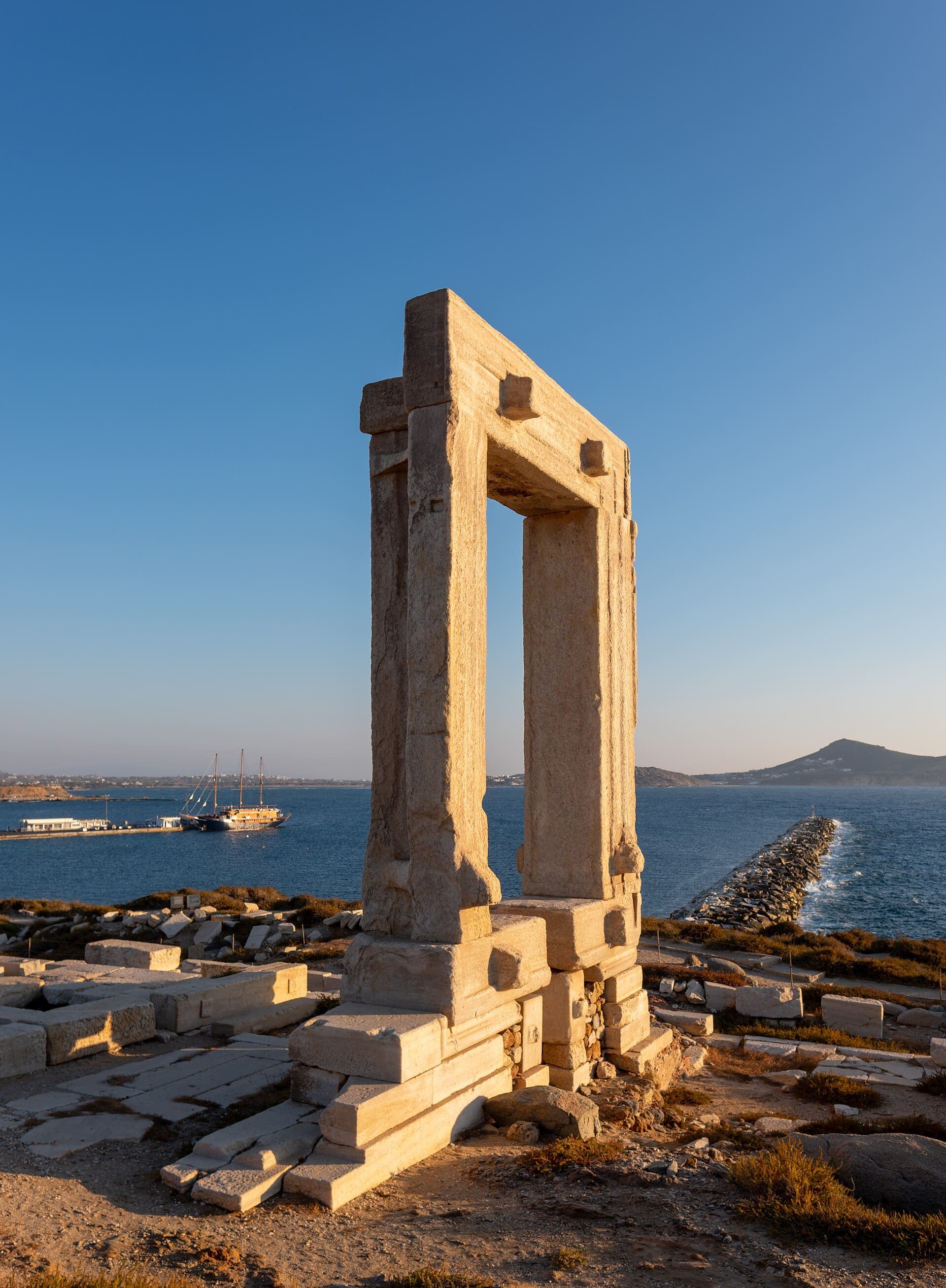
Naxos: the same Greece at half the price
Naxos is the largest and greenest of the Cyclades, and the numbers speak for themselves: €85-150 a day in high season against Santorini's €150-250. It has a thousand-metre mountain, marble villages and kilometres of shallow sand.
The gems are the kind that stay with you: the kouroi of Flerio and Apollonas, archaic statues up to ten metres long abandoned in the quarries where they cracked during carving, lying there for two and a half thousand years; and Alyko, a dune peninsula with the last juniper-cedar forest in the Cyclades and, in the middle, the shell of an unfinished hotel turned into a mural gallery.
Rhodes: medieval city and island to explore
Rhodes holds two things together: the largest inhabited medieval city in Europe behind four kilometres of walls, and an interior of castles and sites almost nobody visits. The hour you go out makes the difference, because the old town empties when the ships leave.
Off the circuit: Kamiros, a Hellenistic town excavated on a natural amphitheatre above the sea, readable like a full-size plan; and Prasonisi, the southern tip where a spit of sand separates two seas. The wind-ruffled Aegean on one side, the flat Mediterranean on the other.
Chania: western Crete, and the lagoons
Chania is the cheapest of the group: €65-100 a day in mid-season, €40-65 in low. It is a Venetian harbour with an Egyptian lighthouse and Ottoman lanes, and an hour's drive away are Balos and Elafonissi.
Worth noting: Seitan Limania, the zigzag fjord of white marble on the Akrotiri peninsula, with a steep ten-to-fifteen-minute descent that demands closed shoes; and the olive tree of Vouves, estimated between 2,000 and 4,000 years old and still producing.
Hydra: the island without engines
On Hydra there are no cars, scooters or bicycles: under a law from the 1950s, the only engine noise is the ferries. Transport is by mule, and that changes everything, including the luggage worth bringing.
It is a couple of hours from Athens and is the right choice for an island without taking a plane. The two-hour walk up to the Profitis Ilias monastery is done by almost no day visitor; the bathing platforms at Vlychos and Kamini, twenty to forty minutes on foot from the port, have clear water and no crowds.
Thessaloniki: the Greece that is not the sea
Thessaloniki is the alternative to all the rest: it lives not off islands but off layers. Roman ruins, Byzantine churches, Ottoman minarets and the memory of one of the largest Sephardic Jewish communities in Europe, told in the Jewish Museum. Almost entirely burnt in 1917 and rebuilt, it is now the country's food capital.
Ano Poli, the upper town, is the one quarter that escaped the fire: paved lanes, Ottoman houses and about four kilometres of Byzantine walls. It costs €70-110 a day in mid-season, and it works in every season, which is not true of the islands.
How to choose
If it is a first trip to Greece and you want the image, Santorini in May or late September, when there are fewer ships. If value and walking matter, Naxos. If you want sea and archaeology together, Rhodes. If you want Crete without days of driving, Chania. If you have few days and are starting from Athens, Hydra. And if the sea is not the point, Thessaloniki, which stays alive in winter while the islands shut.