Madrid, Spain
Photo: Carlos Delgado, Wikimedia Commons (CC BY-SA 3.0)
← All destinations

Madrid, Spain

Madrid has neither the sea nor a postcard-icon monument: it has a blinding light, daily rhythms shifted a few hours from the rest of Europe, and a unique ability to move from the Prado to a neighbourhood market without missing a beat.

✓ Sources checked on 28 September 202620 sources cited

What to see in Madrid?

16 places checked against the sources. The 5 gems the guidebooks skip come first, then the classics: every card has the hard facts on top and the why below.

On the map: yellow pins are the gems. Tap a pin to jump to its card.

✦ Hidden gems · off the standard guides

Lavapiés district
Other✦ gem

Lavapiés district

Entry
free

The district with the highest share of foreign-born residents in the city, immediately south of Sol. The centrepiece is the Tabacalera, the old tobacco factory on calle Embajadores: one part is a self-managed social centre covered in murals, the other holds photography exhibitions with free entry. Around it, Bangladeshi and Senegalese restaurants and the fringe theatres. It is also El Rastro's neighbourhood, so on Sunday mornings it changes face completely.

Photo: Marta Nimeva Nimeviene, Wikimedia Commons (CC BY 2.0)
El Capricho Park
Nature✦ gem

El Capricho Park

Entry
free

The detail that wrecks the trip: it opens only on Saturdays, Sundays and public holidays, 9am to 9pm from April to September and until 6.30pm from October to March. Entry is free. It is an 18th-century garden commissioned by the Duchess of Osuna, with a lake, a temple and a maze; beneath it lies the bunker of Posición Jaca, a Republican command post from the Civil War, visitable on free guided tours by booking, in groups of twenty.

Photo: LBM1948, Wikimedia Commons (CC BY-SA 4.0)
Carabanchel and the murals of Madrid's Soho
Other✦ gem

Carabanchel and the murals of Madrid's Soho

A former industrial district south of the centre, today the area with the highest concentration of contemporary art galleries in Madrid, installed in the disused warehouses. It is not a walk to improvise: the galleries keep office hours and close at the weekend, so it is worth checking what is open first. The large-format murals, on the other hand, are seen from the street at any hour. Metro line 5, Oporto or Vista Alegre.

Photo: Draceane, Wikimedia Commons (CC BY-SA 4.0)
Food✦ gem

Usera, Madrid's Chinatown

This is Madrid's Chinatown, on the south bank of the Manzanares, on metro line 6 (Usera stop) or line 3. The restaurants here do not do the adapted version: you find distinct regional kitchens (Sichuan, Zhejiang, Cantonese) and the menus often have a section written only in Chinese. At Lunar New Year the district hosts the city's biggest parade. It is off the tourist routes and the prices say so.

Templo de Debod
Monuments✦ gem

Templo de Debod

Hours
10:00-20:00

An Egyptian temple from the 2nd century BC, taken apart stone by stone and given to Spain in the 1970s for its help rescuing the Nubian temples threatened by the Aswan dam. Entry is free but only thirty people are let inside at a time, so there is a queue; it is closed every Monday, public holidays included, and opens Tuesday to Sunday 10am-8pm (until 7pm from 15 June to 15 September). The sunset, though, is watched from outside: that has neither queue nor opening hours.

Photo: Diego Delso, Wikimedia Commons (CC BY-SA 4.0)

The classics

Plaza Mayor
Monuments

Plaza Mayor

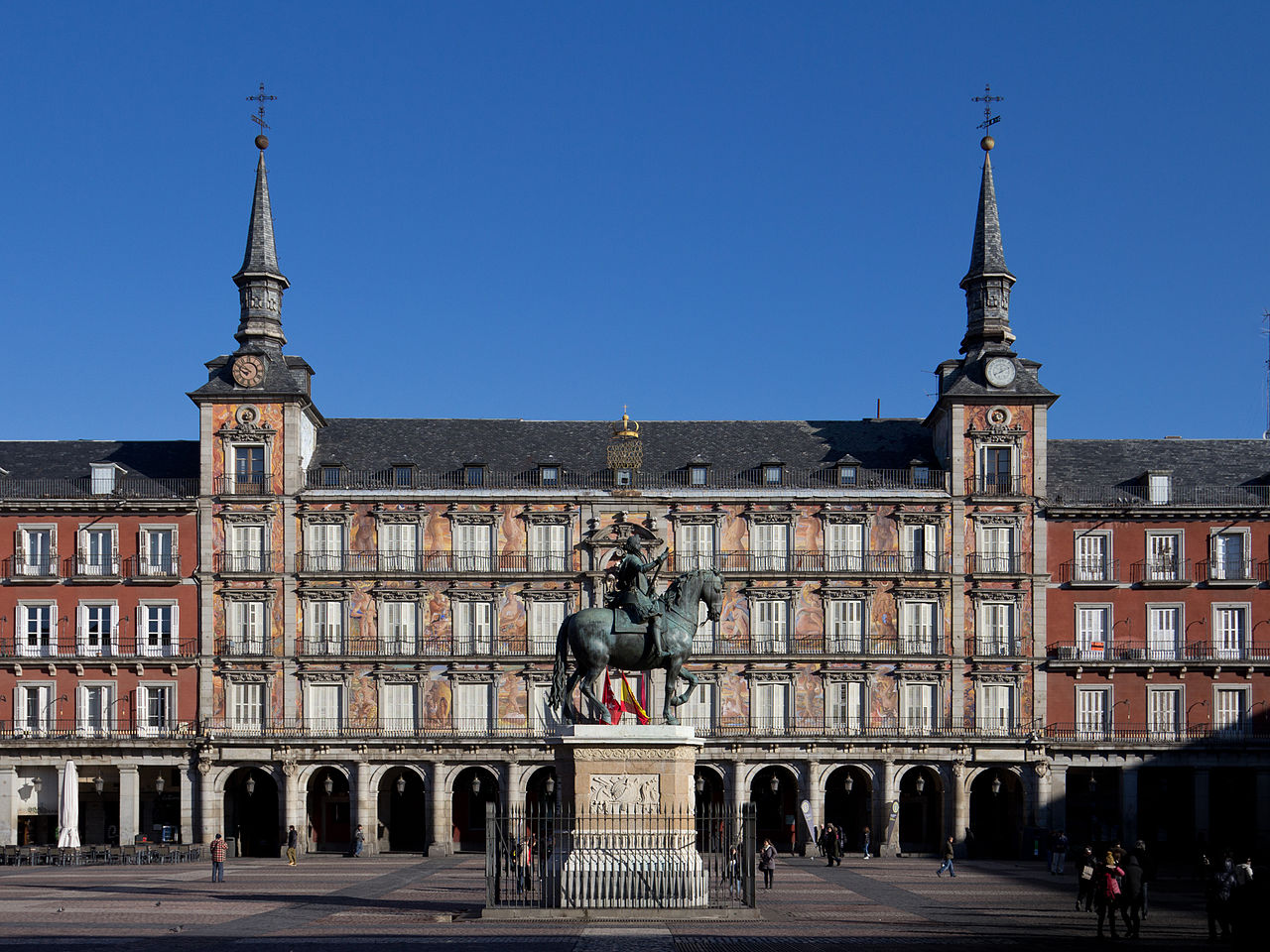
A public square, free and always walkable: what you pay for are the tables under the arcades, at the highest prices in the centre. It was closed on all four sides in the 17th century and rebuilt three times after as many fires, the last by Juan de Villanueva, the same architect as the Prado. The bars where you eat the calamari roll are not on the square but on the streets that wrap around it, towards the Cava de San Miguel: same thing, half the price.

Photo: Carlos Delgado, Wikimedia Commons (CC BY-SA 3.0)
Royal Palace (Palacio Real)
Monuments

Royal Palace (Palacio Real)

Hours
16:00-18:00

Eighteen euros, nine reduced, twenty-four with the Galería de las Colecciones Reales. Capacity is limited and box-office sales are cut back: buy online. Monday to Thursday the last two hours are free (4-6pm October to March, 5-7pm April to September), with last entry an hour before. The changing of the guard is watched free from outside on Wednesdays and Saturdays from 11am to 2pm (10am-noon in July and August), and on the first Wednesday of the month at noon there is the solemn relief, with horses and band. The Campo del Moro gardens are free.

Photo: Selbymay, Wikimedia Commons (CC BY-SA 3.0 es)
Retiro Park
Nature

Retiro Park

Entry
free

A hundred and fourteen free hectares, open 6am to midnight from April to September and 6am to 10pm from October to March; on days of strong wind the city closes it outright, and that happens more often than you would think. Rowing boats are hired on the lake. Watch out for the Palacio de Cristal: it is temporarily closed for building works, and guides still list it as a stop. When open, like the Palacio de Velázquez, it is free to enter.

Photo: Carlos Delgado, Wikimedia Commons (CC BY-SA 3.0)
Prado Museum
Museums

Prado Museum

Fifteen euros, €7.50 reduced, free for under-18s and for students between 18 and 25. The last two hours before closing are free (6pm to 8pm Monday to Saturday, 5pm to 7pm on Sundays), but those tickets are only handed out at the desk and run out once capacity is reached: there are none online. Entry runs on a timed pass and closes 30 minutes before the end. The €32.80 Paseo del Arte pass lasts a year and also covers the Reina Sofía and the Thyssen: it pays for itself on the second visit.

Photo: Vicente López Portaña, Wikimedia Commons (Public domain)
Reina Sofía Museum
Museums

Reina Sofía Museum

Closed
Tuesday

Twelve euros, and it is closed on Tuesdays, not Mondays like almost every European museum: the mistake that wastes the most afternoons in Madrid. Entry is free from 7pm to 9pm on Mondays and Wednesday to Saturday, and on Sundays from 12.30 to 2.30pm, but you still need a ticket, which can be booked online. Guernica is on the second floor of the Sabatini building; anyone who already has an online ticket gets in faster through the Nouvel building on Ronda de Atocha.

Photo: Ввласенко, Wikimedia Commons (CC BY-SA 3.0)
Gran Vía
Other

Gran Vía

Opened in 1910 and finished in 1931, it was a surgical cut through the old city: dozens of streets vanished to make room for it. Today it is the musicals street: the historic theatres run the same production for years, with weekday matinees far cheaper than evening shows. It is also the axis where pickpocketing concentrates, because it is the one place in Madrid where everyone walks looking upwards.

Photo: Tomascastelazo, Wikimedia Commons (CC BY-SA 4.0)
Mercado de San Miguel
Markets

Mercado de San Miguel

Open every day from 10am until midnight, and until 1am on Fridays, Saturdays and the eve of holidays; going in costs nothing. The iron-and-glass structure is from the early 20th century and the market was a wholesale one: today it is a couple of dozen food counters taking seven million visitors a year. Which is also the problem: you eat standing, packed in, at old-town prices. It works as a quick taste, not as dinner.

Photo: Javier Perez Montes, Wikimedia Commons (CC BY-SA 4.0)
El Rastro
Markets

El Rastro

It is held on Sundays and on public holidays, not only Sundays, from 9am to 3pm, with the stalls going up from 8am and coming down right after 3pm. Its heart is plaza de Cascorro and Ribera de Curtidores, in the Embajadores district. On weekdays the stalls are not there, but the area's antique shops and galleries stay open: that is how to see the same things without the crush.

Photo: Nicolas Vigier, Wikimedia Commons (CC0)
Food

Cocido madrileño

It is eaten in three courses and in this order: first the broth with fine noodles, then the chickpeas with the vegetables, then the meats. Asking for it all at once is considered a mistake. It is a winter dish that needs hours of cooking, so many old taverns make it only on certain days of the week and some want it ordered the day before: better to phone than to turn up and hope.

Food

Bocadillo de calamares

Madrid has no sea but it has Mercamadrid, one of the largest fish markets in Europe, which is why the city's signature sandwich is fried calamari. Order it in the bars around Plaza Mayor, not under the arcades: it costs half. It arrives bare, without sauces (lemon yes, mayonnaise is a concession to tourists) and it is eaten standing at the counter, as almost everything is here.

Food

Madrid-style tortilla de patatas

In Madrid it is served tall and still runny in the middle: if it arrives compact and dry, it is overcooked. The question that divides the country is 'with or without onion', and bars write it on the blackboard. It is ordered as a tapa alongside the house beer, the caña, which is a small glass precisely so it stays cold: asking for a large beer in a tapas bar is the quickest way to drink it warm.

How to plan your days in Madrid?

Three routes for different travel styles, built only from this dossier's verified places. Realistic pace: 2-3 stops a day.

First time

2 days

The landmark sights, at the right pace.

Day 1

  • Plaza Mayor

    A public square, free and always walkable: what you pay for are the tables under the arcades, at the highest prices in the centre. It was closed on all four sides in the 17th century and rebuilt three times after as many fires, the last by Juan de Villanueva, the same architect as the Prado. The bars where you eat the calamari roll are not on the square but on the streets that wrap around it, towards the Cava de San Miguel: same thing, half the price.

  • Royal Palace (Palacio Real)

    Eighteen euros, nine reduced, twenty-four with the Galería de las Colecciones Reales. Capacity is limited and box-office sales are cut back: buy online. Monday to Thursday the last two hours are free (4-6pm October to March, 5-7pm April to September), with last entry an hour before. The changing of the guard is watched free from outside on Wednesdays and Saturdays from 11am to 2pm (10am-noon in July and August), and on the first Wednesday of the month at noon there is the solemn relief, with horses and band. The Campo del Moro gardens are free.

  • Prado Museum

    Fifteen euros, €7.50 reduced, free for under-18s and for students between 18 and 25. The last two hours before closing are free (6pm to 8pm Monday to Saturday, 5pm to 7pm on Sundays), but those tickets are only handed out at the desk and run out once capacity is reached: there are none online. Entry runs on a timed pass and closes 30 minutes before the end. The €32.80 Paseo del Arte pass lasts a year and also covers the Reina Sofía and the Thyssen: it pays for itself on the second visit.

Day 2

  • Reina Sofía Museum

    Twelve euros, and it is closed on Tuesdays, not Mondays like almost every European museum: the mistake that wastes the most afternoons in Madrid. Entry is free from 7pm to 9pm on Mondays and Wednesday to Saturday, and on Sundays from 12.30 to 2.30pm, but you still need a ticket, which can be booked online. Guernica is on the second floor of the Sabatini building; anyone who already has an online ticket gets in faster through the Nouvel building on Ronda de Atocha.

  • Retiro Park

    A hundred and fourteen free hectares, open 6am to midnight from April to September and 6am to 10pm from October to March; on days of strong wind the city closes it outright, and that happens more often than you would think. Rowing boats are hired on the lake. Watch out for the Palacio de Cristal: it is temporarily closed for building works, and guides still list it as a stop. When open, like the Palacio de Velázquez, it is free to enter.

  • Gran Vía

    Opened in 1910 and finished in 1931, it was a surgical cut through the old city: dozens of streets vanished to make room for it. Today it is the musicals street: the historic theatres run the same production for years, with weekday matinees far cheaper than evening shows. It is also the axis where pickpocketing concentrates, because it is the one place in Madrid where everyone walks looking upwards.

Off the beaten path

2 days

Hidden gems away from the usual circuits.

Day 1

  • Lavapiés district✦ hidden gem

    The district with the highest share of foreign-born residents in the city, immediately south of Sol. The centrepiece is the Tabacalera, the old tobacco factory on calle Embajadores: one part is a self-managed social centre covered in murals, the other holds photography exhibitions with free entry. Around it, Bangladeshi and Senegalese restaurants and the fringe theatres. It is also El Rastro's neighbourhood, so on Sunday mornings it changes face completely.

  • El Capricho Park✦ hidden gem

    The detail that wrecks the trip: it opens only on Saturdays, Sundays and public holidays, 9am to 9pm from April to September and until 6.30pm from October to March. Entry is free. It is an 18th-century garden commissioned by the Duchess of Osuna, with a lake, a temple and a maze; beneath it lies the bunker of Posición Jaca, a Republican command post from the Civil War, visitable on free guided tours by booking, in groups of twenty.

  • Carabanchel and the murals of Madrid's Soho✦ hidden gem

    A former industrial district south of the centre, today the area with the highest concentration of contemporary art galleries in Madrid, installed in the disused warehouses. It is not a walk to improvise: the galleries keep office hours and close at the weekend, so it is worth checking what is open first. The large-format murals, on the other hand, are seen from the street at any hour. Metro line 5, Oporto or Vista Alegre.

Day 2

  • Usera, Madrid's Chinatown✦ hidden gem

    This is Madrid's Chinatown, on the south bank of the Manzanares, on metro line 6 (Usera stop) or line 3. The restaurants here do not do the adapted version: you find distinct regional kitchens (Sichuan, Zhejiang, Cantonese) and the menus often have a section written only in Chinese. At Lunar New Year the district hosts the city's biggest parade. It is off the tourist routes and the prices say so.

  • Templo de Debod✦ hidden gem

    An Egyptian temple from the 2nd century BC, taken apart stone by stone and given to Spain in the 1970s for its help rescuing the Nubian temples threatened by the Aswan dam. Entry is free but only thirty people are let inside at a time, so there is a queue; it is closed every Monday, public holidays included, and opens Tuesday to Sunday 10am-8pm (until 7pm from 15 June to 15 September). The sunset, though, is watched from outside: that has neither queue nor opening hours.

Food & markets

2 days

Eat and drink where locals actually go.

Day 1

  • Usera, Madrid's Chinatown✦ hidden gem

    This is Madrid's Chinatown, on the south bank of the Manzanares, on metro line 6 (Usera stop) or line 3. The restaurants here do not do the adapted version: you find distinct regional kitchens (Sichuan, Zhejiang, Cantonese) and the menus often have a section written only in Chinese. At Lunar New Year the district hosts the city's biggest parade. It is off the tourist routes and the prices say so.

  • Cocido madrileño

    It is eaten in three courses and in this order: first the broth with fine noodles, then the chickpeas with the vegetables, then the meats. Asking for it all at once is considered a mistake. It is a winter dish that needs hours of cooking, so many old taverns make it only on certain days of the week and some want it ordered the day before: better to phone than to turn up and hope.

  • Bocadillo de calamares

    Madrid has no sea but it has Mercamadrid, one of the largest fish markets in Europe, which is why the city's signature sandwich is fried calamari. Order it in the bars around Plaza Mayor, not under the arcades: it costs half. It arrives bare, without sauces (lemon yes, mayonnaise is a concession to tourists) and it is eaten standing at the counter, as almost everything is here.

Day 2

  • Madrid-style tortilla de patatas

    In Madrid it is served tall and still runny in the middle: if it arrives compact and dry, it is overcooked. The question that divides the country is 'with or without onion', and bars write it on the blackboard. It is ordered as a tapa alongside the house beer, the caña, which is a small glass precisely so it stays cold: asking for a large beer in a tapas bar is the quickest way to drink it warm.

  • Mercado de San Miguel

    Open every day from 10am until midnight, and until 1am on Fridays, Saturdays and the eve of holidays; going in costs nothing. The iron-and-glass structure is from the early 20th century and the market was a wholesale one: today it is a couple of dozen food counters taking seven million visitors a year. Which is also the problem: you eat standing, packed in, at old-town prices. It works as a quick taste, not as dinner.

  • El Rastro

    It is held on Sundays and on public holidays, not only Sundays, from 9am to 3pm, with the stalls going up from 8am and coming down right after 3pm. Its heart is plaza de Cascorro and Ribera de Curtidores, in the Embajadores district. On weekdays the stalls are not there, but the area's antique shops and galleries stay open: that is how to see the same things without the crush.

🧭

Build your itinerary

Tell us how many days you're staying and in which month: we'll compose an itinerary from this dossier's verified places, with notes about the period.

Your itinerary

1

Day 1

  • Plaza Mayor

    A public square, free and always walkable: what you pay for are the tables under the arcades, at the highest prices in the centre. It was closed on all four sides in the 17th century and rebuilt three times after as many fires, the last by Juan de Villanueva, the same architect as the Prado. The bars where you eat the calamari roll are not on the square but on the streets that wrap around it, towards the Cava de San Miguel: same thing, half the price.

  • Royal Palace (Palacio Real)

    Eighteen euros, nine reduced, twenty-four with the Galería de las Colecciones Reales. Capacity is limited and box-office sales are cut back: buy online. Monday to Thursday the last two hours are free (4-6pm October to March, 5-7pm April to September), with last entry an hour before. The changing of the guard is watched free from outside on Wednesdays and Saturdays from 11am to 2pm (10am-noon in July and August), and on the first Wednesday of the month at noon there is the solemn relief, with horses and band. The Campo del Moro gardens are free.

  • Mercado de San Miguel

    Open every day from 10am until midnight, and until 1am on Fridays, Saturdays and the eve of holidays; going in costs nothing. The iron-and-glass structure is from the early 20th century and the market was a wholesale one: today it is a couple of dozen food counters taking seven million visitors a year. Which is also the problem: you eat standing, packed in, at old-town prices. It works as a quick taste, not as dinner.

2

Day 2

  • Prado Museum

    Fifteen euros, €7.50 reduced, free for under-18s and for students between 18 and 25. The last two hours before closing are free (6pm to 8pm Monday to Saturday, 5pm to 7pm on Sundays), but those tickets are only handed out at the desk and run out once capacity is reached: there are none online. Entry runs on a timed pass and closes 30 minutes before the end. The €32.80 Paseo del Arte pass lasts a year and also covers the Reina Sofía and the Thyssen: it pays for itself on the second visit.

  • Reina Sofía Museum

    Twelve euros, and it is closed on Tuesdays, not Mondays like almost every European museum: the mistake that wastes the most afternoons in Madrid. Entry is free from 7pm to 9pm on Mondays and Wednesday to Saturday, and on Sundays from 12.30 to 2.30pm, but you still need a ticket, which can be booked online. Guernica is on the second floor of the Sabatini building; anyone who already has an online ticket gets in faster through the Nouvel building on Ronda de Atocha.

  • El Rastro

    It is held on Sundays and on public holidays, not only Sundays, from 9am to 3pm, with the stalls going up from 8am and coming down right after 3pm. Its heart is plaza de Cascorro and Ribera de Curtidores, in the Embajadores district. On weekdays the stalls are not there, but the area's antique shops and galleries stay open: that is how to see the same things without the crush.

3

Day 3

  • Gran Vía

    Opened in 1910 and finished in 1931, it was a surgical cut through the old city: dozens of streets vanished to make room for it. Today it is the musicals street: the historic theatres run the same production for years, with weekday matinees far cheaper than evening shows. It is also the axis where pickpocketing concentrates, because it is the one place in Madrid where everyone walks looking upwards.

  • Retiro Park

    A hundred and fourteen free hectares, open 6am to midnight from April to September and 6am to 10pm from October to March; on days of strong wind the city closes it outright, and that happens more often than you would think. Rowing boats are hired on the lake. Watch out for the Palacio de Cristal: it is temporarily closed for building works, and guides still list it as a stop. When open, like the Palacio de Velázquez, it is free to enter.

  • Cocido madrileño

    It is eaten in three courses and in this order: first the broth with fine noodles, then the chickpeas with the vegetables, then the meats. Asking for it all at once is considered a mistake. It is a winter dish that needs hours of cooking, so many old taverns make it only on certain days of the week and some want it ordered the day before: better to phone than to turn up and hope.

Want an itinerary tailored to your dates in Madrid?

Travel dates, where you stay and the kind of trip: we tailor this same verified dossier to your exact needs.

Coming soon
Plaza Mayor at sunset, when the golden light sets the baroque facades alight and the arcades fill with life.
Plaza Mayor at sunset, when the golden light sets the baroque facades alight and the arcades fill with life.Photo: Marek Ślusarczyk (Tupungato) Photo portfolio, Wikimedia Commons (CC BY 3.0)

What to know before going to Madrid?

Recurring scams and local rules worth knowing before you arrive.

⚠ Scams to know

The 'lucky rosemary' offered by older women

medium confidence

Groups of women approach tourists offering a sprig of rosemary and to read your palm, then insistently demand a payment of €5-20

How to avoid it: Refuse with a firm 'no thank you' and don't take anything in hand, even if it looks like a free gift; while you're distracted by the sprig or the palm reading, an accomplice can pick your pocket

Source

Fake plain-clothes police officers

medium confidence

People showing fake police badges, especially at night with tourists who have been drinking, ask to check your wallet and documents to then take cash

How to avoid it: Always ask to see the official ID and, if in doubt, suggest going together to the nearest police station; Spanish police rarely ask to check your wallet in the street

Source

Fake charity petitions near the Retiro and the Royal Palace

low confidence

A group distracts the tourist by having them sign a petition while an accomplice picks backpacks and pockets

How to avoid it: Don't stop to sign anything in the street, keep bags and backpacks closed and in front of you in crowded areas

Source

'Broken' taxi meter, especially from the airport

medium confidence

Some drivers claim the meter is broken and offer an inflated fixed fare, different from the official capped one

How to avoid it: Remember the official fixed airport-centre fare (inside the M-30) is €33 all-inclusive; if the meter really is off, change taxis

Source

⚖ Laws & penalties

Ban on drinking alcohol in the street (botellón)

high riskverified

The new municipal ordinance provides fines of up to €2,000 for botellón, on top of penalties for littering; according to other legal sources, fines for drinking alcohol in public in the Comunidad de Madrid can range from €500 (minors) and from €600 (adults) under the regional framework.

Source

Low Emission Zone (ZBE) Madrid Centro - Madrid 360

high riskverified

Since 1 January 2025, 'A'-rated vehicles (the oldest and most polluting) are banned across the whole urban area of Madrid. A breach is a serious offence fined €200 (€100 if paid promptly). Foreign vehicles must register via the official portal or risk a fine as if they had no environmental sticker.

Source

Ban on urinating in the street

high riskverified

Urinating in public in Madrid is a serious offence under art. 87 of the Cleanliness of Public Spaces and Waste Management Ordinance, fined €751 (reducible with immediate payment or commutable to 20 hours of community service). The Policía Municipal issues hundreds of fines a year, concentrated in the Centro.

Source

Ban on busking or offering tours without a licence

medium riskmedium confidence

The UK official advice for Spain states that drinking alcohol in the street is illegal in some areas of the country and carries an on-the-spot fine, and that in some areas it is illegal to be in the street in swimwear or bare-chested. It is not a uniform national ban: it depends on the municipal ordinance, and tourist municipalities enforce it. In Madrid the botellón, group drinking in the street, is penalised under the municipal ordinance.

Source

Foreign plates and the ZBE: registration required to avoid automatic fines

medium riskmedium confidence

The ZBE cameras only read the plate and compare it against the municipal database: a foreign car not registered is treated as 'without a sticker' even if it displays an environmental badge valid in its home country, with a €200 fine.

Source

No tourist tax in Madrid

low riskverified

In 2026 Madrid charges no tourist tax, neither municipal nor regional: the City Council has no power to introduce one on its own and voted it down on 25 June 2024, and the Comunidad de Madrid repeated in July 2026 that it does not intend to create one. If a property charges one, it is not a tax.

Source
The neoclassical pavilion of El Capricho Park, a corner of Madrid's Versailles that very few tourists discover.
The neoclassical pavilion of El Capricho Park, a corner of Madrid's Versailles that very few tourists discover.Photo: Benjamín Núñez González, Wikimedia Commons (CC BY-SA 4.0)

What happens in Madrid through the year?

Hover over a month on the timeline for details.

How much do you spend in Madrid, and when to go?

Jan
Feb
Mar
Apr
May
Jun
Jul
Aug
Sep
Oct
Nov
Dec
  • low55-80€per day
  • mid80-120€per day
  • high120-180€per day

When it works best, by type of trip

Culture and museumsMarch-May, October

Mild temperatures and more manageable queues at the Art Triangle than in the summer months.

Festivals and local lifeMay

The Fiestas de San Isidro bring the city to life with over 200 free events and the most authentically Madrid atmosphere of the year.

BudgetJanuary-February

Lower hotel rates after the Christmas holidays, cool weather but rarely forbidding.

Rough estimate (lodging + meals + local transport), not a precise verified source.

✦

Did you know... Madrid's oldest restaurant, Sobrino de Botín, is certified by Guinness World Records as the oldest restaurant in the world still operating, open since 1725.

How to get to Madrid and around?

No car neededSince 1 January 2025 the 'Madrid Centro' Low Emission Zone (ZBE) bans 'A'-rated vehicles (the most polluting) across the entire urban area; foreign vehicles not registered in the system are treated as having no environmental sticker and risk automatic camera fines.

An integrated network of Metro de Madrid (13 lines), EMT buses and Cercanías (regional trains). A single metro ticket in zone A costs €1.50 to €2 depending on the number of stations, an EMT bus €1.50; the 10-ride Metrobús carnet costs €7.30 with the 40% discount in force until 31 December 2026. You need the Tarjeta Multi (€2.50, non-refundable) to load tickets onto; for the airport a supplement is added. The zone A tourist pass starts at €10.30 for one day and includes the airport supplement.

  • Buy the Tarjeta Multi at metro machines to skip the ticket-office queues
  • If you rent a car, register it for the ZBE Distrito Centro via the City Council's official portal (zbedistritocentro@madrid.es), or you risk a €200 fine (€100 if paid in time)
  • From Barajas airport to the city centre (inside the M-30) there's a fixed taxi fare of €33, valid 24/7, with no night or holiday surcharges
  • Avoid taxis that claim the meter is 'broken' and offer a fixed fare different from the official one: refuse and find another
Is Madrid safe?

⚠ Areas to avoid

  • The Malasaña, Lavapiés and Chueca districts at night: lively and safe by day, but with drug dealing and borderline activity in the late hours
  • Crowded areas around the Art Triangle (Prado, Thyssen, Reina Sofía) and on public transport for the pickpocketing risk

Good to know

  • Pickpocketing is the most common risk for tourists in Madrid, more than violent crime
  • Don't leave bags hanging on chairs in bars and restaurants, especially in the central tourist areas
  • Watch out for the 'pigeon-poop scam': someone offers to clean your clothes and then robs you while you're distracted
  • Enrol in the STEP programme (for US citizens) or check your embassy's alerts for safety updates
Source

Frequently asked questions about Madrid

Short answers drawn from the verified data of this dossier: details and sources are in the sections above.

How much does a day in Madrid cost?

Season low (January-February, November): 55-80€ per day; Season mid (March-May, September-October): 80-120€ per day; Season high (June-August, December): 120-180€ per day.

When to go to Madrid?

Culture and museums: March-May, October. Mild temperatures and more manageable queues at the Art Triangle than in the summer months. Festivals and local life: May. The Fiestas de San Isidro bring the city to life with over 200 free events and the most authentically Madrid atmosphere of the year. Budget: January-February. Lower hotel rates after the Christmas holidays, cool weather but rarely forbidding.

Is Madrid safe?

The Malasaña, Lavapiés and Chueca districts at night: lively and safe by day, but with drug dealing and borderline activity in the late hours Pickpocketing is the most common risk for tourists in Madrid, more than violent crime

Do you need a car in Madrid?

No. Since 1 January 2025 the 'Madrid Centro' Low Emission Zone (ZBE) bans 'A'-rated vehicles (the most polluting) across the entire urban area; foreign vehicles not registered in the system are treated as having no environmental sticker and risk automatic camera fines.

How do you get to Madrid?

An integrated network of Metro de Madrid (13 lines), EMT buses and Cercanías (regional trains). A single metro ticket in zone A costs €1.50 to €2 depending on the number of stations, an EMT bus €1.50; the 10-ride Metrobús carnet costs €7.30 with the 40% discount in force until 31 December 2026. You need the Tarjeta Multi (€2.50, non-refundable) to load tickets onto; for the airport a supplement is added.

Which hidden gems to see in Madrid, off the guidebooks?

Lavapiés district, El Capricho Park, Carabanchel and the murals of Madrid's Soho, Usera, Madrid's Chinatown, Templo de Debod.

Which scams to avoid in Madrid?

The 'lucky rosemary' offered by older women; Fake plain-clothes police officers; Fake charity petitions near the Retiro and the Royal Palace; 'Broken' taxi meter, especially from the airport.

Sources

Every source below was opened and read, not just cited. Entries that didn't hold up were downgraded to "low confidence" or dropped, not presented as certain.

Related destinations

Other dossiers close by country, area or kind of trip.