Budapest is the choice for those who want a big capital: the thermal baths, the ruin bars, the Danube down the middle, and it costs less in every season. Krakow is the choice for those who want a compact medieval centre, a slower pace and two day trips that justify the journey on their own, Auschwitz-Birkenau and the Wieliczka salt mine. The two cities are 524 kilometres apart by road, more than six hours: on a long weekend you do one, which is the point of this article. The numbers come from the two verified dossiers, per person per day, flights excluded.
What they cost, season by season
Budapest costs €35-55 a day in low season (January-March), €55-85 in mid season (April-May and September-October) and €85-125 in high season (June-August and December). Krakow costs €45-75 in low season (January-March outside the holidays, and November), €75-120 in mid season (April-June and September-October) and €120-180 in high season, which means July, August and the Christmas-market December. Krakow is dearer in every season, and the gap widens exactly when people travel: in summer and at Christmas the difference reaches €50 a day.
Then there are the fixed items. In Budapest the tourist tax is 4% of the room price, collected on the spot; Krakow has none, since 2016, because Polish law only allows it in municipalities meeting climate criteria the city doesn't, and in 2026 nothing appears on the bill. Transport costs the same: in Budapest a single ticket is 500 forints (about €1.25) bought in advance or in the BudapestGO app, 700 from the driver, the 24-hour pass 2,750; in Krakow the 20-minute ticket is 4 złoty (about €1), and over-70s ride free. Attractions weigh more in Krakow: Schindler's Factory costs 60 złoty, the Rynek Underground 45, and both are timed-entry with slots selling out days ahead in high season. In Budapest the big spend is the Széchenyi baths, 13,200 forints Monday to Thursday and 15,800 at peak times, but anyone in by 9:00 on a weekday pays 10,500 for the same pools.
How much time you need
Budapest fills three days without leaving the city: half a day at the baths, the Parliament with its 45-minute guided tour (one language per time slot, and most of the next day's slots show as sold out: booking on arrival is almost always too late), Castle Hill with the Fishermen's Bastion, whose lower terraces are free at any hour, the Jewish quarter with the Great Synagogue (closed on Saturdays, the most common planning mistake) and Margaret Island to breathe. Anyone with a fourth day spends it on the Danube or at the Szemlőhegy cave, where there is nobody.
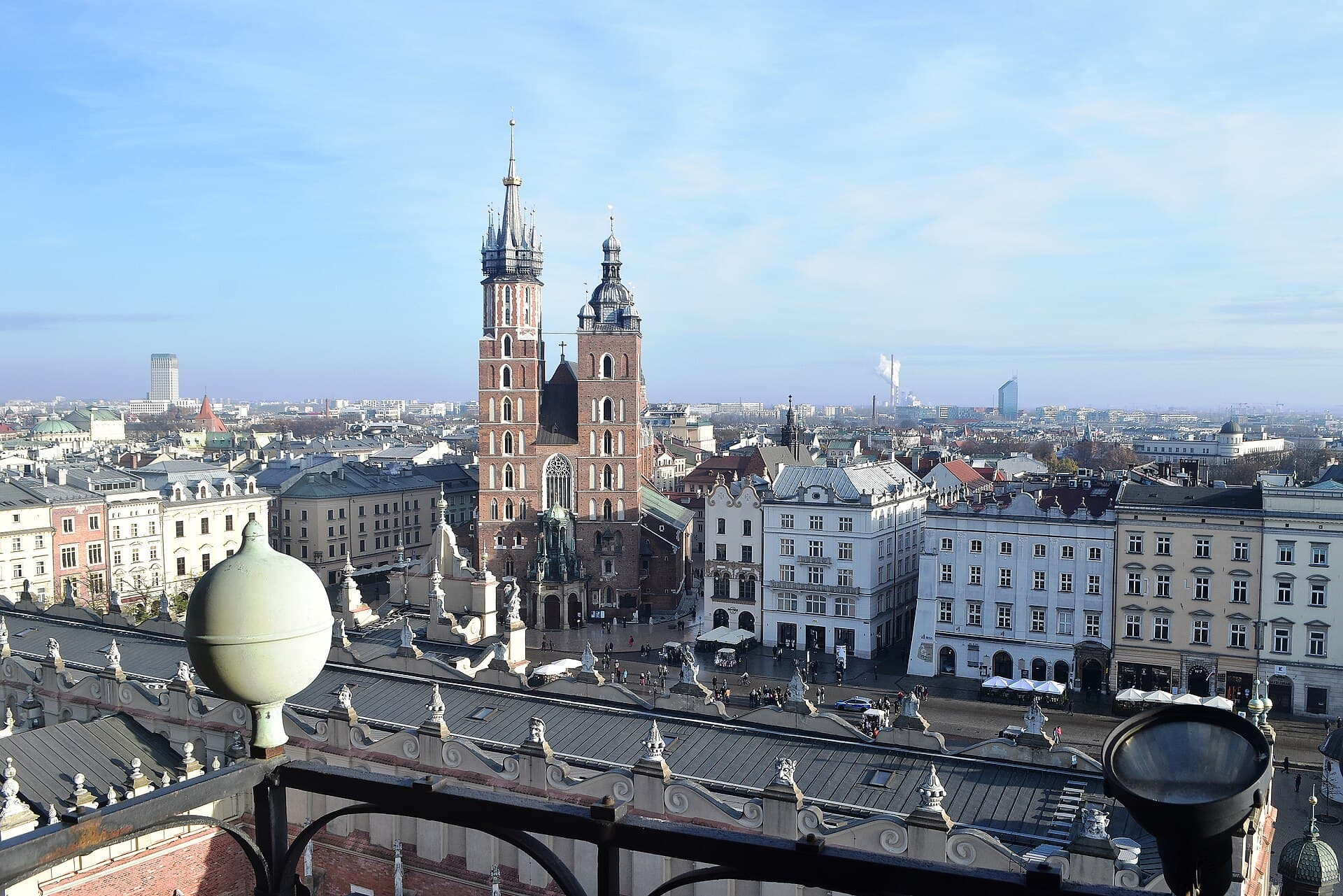
Krakow takes two days: the old town sits inside the Planty ring and is walked, with the Rynek two hundred metres a side, St Mary's Basilica (tourist entry 20 złoty, with the altar opened at 11:50) and Wawel, where the courtyards are free and the exhibitions have a daily cap that sells out in peak months. The second day is for Kazimierz and Podgórze, with Schindler's Factory asking at least 90 minutes. The third day, though, is not in the city: Auschwitz-Birkenau, free to enter but with compulsory time-slot booking in high season, or Wieliczka. This is where Krakow wins on time: three full days with a trip that has no equivalent.
Scams and safety: where you need more care
On this point the two dossiers are not level. Budapest has the heaviest scam profile among Central European cities: the bars in District V and on Váci utca where inviting women get you to sign bills for hundreds or thousands of euros for a few drinks, with payment forced at a cash machine; the 'hyena' taxis with a correct meter and a card terminal that adds figures; the restaurants with an undeclared service charge. The defences are simple and the dossier lists them: taxis only via Bolt or Uber, and at the airport only from the Főtaxi kiosks; in Budapest the taxi fare is fixed by law, 1,100 forints base and 440 per kilometre, so any 'fixed price' offered verbally is already a warning. Crossing outside the zebra is fined.
Krakow is a very safe city, and the risks are pickpocketing on the Rynek and on crowded trams and the pub-crawl and strip-club touts around the square, who lead to venues with inflated card bills at the end of the night. The British advisory adds something serious about unofficial taxis: beyond inflated fares, there have been assaults, including sexual violence, in unlicensed taxis and in cars booked through apps: check that the plate and driver match. And keep in mind that drinking alcohol in the street is banned in Poland, with on-the-spot fines of 100 to 500 złoty.
What you only find there
In Budapest there are the baths inside a neo-baroque palace, which under snow are something else; Szimpla Kert in the afternoon, when you wander it like an abandoned building with bathtubs for sofas, before it turns into a queue at 21:00; the M1 metro, the oldest on the European mainland, ridden with an ordinary ticket; the lángos from the covered markets, the cheap lunch par excellence. In Krakow there are the hejnał sounding from the tower every hour and stopping mid-note, the dragon's den under Wawel, Nowa Huta, the socialist city half an hour away by tram that explains Poland's twentieth century without a museum, the flooded Zakrzówek quarry where locals rather than tourists go in summer, and the obwarzanek from the blue carts, which may only bear that name if made in Krakow.
Which season
Budapest works all year because the baths work all year, and January-March is when it costs least. Krakow in January-March has prices at their lowest but snow and hard frosts, and its real season is May-June and September, with the terraces on the Rynek. December is high season in both for the markets, but in Krakow it rises to €120-180 against Budapest's €85-125. In August Budapest has Sziget, with accommodation and transport saturated for a week, and on 20 August the fireworks on the Danube close the streets of the centre.
In short
If we had to reduce the choice to one line per profile:
- Budget: Budapest, cheaper in every season, even counting its 4% tourist tax against none at all in Krakow
- Three nights in one city without moving: Budapest, which fills three days on its own
- A trip with Auschwitz or Wieliczka: Krakow, with the day trip booked before you leave
- Winter: Budapest for the baths under snow; Krakow only if the cold doesn't bother you, with prices at their lowest