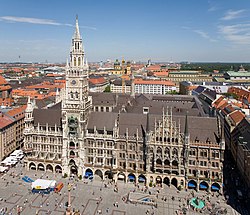
Wrocław, Lower Silesia
Photo: Maksym Kozlenko, Wikimedia Commons (CC BY-SA 4.0)
← All destinations

Wrocław, Lower Silesia

A city that was German under the name Breslau, almost entirely destroyed in 1945 and reborn Polish, with one of the largest medieval squares in Europe. And then there are them: over a thousand bronze gnomes hidden through the streets, heirs to a brilliant anti-communist protest of the 1980s.

✓ Sources verified by hand on 2026-06-305 sources cited

What to see

Rynek and Gothic Town Hall

One of the largest medieval market squares in Europe, surrounded by colourful houses, with the richly decorated Gothic town hall at its centre. The city's drawing room, alive at every hour.

✦ Hidden gems — off the standard guides

Ostrów Tumski (Cathedral Island)

The city's oldest core, with the cathedral and the gas lamps lit by hand every evening at sunset by a costumed lamplighter: one of the most romantic corners of Poland.

Hala Stulecia (Centennial Hall)

A masterpiece of early-1900s reinforced-concrete architecture, a UNESCO site, with its huge dome and surrounding park with a multimedia fountain. Outside the old town, often uncrowded.

Panorama Racławicka

A 360° panoramic painting 114 metres long depicting the Battle of Racławice: you step inside the scene in a purpose-built rotunda. An unusual experience, book the ticket.

University and the Leopoldina Hall

The baroque hall of the University of Wrocław is one of the most sumptuous rooms in Poland, with stucco, frescoes and statues: a hidden treasure steps from the Rynek.

Want an itinerary tailored to your dates in Wrocław?

Travel dates, where you stay and the kind of trip — we tailor this same verified dossier to your exact needs.

Coming soon
One of the over a thousand bronze gnomes (krasnale) hidden through the streets of Wrocław, heirs to the Orange Alternative protest.
One of the over a thousand bronze gnomes (krasnale) hidden through the streets of Wrocław, heirs to the Orange Alternative protest.Photo: Julo, Wikimedia Commons (Public domain)

Before you go

Recurring scams and local rules worth knowing before you arrive.

⚠ Scams to know

Changing money at the kantor/independent ATMs in the centre

medium confidence

The most touristy exchanges and non-bank ATMs (often Euronet-branded) offer unfavourable rates and fees, and propose charging in euros (DCC) which worsens the rate.

How to avoid it: Pay in złoty by card and, at the ATMs of the big Polish banks, always choose to withdraw 'without conversion' (in PLN).

Source

Sticking to the Rynek without exploring Ostrów Tumski and the university

low confidence

Many stay only in the main square and leave: this way you miss the Cathedral Island with its gas lamps, the Leopoldina Hall and the Centennial Hall, the city's real depth.

How to avoid it: Give it at least a full day and an extra half-day: tie together the Rynek, Ostrów Tumski at sunset and a trip to the Hala Stulecia.

Source

⚖ Laws & penalties

Requirement to validate the ticket on trams and buses

low riskmedium confidence

The public-transport ticket must be validated on board (or bought in an app) at the start of the trip: without validation you're considered ticketless and risk a fine, applied to tourists too.

Source

Drinking alcohol in the street banned

medium riskmedium confidence

Drinking alcohol in public spaces (squares, parks, streets, transport) is banned in Poland, allowed only in licensed venues and outdoor seating. A breach incurs on-the-spot fines of about 100 to 500 PLN, confiscation of the alcohol and, in serious cases, a summons before the municipal court.

Source
Ostrów Tumski, Cathedral Island: the city's oldest core, still lit by gas lamps lit by hand.
Ostrów Tumski, Cathedral Island: the city's oldest core, still lit by gas lamps lit by hand.Photo: Jar.ciurus, Wikimedia Commons (CC BY-SA 3.0 pl)

Recurring events

Hover over a month on the timeline for details.

Budget & timing

Average daily cost

Season low (November-March (excluding the Christmas period))45-70€
Season mid (April-May, September-October)60-95€
Season high (June-August, Christmas market)85-130€

Rough estimate (lodging + meals + local transport), not a precise verified source.

Best time by type of trip

Better weather and an outdoor city May-September

Long, warm days for the gnome hunt, the boats on the Oder and the Rynek terraces; the liveliest period, with the most events.

Christmas atmosphere Late November-December

Wrocław's Christmas market is among the finest in Poland; intense cold but a scenic square and lights everywhere.

Budget and quiet January-March

Lower prices and a less touristy city; cold, damp weather, but museums, covered markets and venues always open.

Did you know... Until 1945 the city was German and called Breslau: almost destroyed as 'Festung Breslau' in the last months of the war, it was then rebuilt and repopulated by Poles, many from Lviv.

Getting around

Car recommended: No — The old town is compact and pedestrian: a car isn't needed and in the city it meets partial limited-traffic zones and pricey parking. To explore the Rynek, Ostrów Tumski and the university, walking is enough.

Wrocław has a dense network of trams and buses (MPK): handy for reaching the Centennial Hall and the outer districts. Tickets are bought at machines or in an app and must be validated on board. From the airport, direct buses to the centre.

  • In Poland you pay in złoty (PLN), not euros: use a fee-free card and, if withdrawing, always choose to be charged in złoty to avoid unfavourable rates.
  • Get a gnome map or app (some free, or the paper map at the Rynek info point): without one you'll find only a small fraction.
  • Go to Ostrów Tumski just before sunset to see the lamplighter light the gas lamps by hand.
  • Always validate your tram and bus ticket: inspectors fine those travelling without validation.

Safety

  • Keep an eye on your belongings in the tourist areas and on trams at rush hour.
  • The nightlife around the Rynek and plac Solny is lively but generally safe; as everywhere, moderate the excesses.
  • The single emergency number in Poland (and the EU): 112.

Did you know... Wrocław's Rynek is one of the largest medieval market squares in Europe, dominated by an imposing Gothic town hall.

Sources

Every source below was opened and checked by hand — not just cited. Entries that didn't hold up were downgraded to "low confidence" or dropped, not presented as certain.