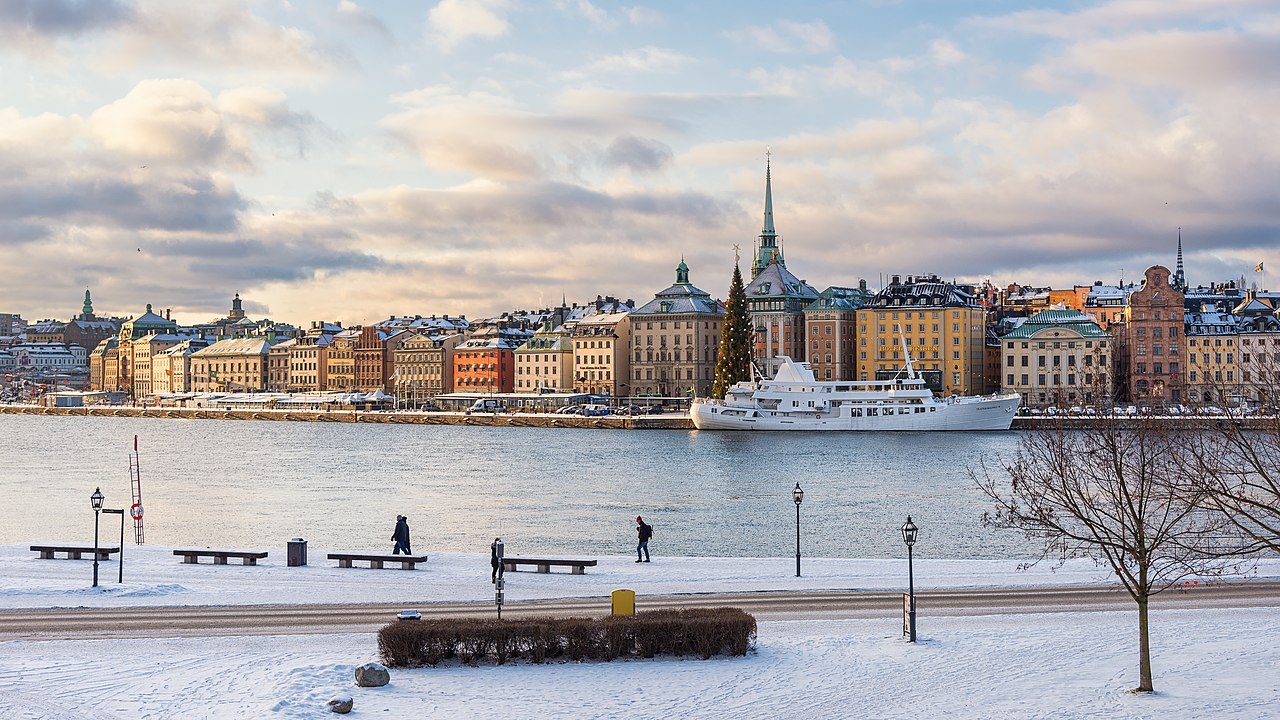
Stockholm, Sweden
Photo: Julian Herzog (Website), Wikimedia Commons (CC BY 4.0)
← All destinations

Stockholm, Sweden

Built on fourteen islands where the Baltic meets Lake Mälaren, Stockholm pairs the medieval alleys of Gamla Stan with minimal Scandinavian design and water so clean you can fish for salmon right in the city centre.

✓ Sources verified by hand on 11 July 202614 sources cited

What to see

Monuments2

Gamla Stan (Old Town)

A medieval old town with ochre-coloured cobbled alleys, the Royal Palace and Storkyrkan Cathedral, the city's tourist and photographic heart

Stadshuset (City Hall)

The venue of the Nobel ceremony and an architectural symbol of the city in the National Romantic style, with a panoramic tower over Lake Mälaren

Nature1

Djurgården and Skansen

A green island with the Skansen open-air museum, the Gröna Lund amusement park and ample nature a stone's throw from the centre

Museums1

Vasamuseet

Home to the warship Vasa, sunk in 1628 and recovered 98% intact in 1961, one of the best-preserved naval finds in the world

Food1

Köttbullar and fika in historic cafés

Swedish meatballs served with mash and lingonberry jam, paired with the traditional coffee-and-cake break called fika

Markets1

Hötorgshallen and Östermalm market

Historic covered markets to taste Swedish specialities like marinated herring, salmon and cinnamon buns

Other1

Södermalm

A hipster district with cafés, indie venues and the famous Monteliusvägen lookout over the old town and the water

✦ Hidden gems — off the standard guides

Fotografiska

A contemporary photography museum in a former customs house on the Södermalm waterfront, with a top-floor café overlooking the harbour

Rosendals Trädgård

A biodynamic garden on Djurgården with greenhouses, an orchard and a wood-fired oven baking fresh bread and pastries, a relaxed oasis away from mass tourism

Skeppsholmen

A quiet island with ArkDes (the centre for architecture and design) and panoramic waterside walks, off the beaten track

Sill (pickled herring) and husmanskost

Pickled herring in endless variants opens every smörgåsbord and every Swedish festive table, served with rye bread and potatoes; in the taverns of Gamla Stan try it alongside husmanskost, the national home-style cooking

Sample itineraries

Three routes for different travel styles, built only from this dossier's verified places. Realistic pace: 2-3 stops a day.

First time

2 days

The landmark sights, at the right pace.

Day 1

  • Gamla Stan (Old Town)

    A medieval old town with ochre-coloured cobbled alleys, the Royal Palace and Storkyrkan Cathedral, the city's tourist and photographic heart

  • Stadshuset (City Hall)

    The venue of the Nobel ceremony and an architectural symbol of the city in the National Romantic style, with a panoramic tower over Lake Mälaren

  • Vasamuseet

    Home to the warship Vasa, sunk in 1628 and recovered 98% intact in 1961, one of the best-preserved naval finds in the world

Day 2

  • Djurgården and Skansen

    A green island with the Skansen open-air museum, the Gröna Lund amusement park and ample nature a stone's throw from the centre

  • Södermalm

    A hipster district with cafés, indie venues and the famous Monteliusvägen lookout over the old town and the water

  • Hötorgshallen and Östermalm market

    Historic covered markets to taste Swedish specialities like marinated herring, salmon and cinnamon buns

Off the beaten path

2 days

Hidden gems away from the usual circuits.

Day 1

  • Fotografiskahidden gem

    A contemporary photography museum in a former customs house on the Södermalm waterfront, with a top-floor café overlooking the harbour

  • Rosendals Trädgårdhidden gem

    A biodynamic garden on Djurgården with greenhouses, an orchard and a wood-fired oven baking fresh bread and pastries, a relaxed oasis away from mass tourism

  • Skeppsholmenhidden gem

    A quiet island with ArkDes (the centre for architecture and design) and panoramic waterside walks, off the beaten track

Day 2

  • Sill (pickled herring) and husmanskosthidden gem

    Pickled herring in endless variants opens every smörgåsbord and every Swedish festive table, served with rye bread and potatoes; in the taverns of Gamla Stan try it alongside husmanskost, the national home-style cooking

  • Köttbullar and fika in historic cafés

    Swedish meatballs served with mash and lingonberry jam, paired with the traditional coffee-and-cake break called fika

Food & markets

1 days

Eat and drink where locals actually go.

Day 1

  • Köttbullar and fika in historic cafés

    Swedish meatballs served with mash and lingonberry jam, paired with the traditional coffee-and-cake break called fika

  • Sill (pickled herring) and husmanskosthidden gem

    Pickled herring in endless variants opens every smörgåsbord and every Swedish festive table, served with rye bread and potatoes; in the taverns of Gamla Stan try it alongside husmanskost, the national home-style cooking

  • Hötorgshallen and Östermalm market

    Historic covered markets to taste Swedish specialities like marinated herring, salmon and cinnamon buns

🧭

Build your itinerary

Tell us how many days you're staying and in which month: we'll compose an itinerary from this dossier's verified places, with notes about the period.

Your itinerary

1

Day 1

  • Gamla Stan (Old Town)

    A medieval old town with ochre-coloured cobbled alleys, the Royal Palace and Storkyrkan Cathedral, the city's tourist and photographic heart

  • Stadshuset (City Hall)

    The venue of the Nobel ceremony and an architectural symbol of the city in the National Romantic style, with a panoramic tower over Lake Mälaren

  • Hötorgshallen and Östermalm market

    Historic covered markets to taste Swedish specialities like marinated herring, salmon and cinnamon buns

2

Day 2

  • Vasamuseet

    Home to the warship Vasa, sunk in 1628 and recovered 98% intact in 1961, one of the best-preserved naval finds in the world

  • Södermalm

    A hipster district with cafés, indie venues and the famous Monteliusvägen lookout over the old town and the water

  • Köttbullar and fika in historic cafés

    Swedish meatballs served with mash and lingonberry jam, paired with the traditional coffee-and-cake break called fika

3

Day 3

  • Djurgården and Skansen

    A green island with the Skansen open-air museum, the Gröna Lund amusement park and ample nature a stone's throw from the centre

  • Fotografiskahidden gem

    A contemporary photography museum in a former customs house on the Södermalm waterfront, with a top-floor café overlooking the harbour

  • Sill (pickled herring) and husmanskosthidden gem

    Pickled herring in endless variants opens every smörgåsbord and every Swedish festive table, served with rye bread and potatoes; in the taverns of Gamla Stan try it alongside husmanskost, the national home-style cooking

Want an itinerary tailored to your dates in Stockholm?

Travel dates, where you stay and the kind of trip — we tailor this same verified dossier to your exact needs.

Coming soon
The colourful cobbled alleys of Gamla Stan, Stockholm's medieval old town, the beating heart of the old city.
The colourful cobbled alleys of Gamla Stan, Stockholm's medieval old town, the beating heart of the old city.Photo: OleNeitzel, Wikimedia Commons (CC BY 4.0)

Before you go

Recurring scams and local rules worth knowing before you arrive.

⚠ Scams to know

Unofficial taxis and inflated fares outside the airport

medium confidence

Men in dark clothes with no uniform or ID offer rides in luxury vans outside the terminals, or some dishonest drivers apply the pricier night/holiday tariff while showing the base one

How to avoid it: Use only taxis with a clearly visible logo and meter from authorized companies (Taxi Stockholm, Taxi Kurir) or ride-sharing apps, avoid anyone offering rides on arrival

Source

The 'stain' or 'bird poop' scam in Gamla Stan

medium confidence

One accomplice spills a substance on the tourist's clothes, then another offers to help clean it, creating a distraction to rob bags and pockets

How to avoid it: If something lands on you suspiciously in crowded areas, move away and check your belongings before accepting help from strangers

Source

The shell game in the street

medium confidence

Fake players invite passers-by to guess which shell a ball is under, betting money; the game is rigged and accomplices watch the pockets of onlookers

How to avoid it: Don't stop and don't bet money on these improvised street games, especially in crowded tourist areas like Gamla Stan or Sergels Torg

Source

Pickpocketing at the central station and in crowded areas

medium confidence

Sergels Torg, Central Station, Drottninggatan and the Vasamuseet are the most reported spots for petty theft from distracted tourists, especially on public transport at rush hour

How to avoid it: Keep bags and backpacks closed and in front of you in crowded areas, avoid flashing smartphones or showy wallets

Source

⚖ Laws & penalties

Alcohol above 3.5% sold only in the state-run Systembolaget shops

low riskverified

Systembolaget holds the monopoly on selling alcohol above 3.5%; supermarkets only sell light beer (folköl). Hours are limited: closing by 8pm on weekdays, 3pm on Saturdays, closed on Sundays and holidays. The minimum age to buy at Systembolaget is 20, while in bars and restaurants the limit to drink is 18.

Source

Very low blood-alcohol limit for driving (0.2 per mille)

high riskmedium confidence

Sweden has one of the strictest drink-driving limits in Europe, at 0.2 per mille (against 0.5 in many other EU countries), with frequent checks and criminal penalties if exceeded

Source

Fines for travelling on SL transport without a valid ticket

medium riskverified

Checks on the metro and buses are frequent, for tourists too: travelling without a valid ticket incurs a surcharge (tilläggsavgift) of 1,500 SEK. It can be contested in writing within 10 days of the check.

Source

Drinking alcohol in open public places

low riskmedium confidence

In Sweden drinking alcohol in public isn't banned nationally but is regulated by individual municipalities: in Stockholm it's generally tolerated in parks during the day (especially in summer), but in many marked areas it's prohibited. Where banned, drinking from an open container means confiscation of the drink and an on-the-spot fine of about 500 SEK. Always check the signage.

Source
Stockholm's skyline seen from the water, among the islands, bridges and archipelago that define the 'Venice of the North'.
Stockholm's skyline seen from the water, among the islands, bridges and archipelago that define the 'Venice of the North'.Photo: Алексей Решетников, Wikimedia Commons (CC BY 3.0)

Recurring events

Hover over a month on the timeline for details.

Budget & timing

Average daily cost

Season low (January-March (excluding the Christmas period))900-1200 SEK
Season mid (April-May, September-November)1200-1700 SEK
Season high (June-August, December (holidays))1700-2400 SEK

Rough estimate (lodging + meals + local transport), not a precise verified source.

Best time by type of trip

Outdoor life and archipelago June-August

Very long days with almost no darkness, mild temperatures ideal for ferries to the archipelago and outdoor life on the islands, but high season with higher prices and Midsommar closing many businesses.

Culture and city without crowds April-May, September-October

Cooler but pleasant weather, museums and attractions less crowded than in summer, more affordable accommodation.

Winter atmosphere and Lucia December

Christmas markets, St Lucia's Day on 13 December with candle processions, a fairy-tale atmosphere in the snowy city, but very short days and intense cold.

Did you know... Alcohol above 3.5% can only be sold in the state-run Systembolaget shops, which close by 8pm on weekdays, 3pm on Saturdays and stay shut on Sundays: a legacy of the state alcohol-control policy in force for over a century.

Getting around

Car recommended: No — The centre is split into islands linked by often-congested bridges, with a paid congestion charge (Trängselskatt); the SL network of metro, buses and ferries is efficient, dense and reaches even the outlying islands.

The SL network with metro (3 lines: green, red, blue), buses, trams and urban ferries; a single ticket valid for 75 minutes at 43 SEK (26 SEK reduced), a 24-hour pass at about 175 SEK and 72 hours at about 350 SEK; the rechargeable SL Access card costs 20 SEK and is found at stations and Pressbyrån/7-Eleven outlets.

  • Buy tickets via the SL app or at station machines: buses no longer take cash on board
  • The SL urban ferries to Djurgården are included in the normal ticket and offer a free view over the water compared with paid tourist cruises
  • With more than 2-3 trips a day a day pass is almost always better value than single tickets
  • From Arlanda airport the Arlanda Express train is the fastest (about 20 minutes) but expensive; the Flygbussarna buses are a cheaper alternative

Safety

Areas to avoid

  • Rinkeby, Husby and Tensta at night, suburbs with higher crime rates and gang-related violence, far from the central tourist circuit
  • Isolated areas south of the Johanneshovsbron bridge and poorly lit parks/industrial areas after midnight
  • Stockholm's old town and tourist areas stay safe even in the evening, with street robberies of tourists very rare
  • The main risk remains pickpocketing in crowded places like the central station, Sergels Torg and public transport at rush hour
  • In nightlife areas there can be alcohol-related fights, take care in the busier venues in the late hours
  • In an emergency the single European number 112 works in Sweden too

Sources

Every source below was opened and checked by hand — not just cited. Entries that didn't hold up were downgraded to "low confidence" or dropped, not presented as certain.

Related destinations

Other dossiers close by country, area or kind of trip.