What to see
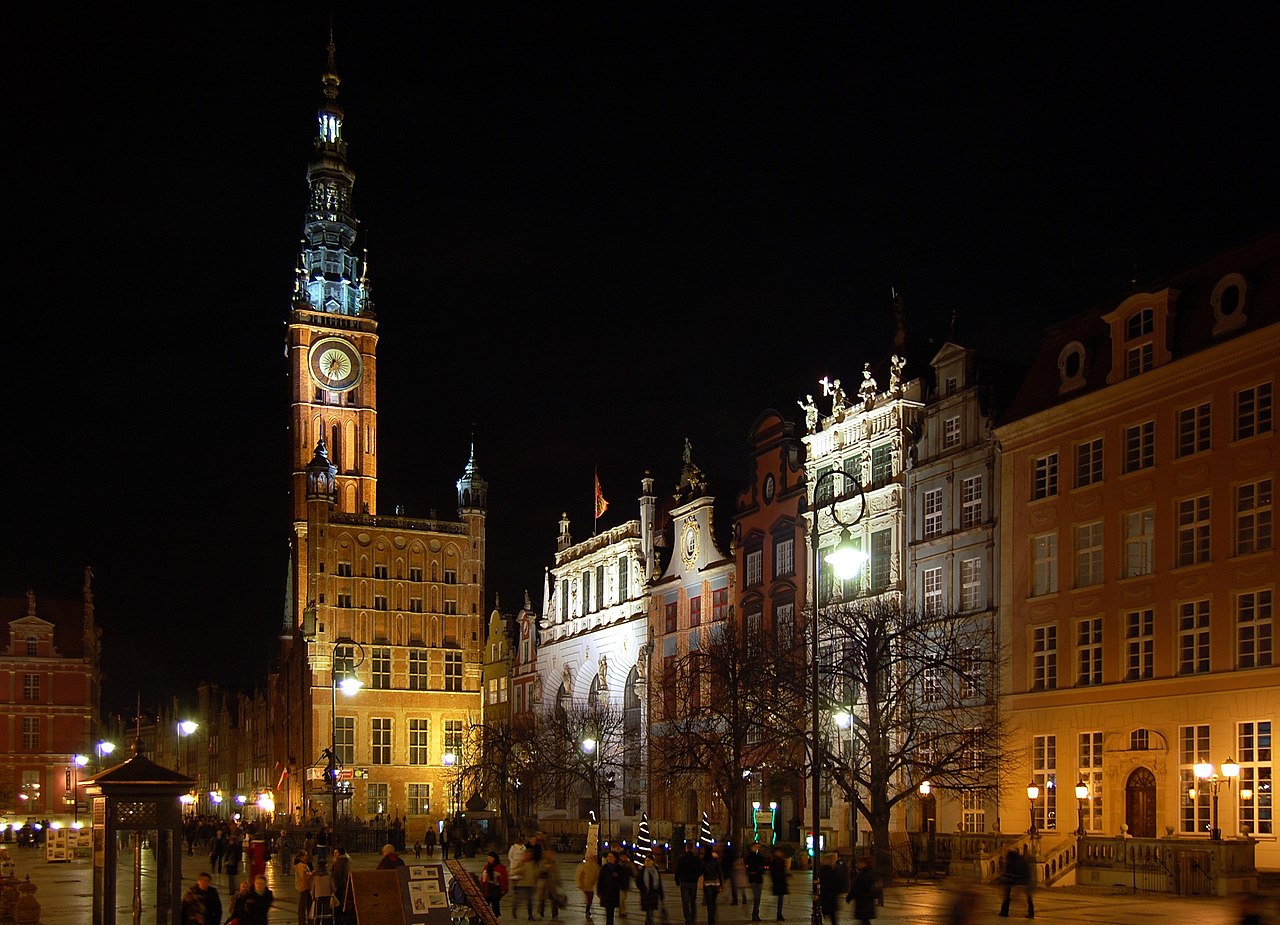
Długi Targ and Ulica Długa (Long Market and Long Street)
The old town's monumental axis, from the Town Hall to the Green Gate, lined with colourful patrician houses and the Neptune Fountain: Gdańsk's drawing room, rebuilt after the war.
Neptune Fountain
The city's symbol since 1633, a tribute to Gdańsk's bond with the sea. Dismantled and hidden during the war, it returned to its place in the Long Market: the most iconic photo spot.
St Mary's Basilica
One of the largest brick churches in the world: from the top of the tower you take in the whole old town and the harbour. An imposing Gothic interior with the medieval astronomical clock.
Żuraw (the medieval Crane on the Motława)
The largest medieval port crane in Europe, in wood and brick on the Motława river: it loaded goods and ships' masts. Today part of the National Maritime Museum.
✦ Hidden gems — off the standard guides
European Solidarity Centre (ECS)
A modern museum at the shipyard telling the birth of Solidarność and the fall of communism. Often less crowded than the central monuments, but essential to understanding the city.
Westerplatte
The peninsula where World War II began: the outpost's ruins, bunkers and a great monument to the defenders. Reached by bus or boat; moving and less touristy than the centre.
Sopot and the Baltic beach
A few minutes by train (SKM), nearby Sopot offers the longest wooden pier in Europe and wide sandy beaches: the seaside soul of the Tricity, ideal for half a day.
Want an itinerary tailored to your dates in Gdańsk?
Travel dates, where you stay and the kind of trip — we tailor this same verified dossier to your exact needs.

Before you go
Recurring scams and local rules worth knowing before you arrive.
⚠ Scams to know
Buying amber without checking its authenticity
medium confidenceGdańsk is the capital of amber, but precisely for this fake amber (plastic or resin) also circulates: the inexperienced tourist risks paying dearly for an imitation.
How to avoid it: Buy in the historic workshops of Mariacka street, ask for a certificate of authenticity and be wary of prices that are too low and of improvised stalls.
SourceChanging money at the kantor/Euronet in the tourist centre
medium confidenceThe most central exchanges and independent ATMs (often Euronet-branded) apply unfavourable rates and fees, with the classic offer to charge in euros (DCC) that worsens the rate.
How to avoid it: Pay in PLN by card and, if withdrawing, always choose 'without conversion' (in złoty) at the ATMs of the big Polish banks.
Source⚖ Laws & penalties
Requirement to validate the ticket on trams and urban trains
low riskmedium confidenceThe public-transport ticket (tram, bus, SKM) must be validated on board or before boarding: travelling without validation counts as travelling without a ticket and incurs a fine, applied to tourists too.
SourceDrinking alcohol in the street banned
medium riskmedium confidenceDrinking alcohol in public spaces (squares, parks, streets, transport) is banned in Poland, allowed only in licensed venues and outdoor seating. A breach incurs on-the-spot fines of about 100 to 500 PLN, confiscation of the alcohol and, in serious cases, a summons before the municipal court.
Source
Recurring events
Hover over a month on the timeline for details.
Budget & timing
Average daily cost
Rough estimate (lodging + meals + local transport), not a precise verified source.
Best time by type of trip
Sea and city together — June-August
Long, warm days to combine the old town with the Baltic beaches of Sopot, but also the peak of crowds and prices, especially during St Dominic's Fair.
Mild weather and fewer crowds — May, September
Pleasant temperatures for walking, fine light on the Motława and a less crowded city than at the summer peak.
Christmas atmosphere — December
Gdańsk's Christmas market is among the most atmospheric in Poland; intense cold but a decorated centre and amber as a typical gift.
Did you know... In 1980 the strike at the Gdańsk shipyard led by Lech Wałęsa gave birth to Solidarność, the first free trade union in the Soviet bloc: today the story is told at the European Solidarity Centre.
Getting around
Car recommended: No — The old town is compact and pedestrian: a car is only needed if you want to explore the coast beyond the Tricity. In the centre it's a hindrance, with partial limited-traffic zones and pricey parking.
Gdańsk is part of the Tricity (with Sopot and Gdynia) linked by the frequent, cheap SKM urban trains: ideal for reaching Sopot, Gdynia, Westerplatte and the airport. In the city, trams and buses cover everything; tickets are bought at kiosks/machines and must be validated on board.
- In Poland you pay in złoty (PLN), not euros: bring a fee-free card and withdraw at bank ATMs, avoiding the 'Euronet' exchanges in the centre with terrible rates.
- Always buy and validate your tram/train ticket: inspectors fine tourists without validation.
- For Westerplatte prefer the bus or the boat on the Motława to the pricier tourist cruise: you reach the same place anyway.
- The SKM to Sopot is the easiest way for a seaside trip: a few złoty and 20-30 minutes.
Safety
- Keep an eye on your belongings in the busier parts of the centre and on the SKM trains at rush hour.
- On summer evenings the Motława riverfront is lively but calm: violent crime is rare.
- The single emergency number in Poland (and the EU): 112.
Did you know... The old town you visit today is a reconstruction: at the end of the war the centre was over 90% destroyed, and it was rebuilt following its original Hanseatic appearance.
Sources
Every source below was opened and checked by hand — not just cited. Entries that didn't hold up were downgraded to "low confidence" or dropped, not presented as certain.
