Cinque Terre, Liguria
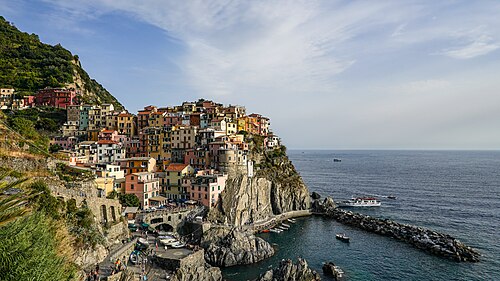
Photo: Timothy A. Gonsalves, Wikimedia Commons (CC BY-SA 4.0)
← All destinations

Cinque Terre, Liguria

Five villages of pastel houses clinging to a coast of terraces and vineyards sheer above the sea, car-free, linked by a train and by trails among the olive groves. So beautiful they've become victims of their own success: today the Via dell'Amore is visited by booking and lingering for a selfie can cost you a fine.

✓ Sources checked on 29 September 202612 sources cited

What to see in the Cinque Terre?

14 places checked against the sources. The 5 gems the guidebooks skip come first, then the classics: every card has the hard facts on top and the why below.

On the map: yellow pins are the gems. Tap a pin to jump to its card.

✦ Hidden gems · off the standard guides

Corniglia and the Lardarina
Nature✦ gem

Corniglia and the Lardarina

Steps
380

It is the only village that does not sit on the sea but on top of a headland, and to reach it from the station you climb the roughly 380 steps of the Lardarina, a good 15 minutes of zigzag stairway, or take the shuttle bus, which is included in the Cinque Terre Card and not paid separately. Those steps are why Corniglia has fewer people than the other four: it selects for them. At the top are quiet lanes and a terrace from which the whole coast is visible.

Photo: Chabe01, Wikimedia Commons (CC BY-SA 4.0)
Monuments✦ gem

The hillside sanctuaries (Soviore, Montenero and the others)

Above every village, 30 or 60 minutes of climbing away, there is a sanctuary: Nostra Signora di Soviore above Monterosso is the oldest Marian sanctuary in Liguria, the Madonna di Montenero looks down on Riomaggiore. The paths up to them are free and need no card, and they stay almost empty even on the days when the Sentiero Azzurro is at breaking point. It is the alternative that solves high season without giving up the view.

The Giant of Monterosso
Monuments✦ gem

The Giant of Monterosso

It is a fourteen-metre concrete Neptune set into the cliff at the end of Fegina beach, built in 1910 to hold up the terrace of a villa. Bombing and storms took away its arms and its shell, and what remains is a mutilated giant stuck to the rock. It is looked at from the beach, free, and it is the least solemn monument in the Cinque Terre.

Photo: Peter Forster from Centobuchi, Italy, Wikimedia Commons (CC BY-SA 2.0)
Other✦ gem

Portovenere by boat

It is part of the same UNESCO site but stays off the quick circuits, because it is not on the railway: in summer you get there by boat from the villages, in winter only by bus from La Spezia. The church of San Pietro sheer above the sea, Byron's grotto and the coloured carruggio are worth the half day. The boats are a separate service and are not covered by the Cinque Terre Card.

Food✦ gem

Sciacchetrà and the terrace wines

Sciacchetrà is a rare sweet wine made from grapes dried on the sheer terraces, picked by hand and brought down on single-rail rack railways because no vehicle can pass: that is why it is called heroic viticulture and why it costs. It is tasted by the glass in the village wine bars, which is the sensible way to try it without buying a bottle. The same vines also make the DOC white, which costs a fraction.

The classics

Vernazza
Monuments

Vernazza

It has the natural harbour, the church on the water and the remains of the Doria castle sheer above, which are visited for a few euros on the spot. The view from above, the postcard one, comes from walking in from Monterosso, not from the station: people who arrive by train enter from below and never see that angle. The little harbour is also the only place to get in the water, but it is not a beach.

Photo: СССР, Wikimedia Commons (CC BY-SA 2.5 ca)
Sentiero Azzurro
Nature

Sentiero Azzurro

Train
€17.30

Trail number 2 links the villages and is not free throughout: the Monterosso-Vernazza and Vernazza-Corniglia stretches require the Cinque Terre Card. The Trekking Card costs 10 € for one day, 17 € for two and 23.50 € for three, rising on high-attendance days to 15 €, 26.70 € and 37.50 €. Watch out for the Train Card, because the figures in circulation are only the low-season ones: from 2 November to 12 March it is 17.30 € for one day, 29 € for two and 34 € for three, but from 14 March to 1 November the price is dynamic and runs from 22 to 35 € for a single day. Sections close often for landslides: check the status on the Park's site the same day.

Photo: СССР, Wikimedia Commons (CC BY-SA 2.5 ca)
Monterosso al Mare
Beaches

Monterosso al Mare

It is the largest of the five and the only one with real serviced sand beaches, so it is the right base for anyone who wants villages and swimming rather than a choice between them. It is split in two: the old town on one side, the newer Fegina on the other, joined by a pedestrian tunnel most people walk through without noticing. Having the beach, it is also the only one where parking genuinely exists, paid though it is.

Photo: This Photo was taken by Timothy A. Gonsalves. Feel free to use my photos, but please mention me as the author. I would much appreciate if you send me an email tagooty@yahoo.com or write on my talk page, for my information. Please contact me before commercial use. Please do not upload an edited image here without consulting me. I would like to make corrections only at my own source to ensure that the changes improve the image and are preserved.Otherwise you may upload an edited image with a new name. Please use one of the templates derivative or extract., Wikimedia Commons (CC BY-SA 4.0)
Manarola
Other

Manarola

Duration
5 min

It is the most photographed of the villages, its houses piled on the spur, and the photograph everyone knows is not taken from the village but from the path towards the cemetery, which starts behind the church and climbs in 5 minutes. It costs nothing and needs no card. At sunset there are dozens of people up there lined up with tripods, so either you arrive 30 minutes early or you stand behind them.

Photo: This Photo was taken by Timothy A. Gonsalves. Feel free to use my photos, but please mention me as the author. I would much appreciate if you send me an email tagooty@yahoo.com or write on my talk page, for my information. Please contact me before commercial use. Please do not upload an edited image here without consulting me. I would like to make corrections only at my own source to ensure that the changes improve the image and are preserved.Otherwise you may upload an edited image with a new name. Please use one of the templates derivative or extract., Wikimedia Commons (CC BY-SA 4.0)
Via dell'Amore
Other

Via dell'Amore

Ticket
€10
Hours
8:30-21:30

You do not simply walk in: you book a fifteen-minute slot, with a maximum of a hundred people per slot, and pay €10 on top of the Cinque Terre Card. It is 900 metres and the maximum crossing time is half an hour, so it is not a stroll to take slowly. In high season, 1 April to 31 October, it is one-way from Riomaggiore to Manarola and opens 8.30am-9.30pm; in winter 9.30am-5pm. Residents of the villages enter free and without booking.

Photo: Twice25 & Rinina25, Wikimedia Commons (CC BY 2.5)
Riomaggiore
Other

Riomaggiore

Entry
free

It is the southernmost village and the first you meet coming from La Spezia, with vertical tower-houses pressed around the street that drops to the marina. The boats are hauled up between the houses because there is no harbour, and that is the detail that explains how the place works. From the rocks by the marina the sunset arrives head-on, and it is where people sit without paying for anything.

Photo: This Photo was taken by Timothy A. Gonsalves. Feel free to use my photos, but please mention me as the author. I would much appreciate if you send me an email tagooty@yahoo.com or write on my talk page, for my information. Please contact me before commercial use. Please do not upload an edited image here without consulting me. I would like to make corrections only at my own source to ensure that the changes improve the image and are preserved.Otherwise you may upload an edited image with a new name. Please use one of the templates derivative or extract., Wikimedia Commons (CC BY-SA 4.0)
Food

Trofie with pesto

Pesto was born on this coast and you tell it by the colour, which should be bright green and not dark: if it is dark the basil has been heated. In the village trattorie it comes on trofie or trenette, often with potato and green beans in the same plate, which is the real Ligurian version rather than an addition. A plate of pasta with a sea view costs a great deal more than the same plate in an inner lane, and the difference is not in the pesto.

Food

Monterosso anchovies

Anchovy fishing is Monterosso's oldest trade and the product has a protected name: on menus look for 'acciughe di Monterosso' rather than generic 'alici', because that is what separates the local catch from the rest. They are eaten fried in paper, salted, marinated in lemon or baked in the tian with potatoes. They are also the cheapest of the coast's fish dishes.

Food

Focaccia and farinata

Olive-oil focaccia and chickpea farinata are the right lunch to carry onto the trails: bought by weight in the village bakeries, they cost a fraction of a table with a view. Farinata has to be eaten straight from the oven, so ask when the next tray is due rather than taking the one that has sat an hour. There are no fountains or kiosks on the trails: you carry the water up.

How to plan your days in the Cinque Terre?

Three routes for different travel styles, built only from this dossier's verified places. Realistic pace: 2-3 stops a day.

First time

2 days

The landmark sights, at the right pace.

Day 1

  • Vernazza

    It has the natural harbour, the church on the water and the remains of the Doria castle sheer above, which are visited for a few euros on the spot. The view from above, the postcard one, comes from walking in from Monterosso, not from the station: people who arrive by train enter from below and never see that angle. The little harbour is also the only place to get in the water, but it is not a beach.

  • Manarola

    It is the most photographed of the villages, its houses piled on the spur, and the photograph everyone knows is not taken from the village but from the path towards the cemetery, which starts behind the church and climbs in 5 minutes. It costs nothing and needs no card. At sunset there are dozens of people up there lined up with tripods, so either you arrive 30 minutes early or you stand behind them.

  • Sentiero Azzurro

    Trail number 2 links the villages and is not free throughout: the Monterosso-Vernazza and Vernazza-Corniglia stretches require the Cinque Terre Card. The Trekking Card costs 10 € for one day, 17 € for two and 23.50 € for three, rising on high-attendance days to 15 €, 26.70 € and 37.50 €. Watch out for the Train Card, because the figures in circulation are only the low-season ones: from 2 November to 12 March it is 17.30 € for one day, 29 € for two and 34 € for three, but from 14 March to 1 November the price is dynamic and runs from 22 to 35 € for a single day. Sections close often for landslides: check the status on the Park's site the same day.

Day 2

  • Via dell'Amore

    You do not simply walk in: you book a fifteen-minute slot, with a maximum of a hundred people per slot, and pay €10 on top of the Cinque Terre Card. It is 900 metres and the maximum crossing time is half an hour, so it is not a stroll to take slowly. In high season, 1 April to 31 October, it is one-way from Riomaggiore to Manarola and opens 8.30am-9.30pm; in winter 9.30am-5pm. Residents of the villages enter free and without booking.

  • Monterosso al Mare

    It is the largest of the five and the only one with real serviced sand beaches, so it is the right base for anyone who wants villages and swimming rather than a choice between them. It is split in two: the old town on one side, the newer Fegina on the other, joined by a pedestrian tunnel most people walk through without noticing. Having the beach, it is also the only one where parking genuinely exists, paid though it is.

  • Trofie with pesto

    Pesto was born on this coast and you tell it by the colour, which should be bright green and not dark: if it is dark the basil has been heated. In the village trattorie it comes on trofie or trenette, often with potato and green beans in the same plate, which is the real Ligurian version rather than an addition. A plate of pasta with a sea view costs a great deal more than the same plate in an inner lane, and the difference is not in the pesto.

Off the beaten path

2 days

Hidden gems away from the usual circuits.

Day 1

  • Corniglia and the Lardarina✦ hidden gem

    It is the only village that does not sit on the sea but on top of a headland, and to reach it from the station you climb the roughly 380 steps of the Lardarina, a good 15 minutes of zigzag stairway, or take the shuttle bus, which is included in the Cinque Terre Card and not paid separately. Those steps are why Corniglia has fewer people than the other four: it selects for them. At the top are quiet lanes and a terrace from which the whole coast is visible.

  • The hillside sanctuaries (Soviore, Montenero and the others)✦ hidden gem

    Above every village, 30 or 60 minutes of climbing away, there is a sanctuary: Nostra Signora di Soviore above Monterosso is the oldest Marian sanctuary in Liguria, the Madonna di Montenero looks down on Riomaggiore. The paths up to them are free and need no card, and they stay almost empty even on the days when the Sentiero Azzurro is at breaking point. It is the alternative that solves high season without giving up the view.

  • The Giant of Monterosso✦ hidden gem

    It is a fourteen-metre concrete Neptune set into the cliff at the end of Fegina beach, built in 1910 to hold up the terrace of a villa. Bombing and storms took away its arms and its shell, and what remains is a mutilated giant stuck to the rock. It is looked at from the beach, free, and it is the least solemn monument in the Cinque Terre.

Day 2

  • Portovenere by boat✦ hidden gem

    It is part of the same UNESCO site but stays off the quick circuits, because it is not on the railway: in summer you get there by boat from the villages, in winter only by bus from La Spezia. The church of San Pietro sheer above the sea, Byron's grotto and the coloured carruggio are worth the half day. The boats are a separate service and are not covered by the Cinque Terre Card.

  • Sciacchetrà and the terrace wines✦ hidden gem

    Sciacchetrà is a rare sweet wine made from grapes dried on the sheer terraces, picked by hand and brought down on single-rail rack railways because no vehicle can pass: that is why it is called heroic viticulture and why it costs. It is tasted by the glass in the village wine bars, which is the sensible way to try it without buying a bottle. The same vines also make the DOC white, which costs a fraction.

Food & markets

2 days

Eat and drink where locals actually go.

Day 1

  • Trofie with pesto

    Pesto was born on this coast and you tell it by the colour, which should be bright green and not dark: if it is dark the basil has been heated. In the village trattorie it comes on trofie or trenette, often with potato and green beans in the same plate, which is the real Ligurian version rather than an addition. A plate of pasta with a sea view costs a great deal more than the same plate in an inner lane, and the difference is not in the pesto.

  • Monterosso anchovies

    Anchovy fishing is Monterosso's oldest trade and the product has a protected name: on menus look for 'acciughe di Monterosso' rather than generic 'alici', because that is what separates the local catch from the rest. They are eaten fried in paper, salted, marinated in lemon or baked in the tian with potatoes. They are also the cheapest of the coast's fish dishes.

Day 2

  • Sciacchetrà and the terrace wines✦ hidden gem

    Sciacchetrà is a rare sweet wine made from grapes dried on the sheer terraces, picked by hand and brought down on single-rail rack railways because no vehicle can pass: that is why it is called heroic viticulture and why it costs. It is tasted by the glass in the village wine bars, which is the sensible way to try it without buying a bottle. The same vines also make the DOC white, which costs a fraction.

  • Focaccia and farinata

    Olive-oil focaccia and chickpea farinata are the right lunch to carry onto the trails: bought by weight in the village bakeries, they cost a fraction of a table with a view. Farinata has to be eaten straight from the oven, so ask when the next tray is due rather than taking the one that has sat an hour. There are no fountains or kiosks on the trails: you carry the water up.

🧭

Build your itinerary

Tell us how many days you're staying and in which month: we'll compose an itinerary from this dossier's verified places, with notes about the period.

Your itinerary

1

Day 1

  • Vernazza

    It has the natural harbour, the church on the water and the remains of the Doria castle sheer above, which are visited for a few euros on the spot. The view from above, the postcard one, comes from walking in from Monterosso, not from the station: people who arrive by train enter from below and never see that angle. The little harbour is also the only place to get in the water, but it is not a beach.

  • Manarola

    It is the most photographed of the villages, its houses piled on the spur, and the photograph everyone knows is not taken from the village but from the path towards the cemetery, which starts behind the church and climbs in 5 minutes. It costs nothing and needs no card. At sunset there are dozens of people up there lined up with tripods, so either you arrive 30 minutes early or you stand behind them.

  • Trofie with pesto

    Pesto was born on this coast and you tell it by the colour, which should be bright green and not dark: if it is dark the basil has been heated. In the village trattorie it comes on trofie or trenette, often with potato and green beans in the same plate, which is the real Ligurian version rather than an addition. A plate of pasta with a sea view costs a great deal more than the same plate in an inner lane, and the difference is not in the pesto.

2

Day 2

  • Via dell'Amore

    You do not simply walk in: you book a fifteen-minute slot, with a maximum of a hundred people per slot, and pay €10 on top of the Cinque Terre Card. It is 900 metres and the maximum crossing time is half an hour, so it is not a stroll to take slowly. In high season, 1 April to 31 October, it is one-way from Riomaggiore to Manarola and opens 8.30am-9.30pm; in winter 9.30am-5pm. Residents of the villages enter free and without booking.

  • Riomaggiore

    It is the southernmost village and the first you meet coming from La Spezia, with vertical tower-houses pressed around the street that drops to the marina. The boats are hauled up between the houses because there is no harbour, and that is the detail that explains how the place works. From the rocks by the marina the sunset arrives head-on, and it is where people sit without paying for anything.

  • Monterosso anchovies

    Anchovy fishing is Monterosso's oldest trade and the product has a protected name: on menus look for 'acciughe di Monterosso' rather than generic 'alici', because that is what separates the local catch from the rest. They are eaten fried in paper, salted, marinated in lemon or baked in the tian with potatoes. They are also the cheapest of the coast's fish dishes.

3

Day 3

  • Sentiero Azzurro

    Trail number 2 links the villages and is not free throughout: the Monterosso-Vernazza and Vernazza-Corniglia stretches require the Cinque Terre Card. The Trekking Card costs 10 € for one day, 17 € for two and 23.50 € for three, rising on high-attendance days to 15 €, 26.70 € and 37.50 €. Watch out for the Train Card, because the figures in circulation are only the low-season ones: from 2 November to 12 March it is 17.30 € for one day, 29 € for two and 34 € for three, but from 14 March to 1 November the price is dynamic and runs from 22 to 35 € for a single day. Sections close often for landslides: check the status on the Park's site the same day.

  • Monterosso al Mare

    It is the largest of the five and the only one with real serviced sand beaches, so it is the right base for anyone who wants villages and swimming rather than a choice between them. It is split in two: the old town on one side, the newer Fegina on the other, joined by a pedestrian tunnel most people walk through without noticing. Having the beach, it is also the only one where parking genuinely exists, paid though it is.

  • Focaccia and farinata

    Olive-oil focaccia and chickpea farinata are the right lunch to carry onto the trails: bought by weight in the village bakeries, they cost a fraction of a table with a view. Farinata has to be eaten straight from the oven, so ask when the next tray is due rather than taking the one that has sat an hour. There are no fountains or kiosks on the trails: you carry the water up.

Want an itinerary tailored to your dates in Cinque Terre?

Travel dates, where you stay and the kind of trip: we tailor this same verified dossier to your exact needs.

Coming soon
The natural little harbour of Vernazza, perhaps the most scenic of the five villages, with the church overlooking the water.
The natural little harbour of Vernazza, perhaps the most scenic of the five villages, with the church overlooking the water.Photo: Mathieu Chollet, Wikimedia Commons (CC BY-SA 4.0)

What to know before going to the Cinque Terre?

Recurring scams and local rules worth knowing before you arrive.

⚠ Scams to know

Tackling the trails in unsuitable footwear

verified

The routes are narrow, unpaved and sloping: in flip-flops or sandals you risk slips and injuries, and the park recommends (and in the past has threatened to fine) those walking without proper shoes.

How to avoid it: Use closed hiking or gym shoes with a treaded sole, bring water and a hat: the trails are exposed to the sun.

Source

Stopping for selfies blocking trails and alleys

medium confidence

To manage overtourism the park has introduced fines of up to €275 for those obstructing the passage of people and vehicles by stopping in the wrong spots, especially on the narrow walkways.

How to avoid it: Take photos by moving to the sides or into the designated areas, without blocking steps, alleys and trails; respect the indicated direction of travel.

Source

Planning everything for midday in high summer

medium confidence

In high season the trains, boats and trails are congested and it's very hot: the villages' magic is lost in the midday crush.

How to avoid it: Use the early morning and late afternoon to move around and take photos, and keep the middle of the day for swimming or the lunch break.

Source

⚖ Laws & penalties

Capped access, Trekking Card and suitable footwear on the trails

medium riskverified

For the National Park trails you need the Cinque Terre Trekking Card (about €10-15 depending on the day) and some stretches (e.g. the Via dell'Amore) require a timed booking. Walking the trails in flip-flops, open sandals or smooth-soled shoes is banned: park staff check and can deny access or fine on the spot, with penalties from €50 up to €2,500 (a safety rule after numerous accidents). Landslide closures change often: check the current status.

Source

Tourist tax in the Cinque Terre municipalities

low riskverified

Monterosso, Vernazza (with Corniglia) and Riomaggiore (with Manarola) apply the same rate since 1 May 2025: €3 per person per night in every type of accommodation, from 4-star hotels to campsites to short lets, for a maximum of 3 consecutive nights. Monterosso confirmed it for 2026 with council resolution 153 of 14 November 2025; Levanto and La Spezia have their own rates.

Source
Riomaggiore seen from the sea: the pastel houses cascading down towards the small landing.
Riomaggiore seen from the sea: the pastel houses cascading down towards the small landing.Photo: Timothy A. Gonsalves, Wikimedia Commons (CC BY-SA 4.0)

What happens in the Cinque Terre through the year?

Hover over a month on the timeline for details.

How much do you spend in the Cinque Terre, and when to go?

Jan
Feb
Mar
Apr
May
Jun
Jul
Aug
Sep
Oct
Nov
Dec
  • low60-95€per day
  • mid90-150€per day
  • high140-230€per day

When it works best, by type of trip

Trekking and ideal weatherMay-June, September

Pleasant temperatures for the trails and the sea already (or still) enjoyable, with less of a crush than the July-August peak.

Sea and village lifeJuly-August

Everything open, boats running and sea swimming, but also the peak of crowds, prices and heat, with extremely busy trains and trails.

Quiet and budgetNovember-March

Quiet villages and lower rates, beautiful winter light; some trails closed, boats stopped and various seasonal activities suspended.

Rough estimate (lodging + meals + local transport), not a precise verified source.

✦

Did you know... To curb overtourism, the park has introduced fines of up to €275 for those who block traffic or the trails by stopping for selfies, and recommends suitable footwear on the routes.

How to get to the Cinque Terre and around?

No car neededThe villages are closed to traffic and have no parking: arriving by car is inadvisable. You can leave the car in La Spezia or Levanto and continue by train. The right way to get around is train + trails + boat.

The regional train links the five villages and La Spezia/Levanto with services every 15-20 minutes and journeys of a few minutes. From 14 March to 1 November 2026 the Levanto-La Spezia stretch is on the Cinque Terre Express fare: €5, €8 or €10 per ride depending on the day (bands A, B and C of the Trenitalia calendar), whatever the stretch, half price from 4 to 11 years old. The Cinque Terre Train Card includes unlimited trains on the line and access to the paid trails. In summer there are also boats between the villages (except Corniglia).

  • Buy the Cinque Terre 'Train' Card: it includes the trains between villages and the toll trails, and saves buying a ticket for each leg.
  • The Via dell'Amore must be booked online for a time slot: check availability and up-to-date rules before you go.
  • Wear hiking shoes or at least trainers with a good sole: they're recommended (at times mandatory) on the trails and flip-flops can cause problems.
  • Leave early: by midday the trains, alleys and trails fill up; morning and late afternoon are far more livable.

Are the Cinque Terre safe?

⚠ Areas to avoid

  • The Cinque Terre are safe: the risks are environmental, not crime-related. Take care on the exposed, landslide-prone trails, on the cliffs and on stretches slippery after rain.

Good to know

  • Check the trail status before you go: after rain some stretches are closed for landslides.
  • On the cliff-edge walkways stay on the marked routes and don't climb over the barriers for a photo.
  • Bring enough water: between villages the trails have few refreshment points.
  • The single emergency number in Italy (and the EU): 112.
Source
✦

Did you know... Corniglia is the only one of the five villages not facing the sea directly: from the station you climb to the village by a stairway of about 380 steps (the Lardarina) or by shuttle.

Frequently asked questions about the Cinque Terre

Short answers drawn from the verified data of this dossier: details and sources are in the sections above.

How much does a day in the Cinque Terre cost?

Season low (November-March): 60-95€ per day; Season mid (April-May, October): 90-150€ per day; Season high (June-September): 140-230€ per day.

When to go to the Cinque Terre?

Trekking and ideal weather: May-June, September. Pleasant temperatures for the trails and the sea already (or still) enjoyable, with less of a crush than the July-August peak. Sea and village life: July-August. Everything open, boats running and sea swimming, but also the peak of crowds, prices and heat, with extremely busy trains and trails. Quiet and budget: November-March. Quiet villages and lower rates, beautiful winter light; some trails closed, boats stopped and various seasonal activities suspended.

Are the Cinque Terre safe?

The Cinque Terre are safe: the risks are environmental, not crime-related. Take care on the exposed, landslide-prone trails, on the cliffs and on stretches slippery after rain. Check the trail status before you go: after rain some stretches are closed for landslides.

Do you need a car in the Cinque Terre?

No. The villages are closed to traffic and have no parking: arriving by car is inadvisable. You can leave the car in La Spezia or Levanto and continue by train. The right way to get around is train + trails + boat.

How do you get to the Cinque Terre?

The regional train links the five villages and La Spezia/Levanto with services every 15-20 minutes and journeys of a few minutes. From 14 March to 1 November 2026 the Levanto-La Spezia stretch is on the Cinque Terre Express fare: €5, €8 or €10 per ride depending on the day (bands A, B and C of the Trenitalia calendar), whatever the stretch, half price from 4 to 11 years old. The Cinque Terre Train Card includes unlimited trains on the line and access to the paid trails.

Which hidden gems to see in the Cinque Terre, off the guidebooks?

Corniglia and the Lardarina, The hillside sanctuaries (Soviore, Montenero and the others), The Giant of Monterosso, Portovenere by boat, Sciacchetrà and the terrace wines.

Which scams to avoid in the Cinque Terre?

Tackling the trails in unsuitable footwear; Stopping for selfies blocking trails and alleys; Planning everything for midday in high summer.

Sources

Every source below was opened and read, not just cited. Entries that didn't hold up were downgraded to "low confidence" or dropped, not presented as certain.

Related destinations

Other dossiers close by country, area or kind of trip.