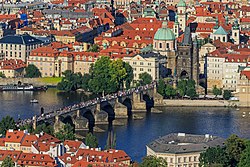
Bratislava, Slovakia
Photo: Stano Novak, Wikimedia Commons (CC BY 2.5)
← All destinations

Bratislava, Slovakia

A small, underrated capital on the Danube, an hour by boat from Vienna: a white castle dominating the city, a compact old town full of playful statues and a fairy-tale blue church. It's all walkable in a day, but it rewards those who give it time.

✓ Sources checked on 12 October 20267 sources cited

What to see in Bratislava?

14 places checked against the sources. The 6 gems the guidebooks skip come first, then the classics: every card has the hard facts on top and the why below.

On the map: yellow pins are the gems. Tap a pin to jump to its card.

✦ Hidden gems · off the standard guides

Other✦ gem

Čumil statue (Man at Work)

A bronze workman climbing out of a manhole at the corner of Panská and Laurinská, placed there in 1997 as the old town was being pedestrianised. It is free, it is at foot level, and that is exactly why people walk past without seeing it: the triangular road sign marking it was added because cars kept hitting it. Others stand nearby (the Napoleonic soldier leaning on a bench, the paparazzo), all from the same period and the same spirit.

Monuments✦ gem

Slavín Memorial

Entry
free

6,845 Soviet soldiers who fell in the battle for the city in 1945 are buried here; the obelisk is over 39 metres tall and carries an eleven-metre statue on top. You walk up from the centre in about half an hour, through a residential district of villas beside the Horský park, and pay nothing. It is the point from which Bratislava is seen whole (castle, bridge, Danube and the Petržalka blocks on the far bank) and almost nobody goes, because it is off the old-town circuit.

Devín Castle
Monuments✦ gem

Devín Castle

Hours
10:00-19:00
Closed
Monday

It stands where the Danube meets the Morava, on the Austrian border, and is reached by bus 29 from Most SNP or by boat along the Danube. It is open Tuesday to Sunday and closed on Mondays all year, with hours that shrink in winter: 10am-7pm from June to August, 10am-4pm from November to February. Until 1989 this was the Iron Curtain: on the bank below the ruins ran the barbed wire and the watchtowers.

Photo: Jakub Hałun, Wikimedia Commons (CC BY-SA 4.0)
Nature✦ gem

Kamzík Tower and the city forest

A 1975 television tower on top of the Koliba hill, inside the Little Carpathians woodland that begins where the city ends. The viewing level at the top is a revolving restaurant: the view is paid for with the bill rather than with an entrance ticket, which is a choice to make knowingly. The woods around it, on the other hand, are free and threaded with waymarked trails: from Kamzík a chairlift drops to Železná studienka, the other city park, in under ten minutes.

Food✦ gem

Lokše

Thin potato flatbreads cooked on a griddle, served savoury with goose pâté or sweet with jam and poppy seeds. They belong to the goose season: in autumn, in the village of Slovenský Grob half an hour away, the inns run goose menus with lokše, and it is a trip locals make every year. In the city they turn up at market kiosks and in a handful of traditional taverns, not in centre restaurants.

Food✦ gem

Kofola

A Czechoslovak cola born in 1960 from Kofo syrup, with less sugar and less caffeine than the American drinks and a herbal, liquorice taste that divides people. The difference that matters is between the bottled version and the draught one, čapovaná Kofola, found in pubs and beer halls: less fizzy, more bitter, and the one locals actually drink. It costs less than a beer and adults order it at lunch without embarrassment.

The classics

Monuments

Bratislava Castle (Bratislavský hrad)

Ticket
€14
Closed
Tuesday

The hill, the courtyard, the baroque garden and the terrace over the Danube are free and open every day from 8am to 10pm: for the view, which is why people climb up, you pay nothing. The museum inside the castle and the climb up the crown tower cost €14, open every day except Tuesday from 10am to 6pm, last entry at 5pm. The castle you see is a reconstruction: the original burned down in 1811 and stayed a ruin until the 1950s.

Monuments

Main Square (Hlavné námestie) and old town

The old town really is small: you cross it on foot in a quarter of an hour, which is why Bratislava works well as one day and badly as three. On the main square stand the old town hall and Roland's fountain; the city museum inside the town hall is ticketed and includes the climb up its tower. The bronze statues scattered through the streets are from the 1990s, not old: they were put there to revive a centre that stood empty after socialism.

St Michael's Gate (Michalská brána)
Monuments

St Michael's Gate (Michalská brána)

Closed
Tuesday

The only one of the four medieval gates left standing. Inside is the Museum of Arms, six euros, open every day except Tuesday from 10am to 6pm: the ticket includes the climb to the top, which is the real reason to go in. The detail that wastes everyone's time: tickets are not sold at the tower but at the old Red Crab pharmacy, at Michalská 28, twenty metres away.

Photo: Lungoleno, Wikimedia Commons (CC BY-SA 4.0)
Monuments

Blue Church (St Elizabeth)

The problem is not finding it, it is finding it open: normally you get in only during mass (early in the morning Monday to Saturday, mid-morning on Sundays) and the door is shut the rest of the time. To see the interior at a convenient hour there are ticketed guided visits with organ accompaniment, Monday to Saturday between 10am and 7pm. The church dates from 1913, in Hungarian Secession style, and is a ten-minute walk from the old town: turn up at the wrong hour and you only photograph the outside.

Monuments

SNP Bridge and UFO tower

Ticket
€9.90

The viewing platform sits 95 metres above the Danube and the lift reaches it in 45 seconds; it is open from 10am to 11pm and costs €9.90 in the early hours and from January to March, €11.90 at peak times. There is a shortcut, though: anyone eating at the restaurant on the floor below gets onto the platform free and a discount on the bill. The bridge, from 1972, was built by demolishing much of the old town below the castle, the Jewish quarter included: the traces are visible on the way down.

Monuments

St Martin's Cathedral

Hours
9:00-11:30 and 13:00-18:00

Between 1563 and 1830 ten kings, one queen and seven Habsburg consorts were crowned here: Bratislava was the capital of the Kingdom of Hungary while Buda was in Ottoman hands. On top of its 85-metre spire sits a gilded replica of the Hungarian crown weighing 300 kilos. Visiting is free but the hours are tight (Monday to Saturday 9-11.30am and 1-6pm, Sundays only 1.30-4pm) and the bridge traffic runs a few metres from the apse.

Food

Bryndzové halušky

Small potato dumplings buried under bryndza, the fermented sheep's cheese that is a protected product, with bacon and its fat on top. The question to ask is whether the bryndza is really sheep's: plenty of central places use a cow's-milk version, cheaper and milder, and do not say so. The dish is heavy and arrives in enormous portions: it is lunch, not a starter. In the salaš, the mountain inns outside town, it costs half what it does on the main square.

Food

Kapustnica

A sauerkraut soup with smoked sausage, dried mushrooms and sometimes prunes: it is the Christmas Eve dish, and every family insists its recipe is the right one. Outside the holidays it turns up in traditional beer halls, served in a hollowed loaf. At the Christmas market on the main square, from late November through December, it is the thing eaten standing with mulled wine, and also the only moment when central Bratislava is genuinely full.

How to plan your days in Bratislava?

Three routes for different travel styles, built only from this dossier's verified places. Realistic pace: 2-3 stops a day.

First time

2 days

The landmark sights, at the right pace.

Day 1

  • Bratislava Castle (Bratislavský hrad)

    The hill, the courtyard, the baroque garden and the terrace over the Danube are free and open every day from 8am to 10pm: for the view, which is why people climb up, you pay nothing. The museum inside the castle and the climb up the crown tower cost €14, open every day except Tuesday from 10am to 6pm, last entry at 5pm. The castle you see is a reconstruction: the original burned down in 1811 and stayed a ruin until the 1950s.

  • Main Square (Hlavné námestie) and old town

    The old town really is small: you cross it on foot in a quarter of an hour, which is why Bratislava works well as one day and badly as three. On the main square stand the old town hall and Roland's fountain; the city museum inside the town hall is ticketed and includes the climb up its tower. The bronze statues scattered through the streets are from the 1990s, not old: they were put there to revive a centre that stood empty after socialism.

  • St Michael's Gate (Michalská brána)

    The only one of the four medieval gates left standing. Inside is the Museum of Arms, six euros, open every day except Tuesday from 10am to 6pm: the ticket includes the climb to the top, which is the real reason to go in. The detail that wastes everyone's time: tickets are not sold at the tower but at the old Red Crab pharmacy, at Michalská 28, twenty metres away.

Day 2

  • Blue Church (St Elizabeth)

    The problem is not finding it, it is finding it open: normally you get in only during mass (early in the morning Monday to Saturday, mid-morning on Sundays) and the door is shut the rest of the time. To see the interior at a convenient hour there are ticketed guided visits with organ accompaniment, Monday to Saturday between 10am and 7pm. The church dates from 1913, in Hungarian Secession style, and is a ten-minute walk from the old town: turn up at the wrong hour and you only photograph the outside.

  • SNP Bridge and UFO tower

    The viewing platform sits 95 metres above the Danube and the lift reaches it in 45 seconds; it is open from 10am to 11pm and costs €9.90 in the early hours and from January to March, €11.90 at peak times. There is a shortcut, though: anyone eating at the restaurant on the floor below gets onto the platform free and a discount on the bill. The bridge, from 1972, was built by demolishing much of the old town below the castle, the Jewish quarter included: the traces are visible on the way down.

  • St Martin's Cathedral

    Between 1563 and 1830 ten kings, one queen and seven Habsburg consorts were crowned here: Bratislava was the capital of the Kingdom of Hungary while Buda was in Ottoman hands. On top of its 85-metre spire sits a gilded replica of the Hungarian crown weighing 300 kilos. Visiting is free but the hours are tight (Monday to Saturday 9-11.30am and 1-6pm, Sundays only 1.30-4pm) and the bridge traffic runs a few metres from the apse.

Off the beaten path

2 days

Hidden gems away from the usual circuits.

Day 1

  • Čumil statue (Man at Work)✦ hidden gem

    A bronze workman climbing out of a manhole at the corner of Panská and Laurinská, placed there in 1997 as the old town was being pedestrianised. It is free, it is at foot level, and that is exactly why people walk past without seeing it: the triangular road sign marking it was added because cars kept hitting it. Others stand nearby (the Napoleonic soldier leaning on a bench, the paparazzo), all from the same period and the same spirit.

  • Slavín Memorial✦ hidden gem

    6,845 Soviet soldiers who fell in the battle for the city in 1945 are buried here; the obelisk is over 39 metres tall and carries an eleven-metre statue on top. You walk up from the centre in about half an hour, through a residential district of villas beside the Horský park, and pay nothing. It is the point from which Bratislava is seen whole (castle, bridge, Danube and the Petržalka blocks on the far bank) and almost nobody goes, because it is off the old-town circuit.

  • Devín Castle✦ hidden gem

    It stands where the Danube meets the Morava, on the Austrian border, and is reached by bus 29 from Most SNP or by boat along the Danube. It is open Tuesday to Sunday and closed on Mondays all year, with hours that shrink in winter: 10am-7pm from June to August, 10am-4pm from November to February. Until 1989 this was the Iron Curtain: on the bank below the ruins ran the barbed wire and the watchtowers.

Day 2

  • Kamzík Tower and the city forest✦ hidden gem

    A 1975 television tower on top of the Koliba hill, inside the Little Carpathians woodland that begins where the city ends. The viewing level at the top is a revolving restaurant: the view is paid for with the bill rather than with an entrance ticket, which is a choice to make knowingly. The woods around it, on the other hand, are free and threaded with waymarked trails: from Kamzík a chairlift drops to Železná studienka, the other city park, in under ten minutes.

  • Lokše✦ hidden gem

    Thin potato flatbreads cooked on a griddle, served savoury with goose pâté or sweet with jam and poppy seeds. They belong to the goose season: in autumn, in the village of Slovenský Grob half an hour away, the inns run goose menus with lokše, and it is a trip locals make every year. In the city they turn up at market kiosks and in a handful of traditional taverns, not in centre restaurants.

Food & markets

2 days

Eat and drink where locals actually go.

Day 1

  • Bryndzové halušky

    Small potato dumplings buried under bryndza, the fermented sheep's cheese that is a protected product, with bacon and its fat on top. The question to ask is whether the bryndza is really sheep's: plenty of central places use a cow's-milk version, cheaper and milder, and do not say so. The dish is heavy and arrives in enormous portions: it is lunch, not a starter. In the salaš, the mountain inns outside town, it costs half what it does on the main square.

  • Kapustnica

    A sauerkraut soup with smoked sausage, dried mushrooms and sometimes prunes: it is the Christmas Eve dish, and every family insists its recipe is the right one. Outside the holidays it turns up in traditional beer halls, served in a hollowed loaf. At the Christmas market on the main square, from late November through December, it is the thing eaten standing with mulled wine, and also the only moment when central Bratislava is genuinely full.

Day 2

  • Lokše✦ hidden gem

    Thin potato flatbreads cooked on a griddle, served savoury with goose pâté or sweet with jam and poppy seeds. They belong to the goose season: in autumn, in the village of Slovenský Grob half an hour away, the inns run goose menus with lokše, and it is a trip locals make every year. In the city they turn up at market kiosks and in a handful of traditional taverns, not in centre restaurants.

  • Kofola✦ hidden gem

    A Czechoslovak cola born in 1960 from Kofo syrup, with less sugar and less caffeine than the American drinks and a herbal, liquorice taste that divides people. The difference that matters is between the bottled version and the draught one, čapovaná Kofola, found in pubs and beer halls: less fizzy, more bitter, and the one locals actually drink. It costs less than a beer and adults order it at lunch without embarrassment.

🧭

Build your itinerary

Tell us how many days you're staying and in which month: we'll compose an itinerary from this dossier's verified places, with notes about the period.

Your itinerary

1

Day 1

  • Bratislava Castle (Bratislavský hrad)

    The hill, the courtyard, the baroque garden and the terrace over the Danube are free and open every day from 8am to 10pm: for the view, which is why people climb up, you pay nothing. The museum inside the castle and the climb up the crown tower cost €14, open every day except Tuesday from 10am to 6pm, last entry at 5pm. The castle you see is a reconstruction: the original burned down in 1811 and stayed a ruin until the 1950s.

  • Main Square (Hlavné námestie) and old town

    The old town really is small: you cross it on foot in a quarter of an hour, which is why Bratislava works well as one day and badly as three. On the main square stand the old town hall and Roland's fountain; the city museum inside the town hall is ticketed and includes the climb up its tower. The bronze statues scattered through the streets are from the 1990s, not old: they were put there to revive a centre that stood empty after socialism.

  • Bryndzové halušky

    Small potato dumplings buried under bryndza, the fermented sheep's cheese that is a protected product, with bacon and its fat on top. The question to ask is whether the bryndza is really sheep's: plenty of central places use a cow's-milk version, cheaper and milder, and do not say so. The dish is heavy and arrives in enormous portions: it is lunch, not a starter. In the salaš, the mountain inns outside town, it costs half what it does on the main square.

2

Day 2

  • St Michael's Gate (Michalská brána)

    The only one of the four medieval gates left standing. Inside is the Museum of Arms, six euros, open every day except Tuesday from 10am to 6pm: the ticket includes the climb to the top, which is the real reason to go in. The detail that wastes everyone's time: tickets are not sold at the tower but at the old Red Crab pharmacy, at Michalská 28, twenty metres away.

  • Blue Church (St Elizabeth)

    The problem is not finding it, it is finding it open: normally you get in only during mass (early in the morning Monday to Saturday, mid-morning on Sundays) and the door is shut the rest of the time. To see the interior at a convenient hour there are ticketed guided visits with organ accompaniment, Monday to Saturday between 10am and 7pm. The church dates from 1913, in Hungarian Secession style, and is a ten-minute walk from the old town: turn up at the wrong hour and you only photograph the outside.

  • Kapustnica

    A sauerkraut soup with smoked sausage, dried mushrooms and sometimes prunes: it is the Christmas Eve dish, and every family insists its recipe is the right one. Outside the holidays it turns up in traditional beer halls, served in a hollowed loaf. At the Christmas market on the main square, from late November through December, it is the thing eaten standing with mulled wine, and also the only moment when central Bratislava is genuinely full.

3

Day 3

  • SNP Bridge and UFO tower

    The viewing platform sits 95 metres above the Danube and the lift reaches it in 45 seconds; it is open from 10am to 11pm and costs €9.90 in the early hours and from January to March, €11.90 at peak times. There is a shortcut, though: anyone eating at the restaurant on the floor below gets onto the platform free and a discount on the bill. The bridge, from 1972, was built by demolishing much of the old town below the castle, the Jewish quarter included: the traces are visible on the way down.

  • St Martin's Cathedral

    Between 1563 and 1830 ten kings, one queen and seven Habsburg consorts were crowned here: Bratislava was the capital of the Kingdom of Hungary while Buda was in Ottoman hands. On top of its 85-metre spire sits a gilded replica of the Hungarian crown weighing 300 kilos. Visiting is free but the hours are tight (Monday to Saturday 9-11.30am and 1-6pm, Sundays only 1.30-4pm) and the bridge traffic runs a few metres from the apse.

  • Lokše✦ hidden gem

    Thin potato flatbreads cooked on a griddle, served savoury with goose pâté or sweet with jam and poppy seeds. They belong to the goose season: in autumn, in the village of Slovenský Grob half an hour away, the inns run goose menus with lokše, and it is a trip locals make every year. In the city they turn up at market kiosks and in a handful of traditional taverns, not in centre restaurants.

Want an itinerary tailored to your dates in Bratislava?

Travel dates, where you stay and the kind of trip: we tailor this same verified dossier to your exact needs.

Coming soon
Čumil, the bronze worker peeking out of a manhole in the old town: Bratislava's most-loved and photographed statue, here mimicked by a street artist.
Čumil, the bronze worker peeking out of a manhole in the old town: Bratislava's most-loved and photographed statue, here mimicked by a street artist.Photo: Frettie, Wikimedia Commons (CC BY 3.0)

What to know before going to Bratislava?

Recurring scams and local rules worth knowing before you arrive.

⚠ Scams to know

Unofficial taxis with triple fares

verified

Unlicensed drivers waiting at the station, airport and nightlife areas charge tourists up to three times the proper fare.

How to avoid it: Use only apps (Bolt, Hopin) or licensed taxis with a displayed meter; agree the price beforehand if there's no meter.

Source

Bars and clubs with inflated bills

verified

The UK official advice for Slovakia is explicit about Bratislava: people have sometimes been charged extortionate prices for drinks, and the recommendation is to check prices before ordering, in the Old Town and in the nightlife areas

How to avoid it: Check the prices before ordering, keep your drink in sight at all times (the advice also flags drink spiking in the clubs of the pedestrian area) and get home with licensed taxis or reputable ride-hailing apps.

Source

Fake inspectors or 'guides' asking for money

low confidence

People posing as inspectors or guides may demand payments or surcharges.

How to avoid it: Real inspectors show an ID; don't pay improvised 'guides' and rely on official tours.

Source

⚖ Laws & penalties

Drinking alcohol banned in the old-town streets

medium riskmedium confidence

Drinking alcohol in the public spaces of the old town is prohibited by municipal ordinance: sitting in a square with a supermarket beer exposes you to a fine. The amounts are not published in English on the city's site, so we quote none: the practical point is that you drink in the bars, not in the street.

Source

Transport ticket to be validated

low riskverified

On public transport the ticket must be validated on boarding and is valid for the whole journey; inspectors carry out random checks and fine those without one.

Source

Clearly identifiable licensed taxis

low risklow confidence

Authorized taxis must display their licence; some drivers add undue surcharges or don't run the meter: make sure it's on or agree the price beforehand.

Source

Accommodation tax (daň za ubytovanie) in Bratislava

low riskverified

Since 1 July 2023 it is €3.50 per person per night in the Staré Mesto district (the old town) and €3 in the other districts, for a maximum of 60 nights a year at the same property. Paid at the property, which passes it on to the city (ordinance VZN 4/2023).

Source
The Blue Church of St Elizabeth, an entirely sky-blue Art Nouveau jewel, seen through its wrought-iron gate: it looks like an iced cake.
The Blue Church of St Elizabeth, an entirely sky-blue Art Nouveau jewel, seen through its wrought-iron gate: it looks like an iced cake.Photo: Jules Verne Times Two, Wikimedia Commons (CC BY-SA 4.0)

What happens in Bratislava through the year?

Hover over a month on the timeline for details.

How much do you spend in Bratislava, and when to go?

Jan
Feb
Mar
Apr
May
Jun
Jul
Aug
Sep
Oct
Nov
Dec
  • low50-80€per day
  • mid80-130€per day
  • high130-200€per day

When it works best, by type of trip

Spring and autumnApril-May, September-October

Mild weather, Danube terraces and fewer crowds; in September the Coronation Days bring the centre to life.

Summer on the DanubeJune-August

Boats to Vienna and Devín, cultural summer and outdoor life; hot and a more touristy city.

Christmas atmosphereDecember

Cosy, welcoming markets in the central squares; cold but moderate prices.

Rough estimate (lodging + meals + local transport), not a precise verified source.

✦

Did you know... The SNP bridge, nicknamed UFO for its flying-saucer-shaped tower, has a panoramic restaurant-observatory over the Danube at the top.

How to get to Bratislava and around?

No car neededThe old town is small and pedestrian: it's all walkable in half a day. A car is only needed for trips out (Devín) but the bus or boat is more convenient.

The DPB/IDS BK network of trams, buses and trolleybuses: a 30-minute ticket costs €1.20 (€1.09 in the app), 60 minutes €1.80 (€1.60), 24 hours €5.40 (€4.85), fares in force since 1 June 2025; the paper ticket must be validated on boarding and inspectors fine those without one. For Devín there's the bus or, in season, the boat on the Danube; Vienna is reached in just over an hour by catamaran.

  • Always validate your ticket as soon as you board: checks are frequent and the fine far exceeds the ticket price
  • For taxis use apps like Bolt or Hopin that show the fare before the ride
  • The old town is visited on foot: transport is mainly for Devín Castle and Slavín
  • A boat trip to Vienna or Devín along the Danube is worthwhile in the warm months

Is Bratislava safe?

Good to know

  • Bratislava is a safe city: the main risks are taxis and inflated nightlife bills, not street crime
  • Watch out for petty pickpocketing at the tourist spots and around the station
  • Nightlife can be noisy on weekends (stag-party groups): choose venues wisely
Source
✦

Did you know... The centre is dotted with ironic bronze statues: the most famous is Čumil, the worker peeking out of a manhole, a favourite of tourists who photograph him.

Frequently asked questions about Bratislava

Short answers drawn from the verified data of this dossier: details and sources are in the sections above.

How much does a day in Bratislava cost?

Season low (January-March, November): 50-80€ per day; Season mid (April-May, September-October): 80-130€ per day; Season high (June-August, December): 130-200€ per day.

When to go to Bratislava?

Spring and autumn: April-May, September-October. Mild weather, Danube terraces and fewer crowds; in September the Coronation Days bring the centre to life. Summer on the Danube: June-August. Boats to Vienna and Devín, cultural summer and outdoor life; hot and a more touristy city. Christmas atmosphere: December. Cosy, welcoming markets in the central squares; cold but moderate prices.

Is Bratislava safe?

Bratislava is a safe city: the main risks are taxis and inflated nightlife bills, not street crime

Do you need a car in Bratislava?

No. The old town is small and pedestrian: it's all walkable in half a day. A car is only needed for trips out (Devín) but the bus or boat is more convenient.

How do you get to Bratislava?

The DPB/IDS BK network of trams, buses and trolleybuses: a 30-minute ticket costs €1.20 (€1.09 in the app), 60 minutes €1.80 (€1.60), 24 hours €5.40 (€4.85), fares in force since 1 June 2025; the paper ticket must be validated on boarding and inspectors fine those without one. For Devín there's the bus or, in season, the boat on the Danube; Vienna is reached in just over an hour by catamaran.

Which hidden gems to see in Bratislava, off the guidebooks?

Čumil statue (Man at Work), Slavín Memorial, Devín Castle, Kamzík Tower and the city forest, Lokše, Kofola.

Which scams to avoid in Bratislava?

Unofficial taxis with triple fares; Bars and clubs with inflated bills; Fake inspectors or 'guides' asking for money.

Sources

Every source below was opened and read, not just cited. Entries that didn't hold up were downgraded to "low confidence" or dropped, not presented as certain.

Related destinations

Other dossiers close by country, area or kind of trip.