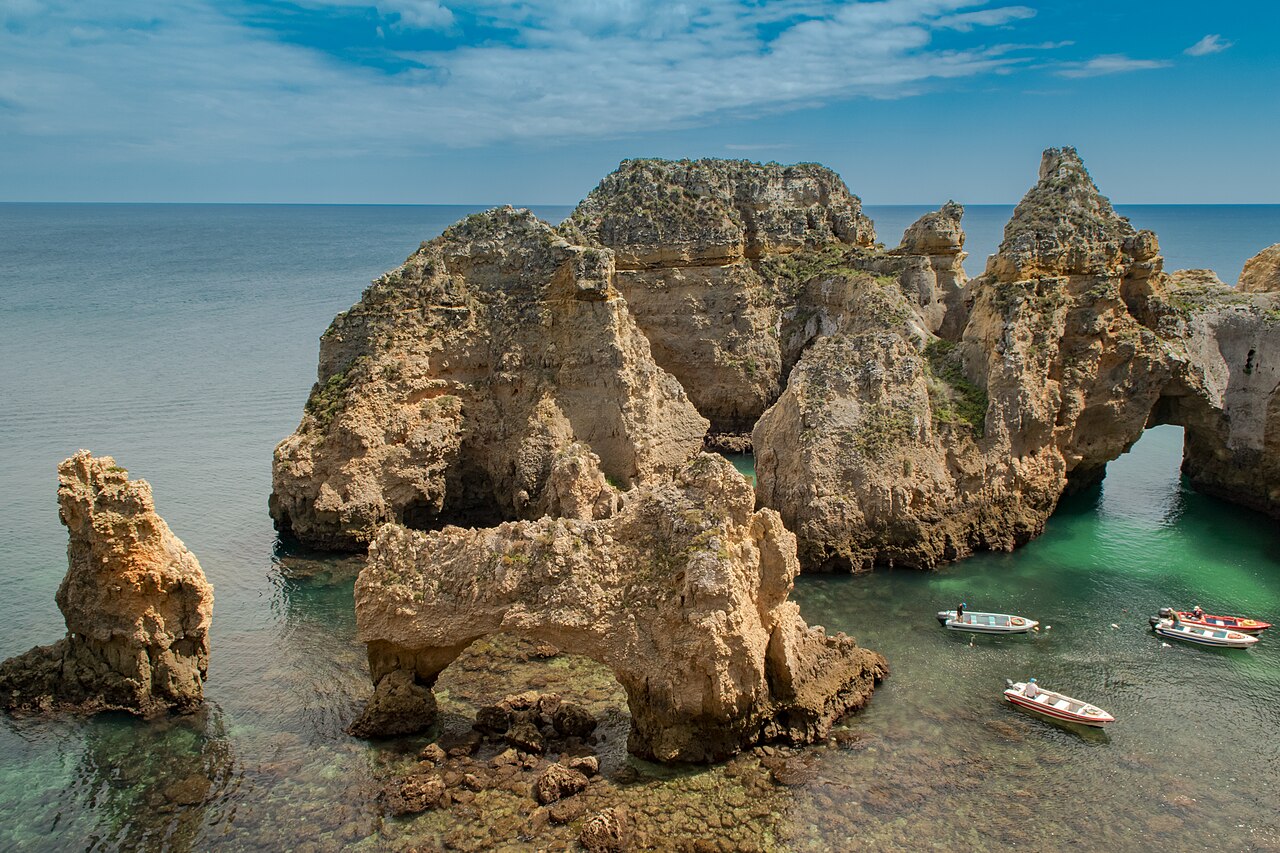
Lagos, Algarve, Portugal
Photo: Dronepicr, Wikimedia Commons (CC BY 3.0)
← All destinations

Lagos, Algarve, Portugal

Golden cliffs sculpted by the ocean, coves reached by wooden staircases and a town that was once the capital of the Discoveries. Lagos is the Algarve with a soul: as beautiful as Instagram promises, as real as Instagram never tells.

✓ Sources verified by hand on 7 July 202613 sources cited

What to see

Old town and walls

Inside the 16th-century walls: cobbled lanes, small squares with jacarandas, the statue of Henry the Navigator and the 17th-century Ponta da Bandeira fort guarding the river mouth. Compact, alive year-round and still inhabited by locals.

✦ Hidden gems — off the standard guides

Praia do Porto de Mós and the clifftop path to Luz

A long, quieter beach west of the famous coves; from its far end the clifftop trail climbs to the obelisk above Praia da Luz, with huge Atlantic views. Sunset from up here is Lagos's best-kept secret.

Igreja de Santo António

Behind a sober façade, one of Portugal's most surprising Baroque churches: an interior entirely clad in talha dourada (gilded woodwork) and azulejos, a survivor of the 1755 earthquake. Visited together with the adjacent municipal museum.

Mercado de Escravos

In the small building under the arcades of Praça Infante D. Henrique, the museum tells the story of Europe's first slave market (1444) and Lagos's role in the Atlantic trade. Small, necessary: it gives historical depth to a town that is much more than its coastline.

Percebes and Alvor oysters

Goose barnacles hand-harvested from the Atlantic rocks (percebes) are western Algarve's iodine-rich delicacy, together with oysters from the Alvor lagoon farms. Seasonal and not cheap: if you see them chalked on the board, trust them.

Almond and fig sweets + medronho

Dom Rodrigo and almond morgado tell of the Algarve's Arab heritage; medronho is the strawberry-tree brandy distilled in the Monchique hills — ask for 'caseiro' in village bars. Finish with a bica and a pastel de nata, which rarely disappoints here.

Sample itineraries

Three routes for different travel styles, built only from this dossier's verified places. Realistic pace: 2-3 stops a day.

First time

2 days

The landmark sights, at the right pace.

Day 1

  • Old town and walls

    Inside the 16th-century walls: cobbled lanes, small squares with jacarandas, the statue of Henry the Navigator and the 17th-century Ponta da Bandeira fort guarding the river mouth. Compact, alive year-round and still inhabited by locals.

  • Ponta da Piedade

    The Algarve's masterpiece: sea stacks, arches and caves of golden rock around the lighthouse, 3 km from the centre. Explore it from above on the (free) panoramic boardwalks and the staircase descending among the pinnacles, or from the sea on fishermen's boats and kayaks. Best light early morning or at sunset.

  • Praia Dona Ana

    Lagos's postcard beach, framed by honey-coloured layered cliffs and sea stacks in turquoise water. Enlarged by sand replenishment, it still gets packed in summer: arrive before 10 or after 17.

Day 2

  • Praia do Camilo

    About 200 wooden steps descend to an intimate cove split in two by a tunnel carved through the rock. Small and with minimal services: the jewel for those happy to trade space for beauty.

  • Meia Praia

    The opposite of the coves: 4 km of open sand beyond the marina, with room even in mid-August, surf/kite schools and restaurants on the sand. Ideal for families and endless low-tide walks.

  • Boat trip to the caves

    Traditional small boats leave from the marina and the riverfront to slip between the arches of Ponta da Piedade: 30-90 minutes among caves and stacks. Book at the operators' official kiosks in the marina and compare prices — the 'last minute' touts on the promenade inflate fares.

Off the beaten path

2 days

Hidden gems away from the usual circuits.

Day 1

  • Praia do Porto de Mós and the clifftop path to Luzhidden gem

    A long, quieter beach west of the famous coves; from its far end the clifftop trail climbs to the obelisk above Praia da Luz, with huge Atlantic views. Sunset from up here is Lagos's best-kept secret.

  • Igreja de Santo Antóniohidden gem

    Behind a sober façade, one of Portugal's most surprising Baroque churches: an interior entirely clad in talha dourada (gilded woodwork) and azulejos, a survivor of the 1755 earthquake. Visited together with the adjacent municipal museum.

  • Mercado de Escravoshidden gem

    In the small building under the arcades of Praça Infante D. Henrique, the museum tells the story of Europe's first slave market (1444) and Lagos's role in the Atlantic trade. Small, necessary: it gives historical depth to a town that is much more than its coastline.

Day 2

  • Percebes and Alvor oystershidden gem

    Goose barnacles hand-harvested from the Atlantic rocks (percebes) are western Algarve's iodine-rich delicacy, together with oysters from the Alvor lagoon farms. Seasonal and not cheap: if you see them chalked on the board, trust them.

  • Almond and fig sweets + medronhohidden gem

    Dom Rodrigo and almond morgado tell of the Algarve's Arab heritage; medronho is the strawberry-tree brandy distilled in the Monchique hills — ask for 'caseiro' in village bars. Finish with a bica and a pastel de nata, which rarely disappoints here.

Food & markets

1 days

Eat and drink where locals actually go.

Day 1

  • Cataplana de marisco and grilled fish

    The clam-shaped copper pot is the Algarve's flagship dish: shellfish, fish and coriander steamed in their own juices. Seek it out in the tascas off the main drags or at Meia Praia; the grilled catch of the day with 'salada montanheira' is the fail-safe alternative.

  • Percebes and Alvor oystershidden gem

    Goose barnacles hand-harvested from the Atlantic rocks (percebes) are western Algarve's iodine-rich delicacy, together with oysters from the Alvor lagoon farms. Seasonal and not cheap: if you see them chalked on the board, trust them.

  • Almond and fig sweets + medronhohidden gem

    Dom Rodrigo and almond morgado tell of the Algarve's Arab heritage; medronho is the strawberry-tree brandy distilled in the Monchique hills — ask for 'caseiro' in village bars. Finish with a bica and a pastel de nata, which rarely disappoints here.

🧭

Build your itinerary

Tell us how many days you're staying and in which month: we'll compose an itinerary from this dossier's verified places, with notes about the period.

Your itinerary

1

Day 1

  • Old town and walls

    Inside the 16th-century walls: cobbled lanes, small squares with jacarandas, the statue of Henry the Navigator and the 17th-century Ponta da Bandeira fort guarding the river mouth. Compact, alive year-round and still inhabited by locals.

  • Boat trip to the caves

    Traditional small boats leave from the marina and the riverfront to slip between the arches of Ponta da Piedade: 30-90 minutes among caves and stacks. Book at the operators' official kiosks in the marina and compare prices — the 'last minute' touts on the promenade inflate fares.

  • Cataplana de marisco and grilled fish

    The clam-shaped copper pot is the Algarve's flagship dish: shellfish, fish and coriander steamed in their own juices. Seek it out in the tascas off the main drags or at Meia Praia; the grilled catch of the day with 'salada montanheira' is the fail-safe alternative.

2

Day 2

  • Ponta da Piedade

    The Algarve's masterpiece: sea stacks, arches and caves of golden rock around the lighthouse, 3 km from the centre. Explore it from above on the (free) panoramic boardwalks and the staircase descending among the pinnacles, or from the sea on fishermen's boats and kayaks. Best light early morning or at sunset.

  • Kayak or SUP under the cliffs

    The best way to experience the Lagos coast: guided kayak tours from Praia do Camilo or the marina right into the caves, with stops in coves reachable only from the sea. The sea is almost always calm in the morning: book the first departure.

  • Percebes and Alvor oystershidden gem

    Goose barnacles hand-harvested from the Atlantic rocks (percebes) are western Algarve's iodine-rich delicacy, together with oysters from the Alvor lagoon farms. Seasonal and not cheap: if you see them chalked on the board, trust them.

3

Day 3

  • Sagres and Cabo de São Vicente (day trip)

    30-40 minutes away: the Sagres fortress linked to Henry the Navigator and the lighthouse on Europe's south-westernmost cape, where the Romans placed the end of the world. Vertical cliffs, real wind and definitive sunsets. Off season it's pure Atlantic poetry.

  • Benagil and the Seven Hanging Valleys trail (day trip)

    Half an hour away, on the Lagoa coast: the famous cave with the oculus can now only be visited on licensed tours (swimming inside is banned, fines up to €2,500; kayaks only guided, with time limits). Better still: walk the Percurso dos Sete Vales Suspensos, 5.7 km of clifftop from Praia da Marinha, among Europe's finest coastal trails.

  • Almond and fig sweets + medronhohidden gem

    Dom Rodrigo and almond morgado tell of the Algarve's Arab heritage; medronho is the strawberry-tree brandy distilled in the Monchique hills — ask for 'caseiro' in village bars. Finish with a bica and a pastel de nata, which rarely disappoints here.

Want an itinerary tailored to your dates in Lagos?

Travel dates, where you stay and the kind of trip — we tailor this same verified dossier to your exact needs.

Coming soon
Praia Dona Ana between its honey-coloured cliffs: Lagos's postcard beach, best enjoyed early in the morning in summer.
Praia Dona Ana between its honey-coloured cliffs: Lagos's postcard beach, best enjoyed early in the morning in summer.Photo: Vitor Oliveira from Torres Vedras, PORTUGAL, Wikimedia Commons (CC BY-SA 2.0)

Before you go

Recurring scams and local rules worth knowing before you arrive.

⚠ Scams to know

Boat tours marked up by promenade touts

medium confidence

In high season, sellers with tablets push 'last places' for the caves at inflated prices, or generic tours passed off as exclusive; complaints about Lagos boat-tour overcharges are recurrent.

How to avoid it: Buy at the operators' official kiosks in the marina, compare several posted price lists and check duration, route and weather refund policy before paying.

Source

Holiday rental scams (non-existent homes)

verified

The Algarve is fertile ground for ghost listings: prices well below market, deposit requests by bank transfer off-platform, and on arrival the house doesn't exist or isn't the advertiser's.

How to avoid it: Distrust prices that are too low, always stay within the platform's payment channels, check the AL registration number and cross-check address and photos on street view.

Source

Unrequested couvert and starters at restaurants

verified

Bread, olives, cheeses and pâtés arrive at the table unasked: they're legal but charged (€2-3 and up per item) if you touch them, and in tourist places they become a systematic extra.

How to avoid it: Send back immediately what you don't want with a 'não, obrigado', check the bill and verify couvert prices on the menu.

Source

Street dealers selling fake substances

verified

In the nightlife streets they whisper 'hashish, coke': they almost always sell fakes (bay leaves, baking soda) counting on tourists not reporting it; buying is illegal in any case.

How to avoid it: Ignore and keep walking: don't stop to argue and don't show your wallet in the street at night.

Source

Dynamic currency conversion (DCC) on card machines and ATMs

verified

Paying with a foreign card, the terminal offers to charge in your home currency at a poor exchange rate: a hidden 3-8% fee.

How to avoid it: ALWAYS choose to be charged in euros, both on restaurant card machines and at ATMs (avoid the Euronet ones in tourist streets).

Source

Theft from cars at beach car parks

verified

The most frequent crime against tourists in the Algarve: smashed windows and vanished bags in the unpaved car parks of the coves and coastal trails.

How to avoid it: Leave nothing visible (not even worthless items), empty the car before parking and prefer the supervised car parks near the marina.

Source

⚖ Laws & penalties

Strict rules at Benagil cave

medium riskverified

Since 2024 it is forbidden to swim to the cave or enter with independent kayaks/SUPs: access only with licensed operators, capped time limits (2 minutes for motor boats, 8 for guided kayaks), and landing on the inner beach is banned. Fines up to €2,500, actively enforced by the maritime police.

Source

Swimwear on the beach only

medium riskverified

In several Algarve resorts, walking around in swimwear or shirtless away from the beach and seafront is fined: in Albufeira (40 min from Lagos) the code of conduct sets fines from €300 to €1,500 for partial nudity in the street, drunken disorder and noise. Lagos has no equivalent code, but common sense applies everywhere.

Source

No drinking alcohol in the street

medium riskmedium confidence

As in most Portuguese municipalities, drinking alcohol in the street outside licensed terraces is prohibited and fineable, with zero tolerance in the nightlife zones in high season.

Source

Keep away from cliff edges and bases

high riskverified

The Algarve's cliffs are unstable and rockfalls are not rare: the maritime authority flags off-limits zones every year and beach signs indicate safe distances from the cliff base. Ignoring them is dangerous and fineable.

Source

Bathing flags and lifeguards

medium riskverified

On supervised beaches the flag system applies: red means no entering the water (fineable), yellow means no swimming out of your depth. The chequered flag means the beach is temporarily unsupervised.

Source

No tourist tax in Lagos (but mind the neighbouring municipalities)

low riskverified

In 2026 Lagos charges no tourist tax; 7 of the Algarve's 16 municipalities do (Albufeira, Faro, Lagoa, Loulé, Olhão, Portimão, Vila Real de Santo António), typically €2/night in high season and €1 in low season.

Source

Holiday rentals: Alojamento Local registration

low riskmedium confidence

Legal tourist accommodation displays the AL/RNAL number in the listing: check it before paying. For non-compliant owners, 2026 fines reach €40,000.

Source
The wooden staircase down to Praia do Camilo: about 200 steps to one of the Algarve's most beautiful coves.
The wooden staircase down to Praia do Camilo: about 200 steps to one of the Algarve's most beautiful coves.Photo: dronepicr, Wikimedia Commons (CC BY 2.0)

Recurring events

Hover over a month on the timeline for details.

Budget & timing

Average daily cost

Season low (November-March)45-70€
Season mid (April-June, September-October)70-110€
Season high (July-August)110-170€

Rough estimate (lodging + meals + local transport), not a precise verified source.

Best time by type of trip

Sea and beaches June, September

The water at its seasonal warmest and guaranteed sun without the crush and prices of July-August, when the coves run out of space by mid-morning.

Coastal trails and kayaking April-June, September-October

Perfect temperatures for walking the cliffs and a sea that's often calm in the morning for kayaking; spectacular wildflowers in spring.

Surf and the winter Atlantic October-March

Winter swells light up the Vicentine coast half an hour from Lagos; the town stays alive year-round, unlike the central Algarve resorts.

Budget November-March

Accommodation prices halved, 300 days of sun a year and no tourist tax: the Algarve winter is the northern European snowbirds' secret.

Did you know... The Mercado de Escravos in Lagos (1444) is considered Europe's first slave market: today it is a museum confronting this dark chapter of the Discoveries.

Getting around

Car recommended: Yes — The centre and main beaches are walkable (Dona Ana and Camilo are 25-30 minutes from the centre, Ponta da Piedade 45), but for Sagres, the Vicentine coast, Benagil and the inland villages a car is the right choice. In peak August though, parking at the coves is a lottery: better to walk, cycle or take the local bus and keep the car for day trips.

From Lisbon: train in ~4h10 with a change at Tunes (from ~€24, Intercidades €22.65) or direct buses in 3h40-4h (€12-20, book online). The railway station is beyond the marina, a 15-minute walk from the centre. In town, the local ONDA network covers beaches and neighbourhoods: €1.20-1.60 cash on board, €0.80 per ride with the prepaid card; useful lines to Meia Praia, Porto de Mós and Luz. Taxis and Uber/Bolt work well and cost little over short distances.

  • Book trains and buses to/from Lisbon in advance in summer: seats genuinely sell out, especially at weekends.
  • For Dona Ana and Camilo in August forget the car: walk along the clifftop (a beautiful stroll) or take the ONDA.
  • The Ponta da Piedade boardwalks are free and panoramic: many pay for a tour without knowing you can see (almost) everything from above.
  • Buy boat-tour tickets at the official kiosks in the marina: compare 2-3 operators, prices vary a lot for the same route.
  • The Atlantic wind often picks up in the afternoon: book kayaks and boats for the morning, when the sea is calmer.
  • For Benagil you don't need (and it often doesn't pay) to sail from Lagos: licensed tours also leave from Benagil/Carvoeiro with far less sailing time.
Safety

  • Portugal is rated Level 1 ('exercise normal precautions') by the US State Department; the Algarve is among Europe's safest regions.
  • Respect the cliff-distance warnings on the signs: rockfalls on Algarve beaches have caused fatalities in the past.
  • The Atlantic is colder than it looks (18-22°C even in summer) and rip currents are serious on the open beaches: swim in supervised zones.
  • On the coastal trails (Seven Hanging Valleys, Porto de Mós clifftop) carry water and mind the edge: there are almost no railings anywhere.
  • At night in the bar streets keep an eye on your glass and phone: opportunistic thefts concentrate there.
  • Single emergency number: 112. Tap water is drinkable everywhere.

Did you know... The caves and arches of Ponta da Piedade are the symbol of the Algarve: golden limestone shaped by millions of years of Atlantic.

Did you know... There is no tourist tax in Lagos (2026): it is one of the Algarve municipalities that never adopted it, unlike Albufeira, Faro or Portimão.

Sources

Every source below was opened and checked by hand — not just cited. Entries that didn't hold up were downgraded to "low confidence" or dropped, not presented as certain.